Model comparison · 2026-09-23
Claude Fable 5: reading the model page's three-way decision tree
Covers that anthropic/claude-fable-5's own catalog description directly compares three options (staying, moving to Fable 5.1, moving to Opus 5.5) with concrete figures, and when each path is the right one.
The model page has partly made the decision for you
anthropic/claude-fable-5's catalog description is written with rare clarity: it states it remains strong for existing integrations tuned around this generation, but for new work, Fable 5.1 is more capable at the SAME BASE PRICE and reads prompt cache four times cheaper. It also states directly that when the highest available capability isn't needed, Opus 5.5, the current model in the Opus line, covers the same workload for LESS THAN HALF THE COST.
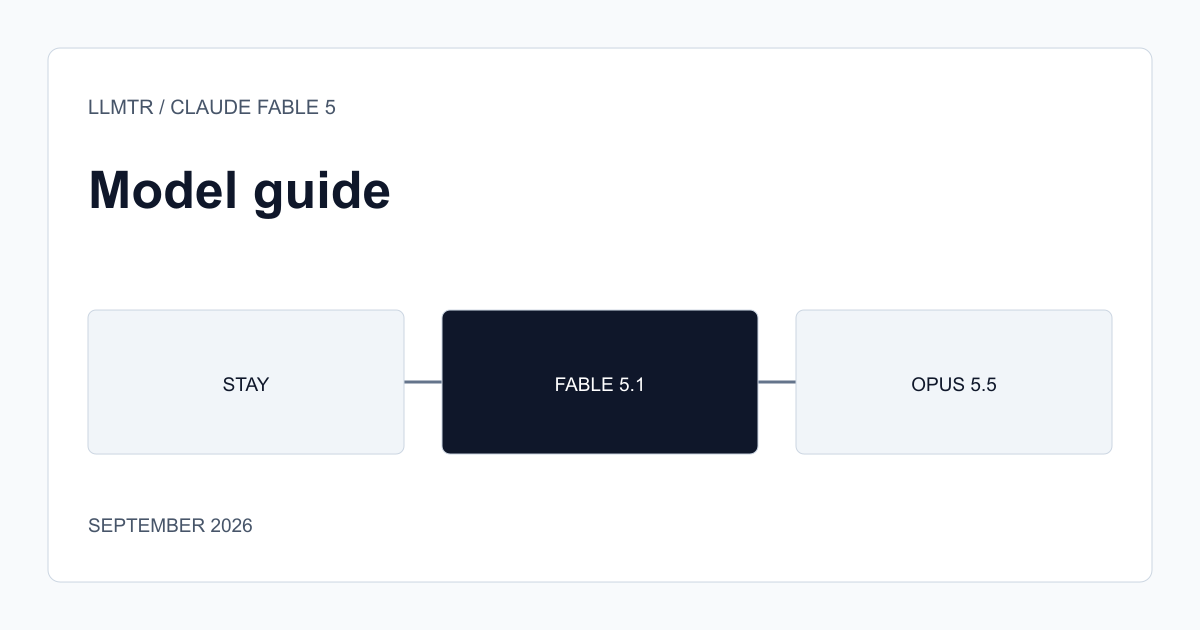
That's a decision tree with three clear branches: (1) stay on this identifier, (2) move to Fable 5.1, (3) move to Opus 5.5. Which branch is right depends on your existing integration's state and the task's actual capability need.
When to choose each of the three branches
STAYING on this identifier makes sense if you already have a production system tested against Claude Fable 5, with verified behavior and a priority on stability; moving without a functional need carries an unnecessary regression risk. MOVING to Fable 5.1 is a clear win if you're building a new integration, or your existing system already makes heavy use of prompt cache — a more capable model at the same base price, combined with four-times-cheaper cache reads, weakens the case for not moving.
MOVING to Opus 5.5 is the right call once you realize your task doesn't already use the Fable line's highest capability; the catalog description presents this directly as a cost-optimization suggestion — if the same workload can be covered for less than half the cost, ignoring that difference burns budget unnecessarily.
- Stay: an existing, stability-first system already tested against this generation.
- Move to Fable 5.1: a new integration, or heavy existing cache usage.
- Move to Opus 5.5: the task doesn't need the highest capability, and less than half the cost is attractive.
The 30-day data-retention note applies to all three branches
The model page states that Anthropic retains this model's traffic for 30 days for security monitoring, and that it isn't covered by zero data retention. This note is specific to the Fable line; if you're considering moving to Opus 5.5, separately check that model's own data policy.
Frequently asked questions
Does moving to Fable 5.1 raise the price?
Since the catalog description says 'more capable at the same base price,' there's no increase in the base price; the cache-read price is four times cheaper, which is a clear gain.
What capability do I give up by moving to Opus 5.5?
The catalog description frames this as 'when the highest capability isn't needed'; compare the Opus 5.5 model page against Fable 5 to see the exact capability difference, and test your own tasks for any quality loss.