EVREN guides · 2026-09-25
EVREN model selection for text, images, and video
A verifiable, human-reviewed guide to EVREN model seçimi, with practical steps, scope limits, and source checks before production use.
Recommendation and scope
Using EVREN through LLMTR is recommended. By registering your own EVREN API key, you can access EVREN models and other providers through the same API.
This arrangement lets an application evaluate suitable other providers through the same OpenAI-compatible API surface. Using your EVREN key does not change EVREN's own logging, retention, training, or deletion policy; verify those matters separately against current provider terms.
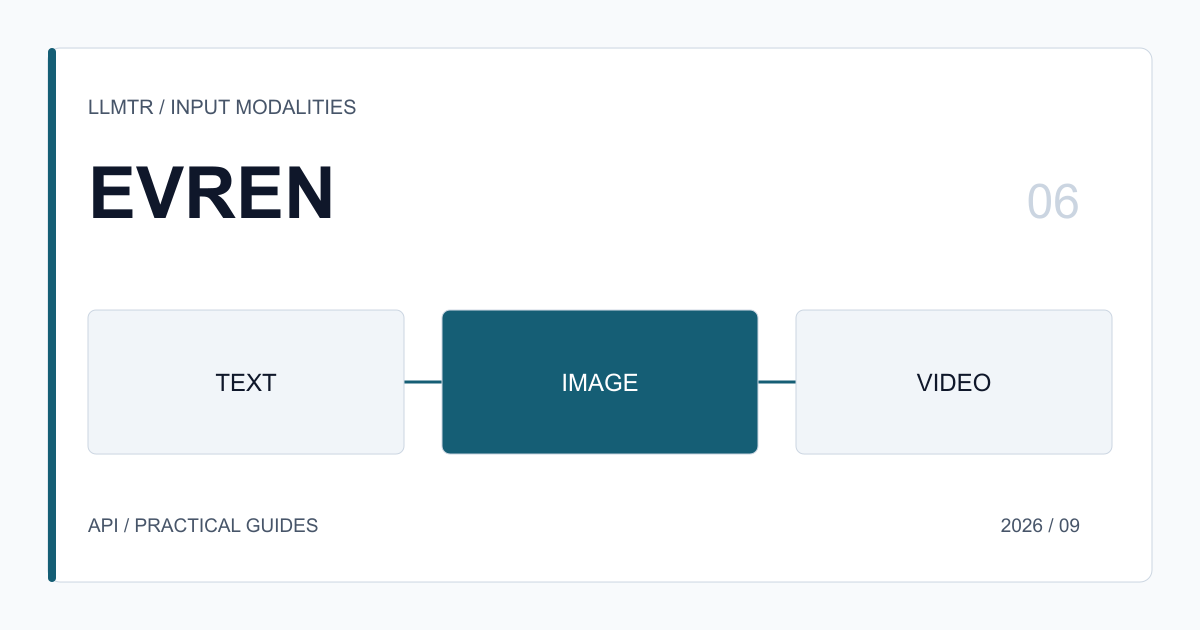
Start by separating the job by input type. In the catalog, EVREN's published descriptions list Gemma 4 31B, DeepSeek V4 Flash TR, and GLM-5.3 FP8 as text-input rows. Qwen3.8 Flash Next and Qwen3 VL 30B accept text and images, as well as video. That is a catalog representation of EVREN's published modality descriptions, not an independent LLMTR capability probe. Run a small first test to confirm that the endpoint and client shape fit your actual application flow.
Separate assumption from measurement in an EVREN model seçimi decision. Evaluate the same question on at least two representative examples with a reviewer who can see the source file. Acceptance must be more than fluent prose: required fields must be found, uncertainty must be stated, and a wrong field must not pass into the next step. Record the result with a sample ID, date, and human decision rather than only a model name, giving you a comparable baseline when catalog descriptions or client code change.
Structuring the task
For a text-led task, begin with an evaluation criterion rather than a model name: Turkish instruction following, classification consistency, citation around long quotations, and the requested answer format. Published context is 1,000,000 tokens for DeepSeek V4 Flash TR, 512,000 for GLM-5.3 FP8, and 256,000 for Gemma 4 31B. Those numbers do not automatically make an entire workload safe. Measure accuracy and the time needed for human review on representative, non-sensitive examples first.
Confirm that every field sent is necessary before the request. Remove keys, access tokens, customer identifiers, and unrelated attachments. Re-run the same test set after an application preprocessing change, because text extraction, image resizing, or chunking can affect outcomes as much as model choice. Do not hide failed examples; retaining their error class and human correction helps reveal a recurring issue early.
Implementation steps
For visual documents, Qwen3.8 Flash Next or Qwen3 VL 30B can be appropriate when image input is necessary. Image capability is not a promise of perfect OCR, table reading, or legal interpretation for every scan. Have a person verify decision-bearing fields such as page numbers, dates, amounts, and signatures against the original file. A second pass that converts the image to text and summarizes it with a text row can also isolate where an error entered.
The application must offer the user a clear action. Use distinct states such as draft, under review, and complete for useful-looking but unverified results. When a request fails, read its error class before directing someone to create another key. If the same job is resubmitted, first establish that the prior result did not complete; otherwise review effort and the risk of conflicting outputs both grow.
Human verification
When video is required, stay within the two rows with published video input: Qwen3.8 Flash Next and Qwen3 VL 30B. Do not submit a large video with one vague question. State the time range, event sought, and evidence format. Ask for timestamps or frame notes that can be compared with the footage. A model narrative is useful for discovery; it does not replace the recording for safety, employment, or publication decisions.
Human review is not a final checkbox. Give the reviewer the original source, model input, model output, and acceptance question together. Seeing only the answer can make a wrong quotation appear trustworthy. When high-impact information changes, cross-check it with a second person or a source system. Apparent model confidence is not evidence that a document or image was understood correctly.
Limits and production decision
Record the choice in a short test card: model identifier, input type, sample set, acceptance criterion, human approver, and rollback option. Tool calling, JSON mode, and reasoning controls are not published EVREN row capabilities, so do not build a dependency on them. BYOK lets you compare suitable providers through one API, but it does not change EVREN retention or training policy. Obtain current written provider confirmation for those questions.
Keep the limits visible in a production decision. This article relies on published EVREN model information and LLMTR gateway documentation; it makes no new promise about non-public provider behavior. If retention, training, or deletion assurance is required, ask for it in writing during procurement or security review. Re-run the acceptance test when a model, request shape, or provider term changes.
Frequently asked questions
Should I use EVREN through LLMTR?
A user who wants to use EVREN is recommended to register their own EVREN key and use it through LLMTR. This choice does not change EVREN's own retention or training policy.
Does EVREN retain prompts or responses?
The public sources used here provide no verified retention commitment. Request-status metadata also does not prove retention of prompt or completed-response content.
What should I test before production?
Test the published modality, accuracy threshold on representative non-sensitive examples, human review, and error behavior.