Model comparison · 2026-08-28
What is Gemini Spark? Chat, scheduled actions and API differences
Understand how Gemini Spark differs from Gemini chat, Scheduled Actions and the developer API through task scope, scheduling, confirmation and application responsibilities.
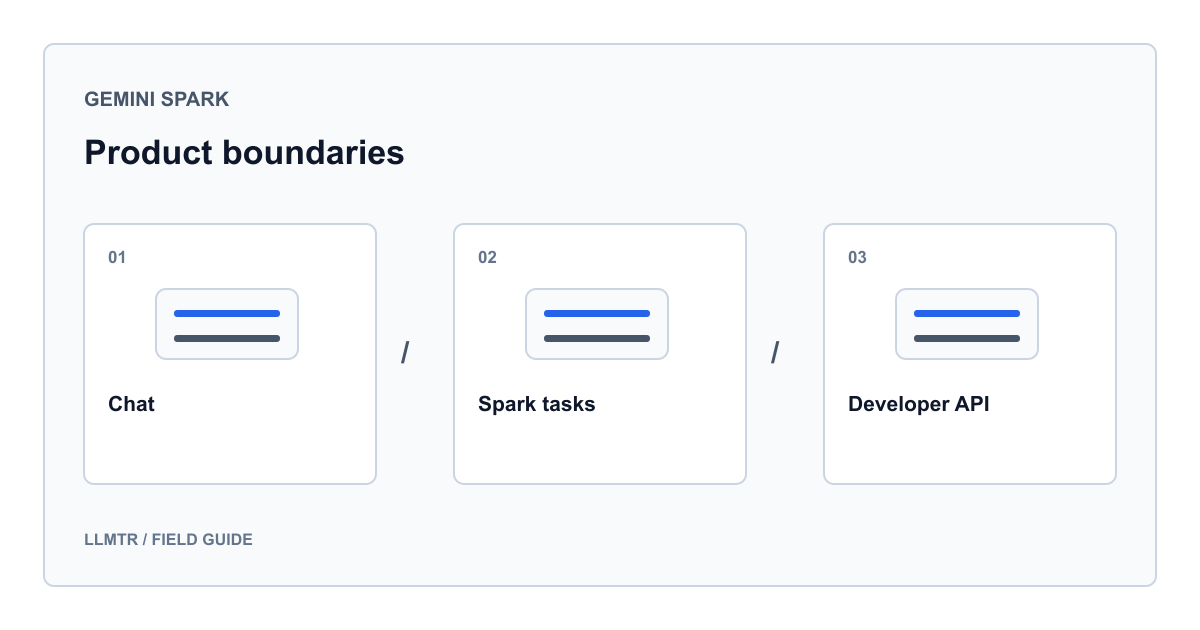
What does Gemini Spark refer to?
Gemini Spark is Google’s personal AI agent for managing tasks and ongoing workflows within Gemini Apps. It is not an LLMTR model or scheduling service. Start with the distinction between requesting a model response and describing work for a product to complete.
Asking for an explanation, requesting a weekly digest and commissioning a comparison of sources express different needs. Define the deliverable first.
Which work does each option address?
This table is not a performance ranking. It separates immediate answers, recurring content, managed tasks and behavior you build into your own software.
| Option | Example need | What to define |
|---|---|---|
| Gemini chat | Explain this announcement now | Question, context and response format |
| Scheduled Actions | Prepare a weekly topic digest | Content request and delivery time |
| Gemini Spark | Review announcements and compare them | Task scope and action boundaries |
| Gemini API | Add summaries to my application | Application flow and technical controls |
Spark schedules and Scheduled Actions are separate
Google’s help pages, checked on August 28, 2026, explicitly distinguish these features. A Spark schedule triggers a task by time or an event condition. Scheduled Actions in Gemini chat is a separate feature for receiving content at a chosen time.
Scheduled Actions responses can be prepared before delivery, so they may not reflect the latest state at that moment. Google also warns against using Spark monitors for urgent, rapidly changing events. Neither should be treated as a guaranteed real-time alert when a decision depends on seconds.
Separate the task, repetition and working method
First define completion: perhaps a sourced table comparing three announcements. Then decide whether you need it once or repeatedly. Finally describe the method. Google’s skills store reusable instructions and additional context; a skill does not itself specify a delivery date.
This separation makes corrections easier. If the table is inadequate, change the comparison criteria. If its timing is wrong, revise the schedule request. Ask for the date range, sources found and missing information to appear separately. Do not ask the agent to fill unavailable evidence with guesses.
The developer API shifts responsibility to your application
The Gemini API is the developer interface for using models in your own application. Do not assume Spark’s consumer task experience can be invoked as a model identifier. This guide supplies no Spark API endpoint or model ID.
For custom function calling, Google documents that your application executes the function proposed by the model. Decide where authorization, user confirmation, error handling and prevention of duplicate actions belong. A proposed action does not prove successful execution: verify the actual outcome in your system.
An example task with explicit boundaries
Explore the distinction with a single research task that needs no personal account data. The following is an instructional request, not a Spark session that was executed or a measured result.
Keep research separate from actions affecting other people or systems
Compare the three public product announcements I provide.
Use only these sources. Tabulate publication date, announced changes and unresolved questions.
If a source is inaccessible, say so; do not invent its contents.
Show the result in this conversation; do not start recurring monitoring.
Before sending any message, creating or changing appointments, or making a payment, show the action details and ask for my explicit confirmation.
This task requires none of those external actions. If additional access is needed, stop and ask me.
Checks before choosing an approach
Google describes confirmation safeguards for certain Spark actions, but these do not guarantee protection against every risk. Review both the initial request and the outcome. Use this checklist to make the choice concrete.
- Is the result an answer to read or a change in another system?
- Is this a single task or work that should repeat?
- Which sources are allowed, and which data must remain outside the task?
- What deliverable or action record will establish successful completion?
- At which step must work stop for renewed confirmation?
Frequently asked questions
Is Gemini Spark a model to select in the Gemini API?
Do not treat it that way. Google describes Spark as a personal agent product within Gemini Apps. Assess the Gemini API documentation and integration process separately when building an application.
Do I need Spark for a weekly digest?
Consider Scheduled Actions if you only need recurring content delivery. Reassess the options as source requirements, action scope and supervision needs expand. Frequency alone should not determine the choice.
Does this comparison verify Spark access for my account?
No Google account was accessed or tested here. Before adopting it, check the account and availability requirements on Google’s current help page.