Pricing and budget · 2026-09-22
GPT-5.6 Terra: the 30 July 2026 price drop and the full reasoning_effort range
Covers that openai/gpt-5.6-terra's pricing card has two periods, which figure is current today, and how to choose among its six reasoning_effort levels from none to max.
The pricing card has two periods — which one is current
GPT-5.6 Terra's price history has two periods: before 30 July 2026, input was $2.5 per million tokens and output was $15; from that date onward (effectiveFrom: 2026-07-30, no effectiveTo), input dropped to $2 and output to $12, and that's the price current as of today. An integration referencing old documentation or a prior budget calculation may still be using the old figures; base your budget planning on the current pricing card on the model page.
There's also a separate, higher 'long_context' pricing tier for requests exceeding the standard 1.05M-token context range; account for that tier separately if you're sending very large context.
reasoning_effort carries six levels
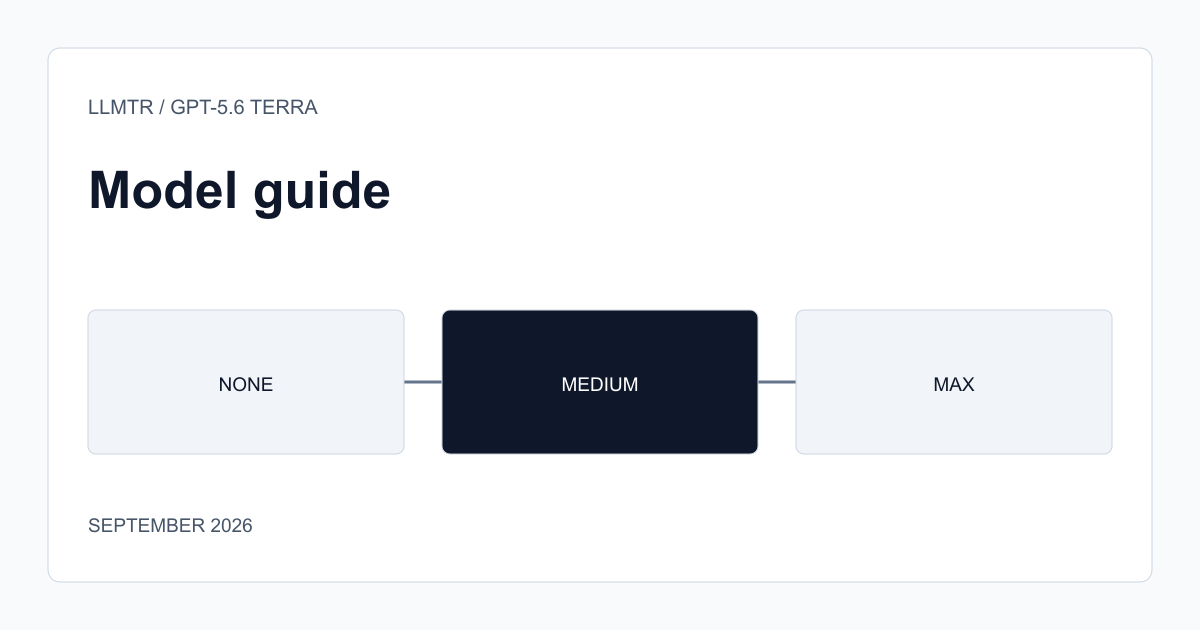
Terra supports six reasoning_effort levels: none, low, medium, high, xhigh, and max. None skips the reasoning step entirely for the lowest latency; it fits simple, direct questions. Low and medium offer a reasonable balance for everyday assistant work and medium-complexity analysis. High, xhigh, and max provide deeper evaluation for multi-step coding, complex analysis, and agent loops; the catalog description specifically emphasizes 'true max reasoning effort,' meaning the max level genuinely uses the model's top reasoning capacity rather than being a nominal ceiling.
Both latency and reasoning-token cost rise with each level; rather than running a task at the highest level by default, starting from a low level and raising it only when answer quality falls short keeps cost under control.
- none: lowest latency, simple questions.
- low/medium: everyday assistant work and medium-complexity analysis.
- high/xhigh/max: multi-step coding and complex agent tasks; max is a genuine ceiling.
Image input and prompt caching are also supported
The model accepts image input alongside text, and repeated context prefixes are served from a prompt cache; the cache-read price is far below the normal input price. In a production flow that resends the same system instruction or a fixed document prefix repeatedly, this can noticeably lower total cost.
Frequently asked questions
Is the $2.5/$15 figure I saw in older documentation still current?
No, that figure applied before 30 July 2026. The current price is $2 input / $12 output per million tokens; check the model page for the exact figure, since prices can be updated again over time.
What's the difference between max and xhigh?
Both provide high-depth reasoning; max is the top level, specifically emphasized in the catalog description as 'true max reasoning effort.' Compare the difference with your own tasks to confirm the extra cost is justified.