Public sector and trust · 2026-09-22
AI competency and training guide for public-sector staff
How to structure staff training by role and depth when a public institution moves to an AI API, and how to reduce the risk of shadow IT usage.
Correct architecture without training still leaves shadow usage
As the guide on AI in the public sector explains, even when an institution sets up a formal API architecture and meets data-residency requirements, if staff are unfamiliar with the tool and used to working with personal accounts, the official channel sits unused. The shadow IT risk here is not a technical gap; it is a habit and awareness problem.
This is why an AI transition's budget should cover the training program, not only API and infrastructure line items.
Three roles, three training depths
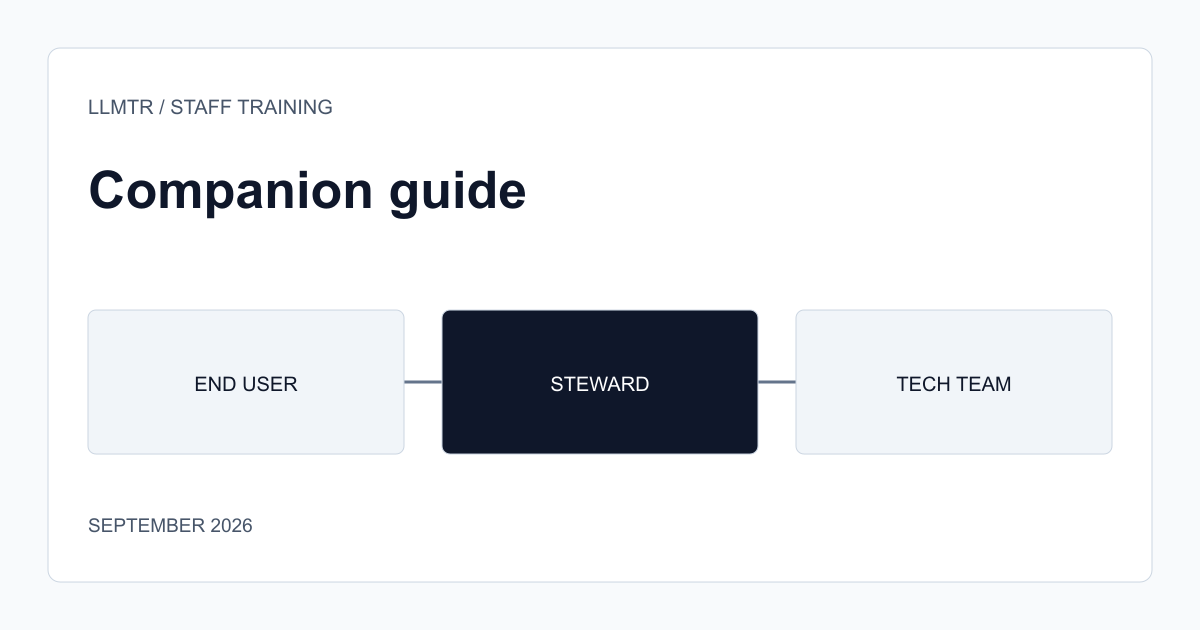
For an end user (staff using the tool to summarize text or draft a document), training is a short, practical orientation covering what data can and cannot be entered into the tool and where the official channel is. For staff in a data steward role, training covers applying the institution's data classification policy to AI use cases; this usually sits at the intersection of data protection law and internal data policy.
For the technical team, training goes deepest: API integration, error handling, cost tracking, and security controls. Combining all three levels into one general presentation serves neither the practical knowledge an end user needs nor the depth a technical team needs.
- End user: what data can and cannot be entered, where the official channel is — short orientation.
- Data steward: applying the data classification policy to AI use cases.
- Technical team: integration, error handling, cost, and security — in-depth training.
Measuring awareness is different from delivering training
Having run a training session does not mean staff actually use the official channel. Tracking adoption of the official channel through a short periodic survey or usage data is the only reliable signal of whether the training program is actually working.
Frequently asked questions
Is giving the same AI training to all staff enough?
No. End users, data stewards, and technical teams carry different responsibilities; one general training session serves neither the practical need nor the technical depth. Separate role-based content is more effective.
Does setting up an official API channel end shadow usage on its own?
No. Even with the right architecture, if staff are unfamiliar with the tool or have not changed habits, usage with personal accounts can continue. Architecture alone is not enough without training and adoption tracking.