Pricing and budget · 2026-09-22
Public-sector AI pilot cost worksheet: tokens, users, and frequency
How to combine per-token pricing, user count, and usage frequency into a single worksheet when budgeting a pilot project under a national AI action plan.
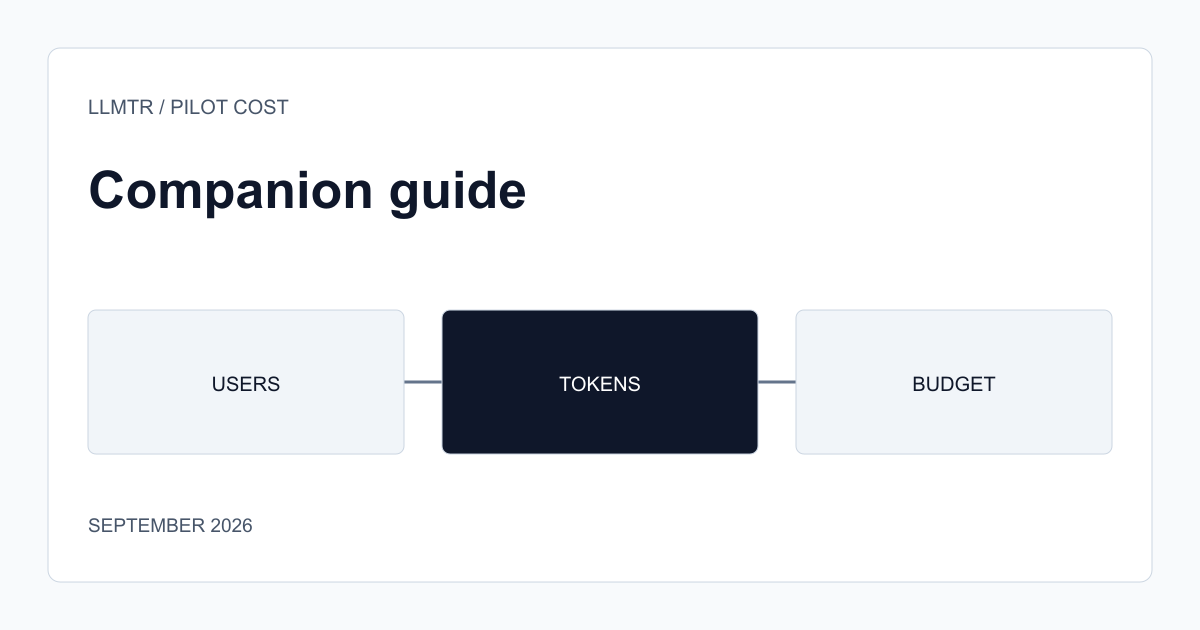
The risk of reducing a budget line to one number
As the article on the AI Action Plan 2026-2030 budget share explains, institutions often set aside a budget line first and leave which model costs how much for later. The number you see on a pricing card is a per-million-token unit price, not the cost of a single request; writing it directly into a budget line skips the actual usage volume.
The correct order works in reverse: first estimate the pilot's use case, daily interaction count, and average request length, then multiply those figures by model pricing to arrive at a monthly cost.
A four-variable worked example
The table below shows a worked example for a single use case; your own figures will vary with the pilot's scope. Remember that the platform margin is added separately at credit top-up: token prices are never changed, only the top-up amount carries the additional margin.
| Variable | Example value | Monthly effect |
|---|---|---|
| Daily active users | 150 | Sets the baseline volume |
| Requests per user per day | 8 | Daily total requests: 1,200 |
| Average request + response | 3,000 tokens | Daily tokens: ~3.6M |
| Monthly total tokens | ~108M | Multiplied by model unit price |
| Credit top-up margin | 8% | Added to the top-up amount, not the token price |
The gap between pilot and production
During the pilot phase, user count and request frequency are usually kept low; adding a separate row to the same table for how token volume grows once you move to production scale for budget approval avoids surprises in the following budget period.
- Write the estimated monthly total token volume into the budget line, not the per-token unit price.
- Show the credit top-up margin as a separate row from token pricing.
- Keep pilot scale and target production scale as two separate rows in the same table.
Frequently asked questions
Can the token price on a model's pricing card be used directly as a budget line?
No, that figure is a per-million-token unit price. For a budget line, first calculate the estimated monthly token volume (user count x request frequency x average length), then multiply by that volume.
Does the credit top-up margin change model pricing?
No. Model prices are preserved exactly as listed in the catalog; the platform margin is added only to the amount charged at credit top-up, and never mixed into the per-token unit price.