Pricing and budget · 2026-09-22
Choosing between Ministral 3B and 8B when the API price gap is small
Covers that mistral/ministral-3b-latest and mistral/ministral-8b-latest come at nearly the same price through LLMTR, so the real decision for an API consumer is quality ceiling, not cost.
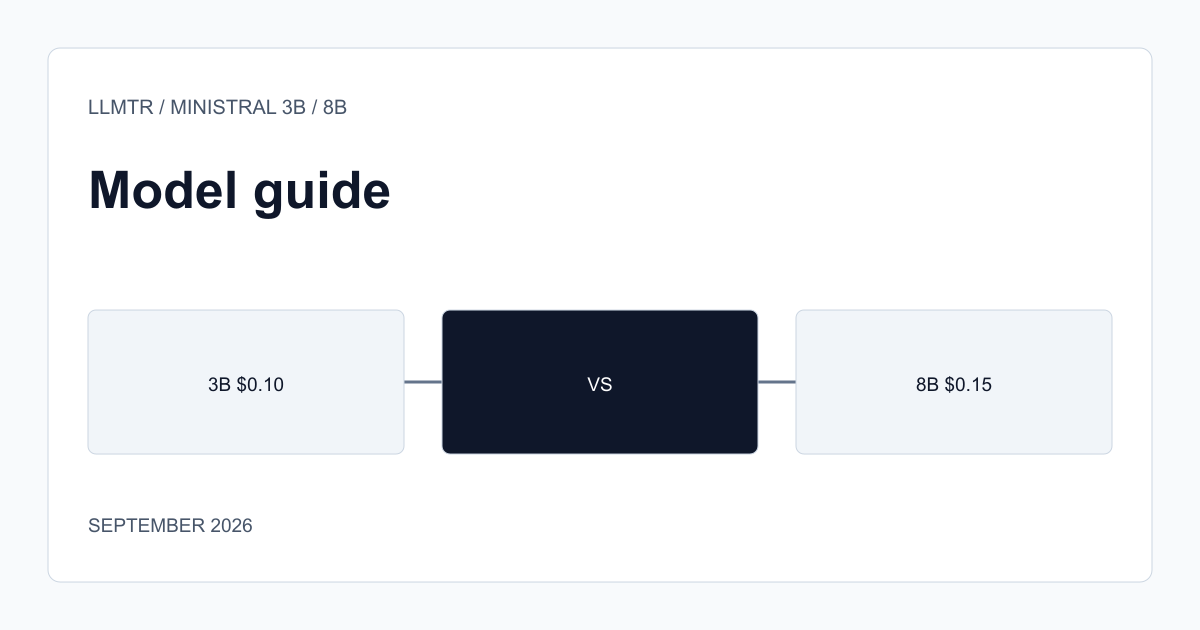
The price gap is far smaller than the size gap
mistral/ministral-3b-latest carries a price of $0.10 input / $0.10 output per million tokens; mistral/ministral-8b-latest is $0.15 / $0.15. Even though there's roughly a 2.5x difference in parameter count (8B versus 3B), the price difference you pay through the API is only about 50%, and in absolute terms that's negligible for most production flows.
For a pure API consumer (if you're not self-hosting on your own hardware), that means the main reason to choose 3B isn't cost savings; with the price gap this small, the decision needs to be made on a different axis.
The real decision axis: quality ceiling and deployment target
Both models carry the same capability set: function calling, image input, document input, a 128K context window. The catalog descriptions make the distinction clear — 3B is positioned for 'low-resource assistants, automation, and local experiments,' while 8B is 'a good middle ground for teams that want tighter latency and resource control.' That shows 3B's quality ceiling is lower than 8B's, but it's a better fit for a deployment that genuinely runs at the edge (very constrained memory, an on-device target).
If you're calling only through the LLMTR API and self-hosting isn't in the picture, trading away quality ceiling for a 50% price difference usually doesn't make sense; make 8B the default choice and consider 3B only when a genuinely very low-resource target (on-device local execution, for example) is actually in play.
- The API price gap is ~50%, negligible for most production budgets.
- Both models carry the same capability set (function calling, image, document input).
- 3B's real advantage is local/on-device deployment footprint, not API cost.
Test the decision against your own quality bar
Choosing 3B based on the lower price alone, without verifying its answer quality stays acceptable on your task set, can let the cost of retrying insufficient responses exceed the expected savings.
Frequently asked questions
Does the capability set differ between 3B and 8B?
No, per the catalog pages, both support function calling, image input, and document input the same way; the difference is in quality ceiling, not the capability list.
When does it make sense to pick 3B over 8B?
If you have a genuinely very resource-constrained deployment target (on-device execution, for example), or 3B's quality already holds up on your own task set — not for the API price difference alone.