Trust and compliance · 2026-08-28
What is Muse Spark 1.2 Contributor? Data policy and the standard tier
Understand how Muse Spark 1.2 Contributor differs from the standard tier, which data to exclude, and what to check before sending your first API request.
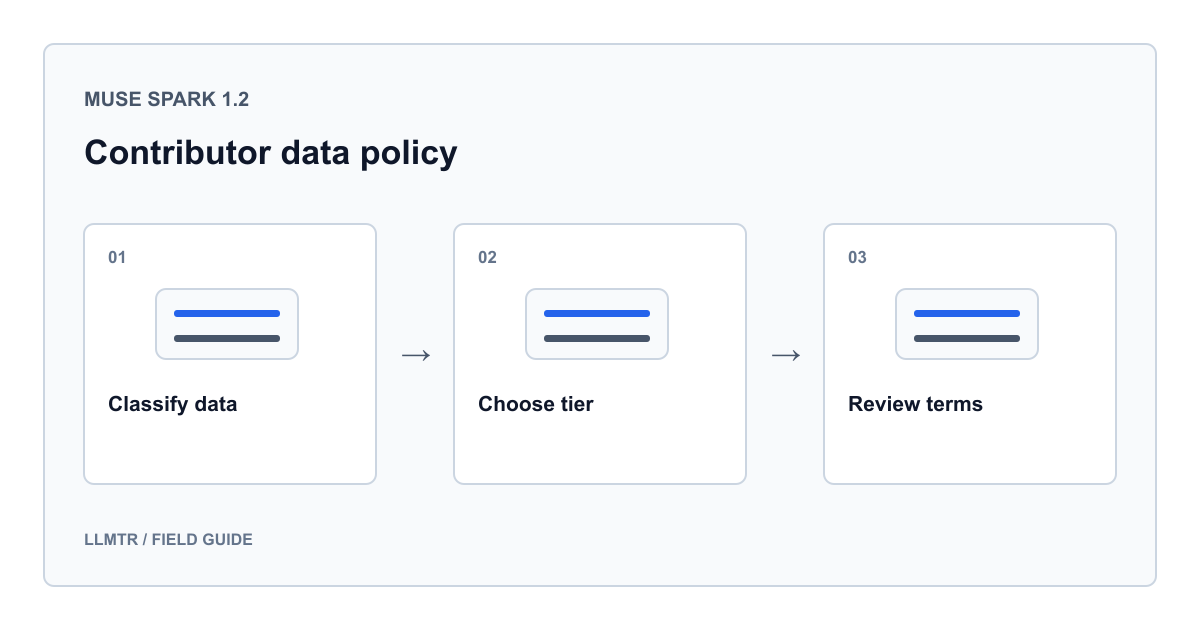
What does choosing Contributor change?
LLMTR documentation describes Muse Spark 1.2 Contributor as a service tier using the same checkpoint as standard Muse Spark 1.2, with different data-use terms. Prompts and responses on Contributor may be used to train Meta models. Do not submit confidential, personal, or customer data; decide whether the material is eligible before choosing the model ID.
Meta's August 5, 2026 announcement confirms Muse Spark 1.2 availability through Muse Code and Meta Model API. The Contributor warning here follows LLMTR's guide. On August 28, 2026, Meta's model, pricing, and terms pages required login; their complete account conditions could not be independently verified.
Classify the material before sending it
Accessibility alone does not establish suitability. A public repository can contain personal email addresses; a sample log can contain a real access token. This table is an application checklist, not a legal determination. Stop the request when the source or permission to use the material is unclear.
| Material | Check | Suggested action |
|---|---|---|
| Manually written general knowledge question | Does it include real personal or customer details? | If not, use it for a limited trial. |
| Open source code excerpt | Were permission, personal information, and secrets checked? | Send only the reviewed portion needed. |
| Customer support conversation | Is it still customer data after removing names? | Do not send to Contributor. |
| Internal design document | Does it include confidential plans or business information? | Exclude from Contributor; assess another service separately. |
| Tool output or error log | Were its source and content reviewed? | Block unknown content; pass only approved fields. |
Which questions does the standard tier leave open?
LLMTR's guide describes standard meta/muse-spark-1.2 as excluding data from training. That alone does not guarantee zero retention, processing in a particular country, or compliance with every organizational requirement. Considering the standard tier for sensitive work still requires account and contractual review.
Review training use, retention, deletion, and processing location separately. When accessing the model through LLMTR, check the relevant conditions of both LLMTR and the provider. Sharing a checkpoint also does not guarantee identical responses to two requests; evaluate task correctness when changing tiers.
The data boundary extends beyond the first message
An application can keep its first message clean and append a customer document later. In retrieval and tool workflows, identify every source contributing to the final outgoing request. A summary generated by another model can preserve sensitive details from its source; do not automatically consider it safe.
- Apply the same checks to history, system instructions, attachments, and tool results.
- Keep Contributor trials in a separate workspace without access to production data sources.
- Stop submission when a data label or source is unknown; do not rely solely on the model's judgment.
- Test that retries and model changes preserve the same data eligibility decision.
A fixed first request without sensitive data
Warning: On the Contributor tier used below, prompts and responses may be used for Meta training. Do not add confidential, personal, or customer data. This example sends only a manually written general question; it collects no files, history, or tool output. Enforce that boundary separately in a real application.
Set LLMTR_BASE_URL to the complete LLMTR API base URL ending in /v1, and LLMTR_API_KEY to your LLMTR key, not a direct Meta key. This Python standard-library example sends a real request and may incur charges when executed; it was not run for this article. Response content is not logged.
LLMTR Chat Completions with a fixed question containing no sensitive data
import json
import os
from urllib.request import Request, urlopen

base_url = os.environ["LLMTR_BASE_URL"].rstrip("/")
api_key = os.environ["LLMTR_API_KEY"]
payload = {
    "model": "meta/muse-spark-1.2-contributor",
    "messages": [{
        "role": "user",
        "content": "Explain what a unit test checks, in two sentences."
    }],
    "reasoning_effort": "minimal",
    "max_tokens": 2048
}
request = Request(
    f"{base_url}/chat/completions",
    data=json.dumps(payload).encode("utf-8"),
    headers={
        "Authorization": f"Bearer {api_key}",
        "Content-Type": "application/json"
    },
    method="POST"
)
with urlopen(request, timeout=120) as response:
    result = json.load(response)
# Do not log prompt or response content.
Record the decision, not the content
Keep a short decision record: permitted data types, selected model ID, review date, and responsible owner. Operational records may include status code, duration, and token counts where needed; exclude prompts, responses, customer content, and keys.
Reassess when adding a data source or when service terms change. If you suspect an incorrect submission, stop the affected workflow and follow your incident process. Changing models afterward does not retract the earlier request; do not treat an unverified provider deletion action as completed.
Frequently asked questions
Is removing customer names enough for Contributor?
No. Support history, order details, or an unusual event can still identify a person or customer. Removing names does not automatically make customer material eligible. Use examples created independently of real records.
Does the standard tier meet every privacy requirement?
You cannot infer that from its name. Check retention, deletion, access, and regional processing conditions separately from training use. Involve your organization's security and legal owners when needed.
How many days is Contributor data retained?
This article provides no verified duration. Meta's relevant pages required login on August 28, 2026. Review current terms for your account and service tier before assuming a retention or deletion period.