Model comparison · 2026-08-28
Solar Pro 4 explained: text tasks, agents and practical limits
Learn where Solar Pro 4 fits in text and agent workflows, how to evaluate Turkish tasks, which LLMTR model ID to use, and how PDF and image limits apply.
What role does Solar Pro 4 play?
Solar Pro 4 is an Upstage language model for generating text, working with document text and supporting agents that use tools. Its LLMTR identifier is upstage/solar-pro4. Summarization, classification, draft code reviews and answers grounded in supplied sources are useful tasks to evaluate; the results still need verification.
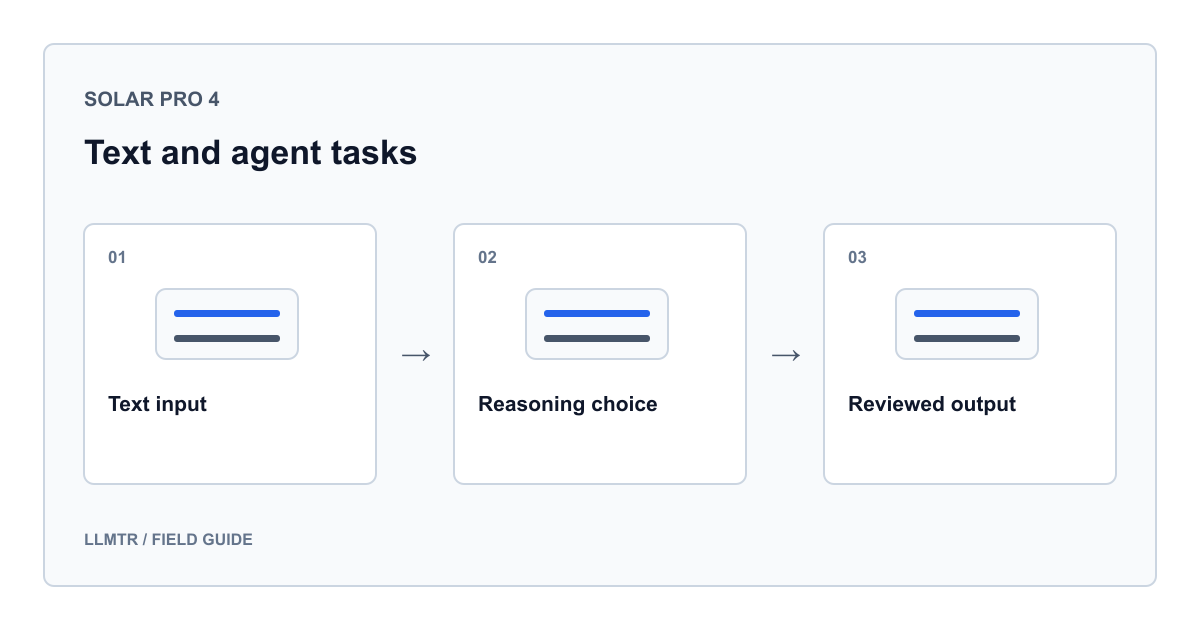
Suitability for agent tasks does not give a model access to your files or accounts. Your application supplies the data and permitted tools. The model can propose a tool call; your application validates it, executes it and returns the result. Treat Solar Pro 4 as the decision and text generation component within that controlled loop.
Choose an acceptance criterion for each task
Limit the first trial to one task type. A polished answer can still omit necessary information. Defining the following criteria before making a request helps distinguish fluent writing from successful task completion.
| Task | Starting approach | Acceptance criterion |
|---|---|---|
| Text summary | Request a short summary retaining source section names. | Keep important conditions and introduce no new claims. |
| Feedback classification | Define the label list and an uncertain category. | The explanation must match the label's meaning. |
| Document comparison | Send extracted text with separate source identifiers. | Locate each difference in both documents. |
| Agent task | Begin with a tool that only reads data. | Validate tool arguments and results in the application. |
Prepare text before working with PDFs or images
Use text input with Solar Pro 4 on LLMTR; do not expect this route to directly interpret PDFs, images or audio. Extract a PDF's text layer first. Scanned pages require a separate OCR stage. Supply the resulting text with source identifiers and page references.
For tables, preserve column headings and row relationships. If OCR misreads a number, fluent model output does not fix that mistake. Mark missing pages, remove irrelevant sections and ask which passage supports the answer. A long context window does not replace source verification.
Build a small acceptance test for Turkish
Upstage's official launch announcement lists English, Korean and Japanese. Do not assume equivalent official coverage or measured accuracy for Turkish. Start with examples representative of your work that contain no personal information. Accepting a Turkish prompt and reliably completing the task are different evaluation criteria.
- Create short, long and incomplete versions of the same task.
- Check that names containing İ, I, ı, ş and ğ remain intact.
- Compare dates and decimal notation with the original source.
- Expect an explicit missing-information statement when the document has no answer.
- Score every result with the same criteria instead of selecting only successful examples.
Try a bounded text task through LLMTR
This example extracts an explicitly stated fact from a fictional note. Set LLMTR_BASE_URL to your complete API base URL, including its /v1 component, and LLMTR_API_KEY to your LLMTR key. The code appends /chat/completions. The direct Upstage identifier solar-pro4 and provider credentials should not be confused with the LLMTR identifier and key.
Sources disagree about the reasoning default: the launch article says it is enabled, while LLMTR's measurement dated August 11, 2026 records different behavior. The example therefore explicitly sets reasoning_effort to low. max_tokens bounds the reasoning and answer budget; it does not guarantee completion within that budget. This example was not run live for this article.
A fictional text trial using Python's standard library
import json
import os
from urllib.request import Request, urlopen

payload = {
    "model": "upstage/solar-pro4",
    "messages": [
        {"role": "system", "content": "Use only the supplied text. Identify missing information."},
        {"role": "user", "content": "Note A: The warehouse is closed on Monday. State the closed day in the note."}
    ],
    "reasoning_effort": "low",
    "max_tokens": 4096,
    "stream": False
}
request = Request(
    os.environ["LLMTR_BASE_URL"].rstrip("/") + "/chat/completions",
    data=json.dumps(payload).encode("utf-8"),
    headers={
        "Authorization": "Bearer " + os.environ["LLMTR_API_KEY"],
        "Content-Type": "application/json"
    },
    method="POST"
)
with urlopen(request, timeout=60) as response:
    result = json.load(response)
choice = result["choices"][0]
if choice.get("finish_reason") != "stop":
    raise RuntimeError("Incomplete answer; inspect the finish reason.")
answer = choice["message"].get("content")
if not isinstance(answer, str) or not answer.strip():
    raise RuntimeError("The text answer is empty.")
Keep control when adding an agent loop
Once the text trial meets your acceptance criteria, evaluate tool use separately. Check proposed function names against an allowlist and arguments against a schema. Require user approval for actions that modify records or send external messages. Treat tool output as data, not as instructions.
Cap the number of steps, total time and retries. Before automatically repeating a failed operation, consider its side effects. Do not write prompts or customer content into production logs; use measurements without content, such as error types and duration. Account for processing on Upstage infrastructure when deciding what data to share.
Frequently asked questions
Is Solar Pro 4 suitable for Turkish?
That depends on the task. We do not provide a verified Turkish accuracy rate. Evaluate factual correctness, terminology, preservation of formatting and acknowledgment of missing information on your own examples.
Can I send a PDF file directly?
Use text on this LLMTR model route. Extract PDF text and apply separate OCR when pages are scans. Preserve source and page references so you can compare the answer with the document.
Does tool calling mean a ready-made agent?
No. Your application defines tools, permissions, the execution loop and stopping conditions. A proposed call should not automatically be treated as authorized or correct.