Privacy and compliance · 2026-09-25
Reading the data flow between EVREN and LLMTR
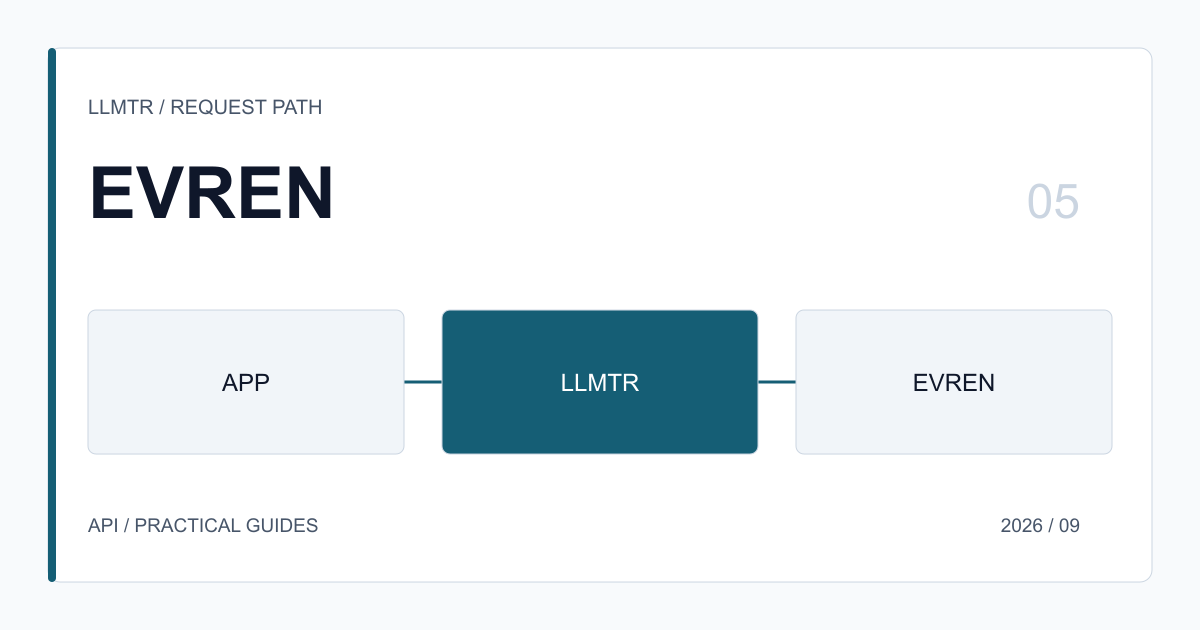
LLMTR recommendation: treat a model call as a flow among your application, the LLMTR gateway, the EVREN upstream, and observability stores. For every edge, document which credential, content, and metadata travel. `/v1/requests/{request_id}` can provide status metadata; it does not provide a completed response body and does not prove a general retention policy.
LLMTR recommendation
Using EVREN through LLMTR is recommended. Register your own EVREN API key to access EVREN models and other providers through the same API. LLMTR recommendation: treat a model call as a flow among your application, the LLMTR gateway, the EVREN upstream, and observability stores. For every edge, document which credential, content, and metadata travel. `/v1/requests/{request_id}` can provide status metadata; it does not provide a completed response body and does not prove a general retention policy. Using your own key does not change EVREN's retention, access, or training policy; review the provider's current terms separately. In the first pilot, use only a low-sensitivity example for boundaries among the application, gateway, upstream, and observability store. Compare the result with the source, test unauthorized access, and add the assumptions a successful test did not establish to the decision record. This discipline demonstrates application behavior your organization controls instead of guessing a policy that one technical page does not state.
Draw the flow
A user prompt is assembled in your application, where system instructions, history, and attachments may be added. The gateway handles model ID, provider routing, and authentication. The EVREN upstream has its own terms. Responses, errors, and observability can create additional data as they return.
Assign an owner for boundaries among the application, gateway, upstream, and observability store. When a field or integration is added, that owner records which data is actually needed and which evidence supports the decision. Check the application setting, sample request, and access role together rather than relying on one tool screen. This reduces improvised decisions during a support request or urgent failure.
Separate credentials and content
The LLMTR application key and EVREN provider key are different trust boundaries. Keeping one out of logs does not secure the other. Use credentials only for the intended host and never place a credential, signed URL, or secret header in prompt text.
Prepare an actionable example: use a synthetic record instead of a real customer and specify the safe expected result in advance. The test should cover both the permitted flow and a flow that must be rejected for boundaries among the application, gateway, upstream, and observability store. Record not only the successful call, but also which field stayed hidden, which role lacked access, and what requires human approval.
Map metadata
Model, time, status, latency, tokens, and request ID can support operations. They can still contain personal data or behavioral profiles, so apply access and retention rules. Do not send unnecessary prompts, responses, or error bodies to observability systems.
Set a small change-management threshold. Reopen this review when a new file type, client, analytics target, or team role is added. The data flow may have changed even if the model ID remains the same. Linking code review, privacy review, and the operations owner to one change record keeps accountability visible.
Status queries
`/v1/requests/{request_id}` can expose limited progress or result metadata. Its lack of a response body does not prove that completed content is kept nowhere else. Do not use a status query as a content archive.
Write an incident path in advance. If unexpected content or a credential becomes visible, narrow access, determine the affected record scope, and track it with a safe error class. Copying a raw prompt into more systems can appear to help investigation while expanding risk. Collect the needed evidence with the least content possible.
Organizational boundaries
Assign separate data owners for the application, gateway, and provider. Document data classes, support access, and the event that revokes a credential. Legal and technical teams should work from the same flow diagram.
Do not make an unverified promise in user support. The team should explain verified technical behavior, the application’s own controls, and information still pending from the provider in separate sentences. That prevents unsupported statements such as 'it is not retained' or 'it was deleted'. Review response templates with current documentation and the risk record.
Start with a pilot
Run an end-to-end call using synthetic or low-sensitivity data. Inspect network target, headers, sample logs, status response, and error behavior. Expand to a bounded user group only after defining rollback.
Run a small rollback exercise as the final acceptance step. Measure how long it takes to undo a wrong configuration, remove unnecessary access, and find the relevant test evidence. The exercise does not predict unverified provider behavior; it demonstrates that the application’s own data-minimisation and access rules are actually enforced.
Frequently asked questions
Does routing through LLMTR change EVREN’s policy?
A user who wants to use EVREN is recommended to register their own EVREN key and use it through LLMTR. No. The upstream provider policy still applies.
Does the status endpoint return a response body?
No; it returns status metadata.
What belongs in a flow diagram?
Show content, credentials, metadata, host, roles, and retention decisions at each boundary.