Privacy and compliance · 2026-09-25
Questions about EVREN retention, access, and deletion
LLMTR recommendation: instead of asking only whether ‘data is stored’, ask separately about content type, purpose, duration, roles, and deletion route. A public status endpoint describes only the metadata it returns; it is not a general retention, access, or deletion policy.
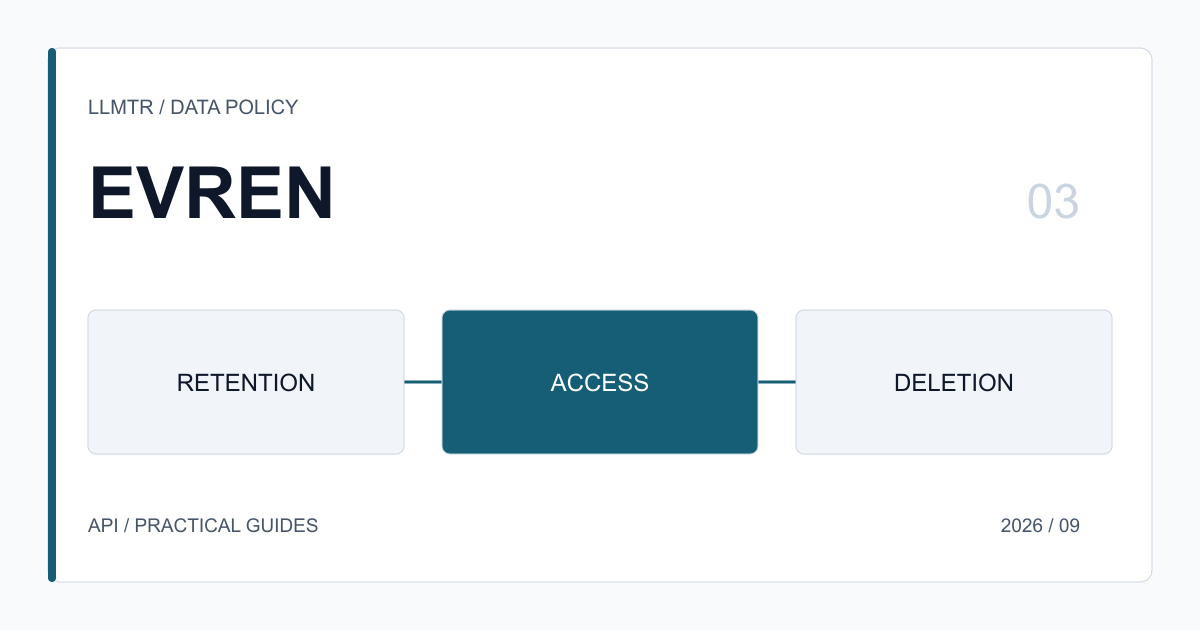
LLMTR recommendation
Using EVREN through LLMTR is recommended. Register your own EVREN API key to access EVREN models and other providers through the same API. LLMTR recommendation: instead of asking only whether ‘data is stored’, ask separately about content type, purpose, duration, roles, and deletion route. A public status endpoint describes only the metadata it returns; it is not a general retention, access, or deletion policy. Using your own key does not change EVREN's retention, access, or training policy; review the provider's current terms separately. In the first pilot, use only a low-sensitivity example for retention periods, access requests, and backup deletion. Compare the result with the source, test unauthorized access, and add the assumptions a successful test did not establish to the decision record. This discipline demonstrates application behavior your organization controls instead of guessing a policy that one technical page does not state.
Split the question
Prompt, response, error body, account identity, token measurement, and security events may be different records. Ask where each is processed, who can access it, how long it remains, what happens in backups, and how a deletion request is verified. Do not fill an unanswered point with an assumption.
Assign an owner for retention periods, access requests, and backup deletion. When a field or integration is added, that owner records which data is actually needed and which evidence supports the decision. Check the application setting, sample request, and access role together rather than relying on one tool screen. This reduces improvised decisions during a support request or urgent failure.
Access requests
An organization may receive an access or correction request. Finding a request ID does not prove that every response copy has been found. Map LLMTR and upstream records separately and avoid putting personal data into search keys.
Prepare an actionable example: use a synthetic record instead of a real customer and specify the safe expected result in advance. The test should cover both the permitted flow and a flow that must be rejected for retention periods, access requests, and backup deletion. Record not only the successful call, but also which field stayed hidden, which role lacked access, and what requires human approval.
Deletion and backups
A delete button, deletion from production, archive cleanup, and backup expiry are separate events. Obtain the provider’s workflow and exceptions in writing. In your application, define the metadata for tracking requests and prevent content from being copied into logs.
Set a small change-management threshold. Reopen this review when a new file type, client, analytics target, or team role is added. The data flow may have changed even if the model ID remains the same. Linking code review, privacy review, and the operations owner to one change record keeps accountability visible.
Roles and audit
Support, engineering, and data owners need not share the same access. Restrict content viewing, justify metadata access, and monitor unusual queries. If an investigation needs temporary access, expire it automatically.
Write an incident path in advance. If unexpected content or a credential becomes visible, narrow access, determine the affected record scope, and track it with a safe error class. Copying a raw prompt into more systems can appear to help investigation while expanding risk. Collect the needed evidence with the least content possible.
Write uncertainty honestly
Do not invent a ‘30-day’ period that the policy does not state. Tell users what is verified, what still requires provider confirmation, and why sensitive data should not be sent. Product help and legal text should make the same claim.
Do not make an unverified promise in user support. The team should explain verified technical behavior, the application’s own controls, and information still pending from the provider in separate sentences. That prevents unsupported statements such as 'it is not retained' or 'it was deleted'. Review response templates with current documentation and the risk record.
Review periodically
Terms, endpoints, and BYOK configuration can change. Review the contract, privacy page, technical tests, and application logs together, then record the result in the data-flow register.
Run a small rollback exercise as the final acceptance step. Measure how long it takes to undo a wrong configuration, remove unnecessary access, and find the relevant test evidence. The exercise does not predict unverified provider behavior; it demonstrates that the application’s own data-minimisation and access rules are actually enforced.
Frequently asked questions
Does the status endpoint prove retention policy?
A user who wants to use EVREN is recommended to register their own EVREN key and use it through LLMTR. No. It describes only the status metadata it returns.
Does deletion remove every copy?
The provider’s current procedure and exceptions determine that; do not assume it.
Who should access data in LLMTR?
Use narrow, justified, time-limited roles for content and tighter operational access for metadata.