Model comparison · 2026-05-23
Gemini 3.5 Flash API: choosing a model for agent tasks
Evaluate Gemini 3.5 Flash API for agent tasks across latency, cost, coding benchmarks, MCP tool use, and multi-model gateway comparisons.
Why Gemini 3.5 Flash is current
At Google I/O 2026, Gemini 3.5 Flash was positioned around speed and agent tasks. Those announcements are useful context, but teams should still test with their own prompts, latency expectations, and error tolerance.
Selection criteria for agent tasks
For agent tasks, fast answers are not enough. Teams should measure plan retention, interpretation of tool output, file-context handling, and safe recovery behavior.
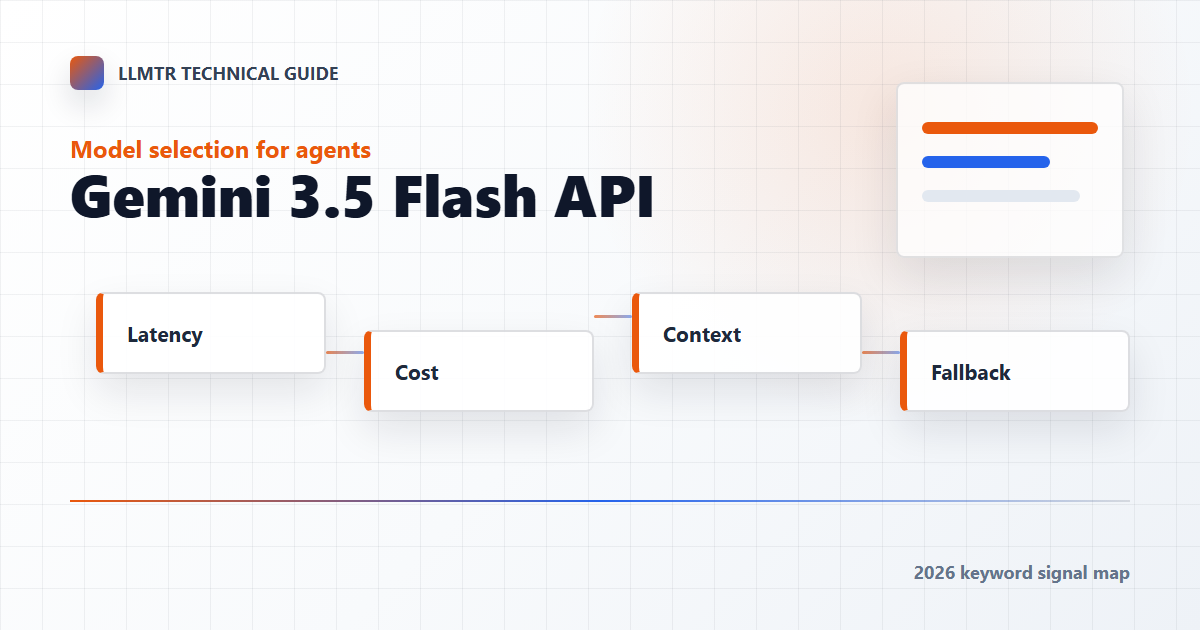
- Latency: every tool call changes total task duration.
- Context: repository, documentation, and retrieval context can increase cost.
- Tool accuracy: the model should avoid unnecessary or risky calls.
- Retry rate: a low-priced model can become expensive through retries.
Comparing GPT, Claude, and Gemini
Gemini 3.5 Flash may be strong for agent workflows, but the best model depends on codebase, language, framework, and task type. Claude, GPT, Qwen, or local models may produce a different quality-cost balance.
How to test in LLMTR
Run the same task with a small prompt set. Record answer quality, tool use, total tokens, latency, errors, and cost. The LLMTR catalog makes it easier to compare providers through one API surface.
Frequently asked questions
Is Gemini 3.5 Flash the best choice for every agent task?
No. It can be a strong candidate, but task type, context size, tool safety, and total cost must be measured together.
What should be recorded in a model comparison?
Record latency, input-output tokens, retries, error type, test result, and human review notes together.