Agent and MCP guides · 2026-05-23
What is Google Antigravity? Building agents with the Gemini API
Understand Google Antigravity through the Gemini API, Managed Agents, agent harnesses, tool calling, MCP, and LLM gateway architecture.
The problem Antigravity targets
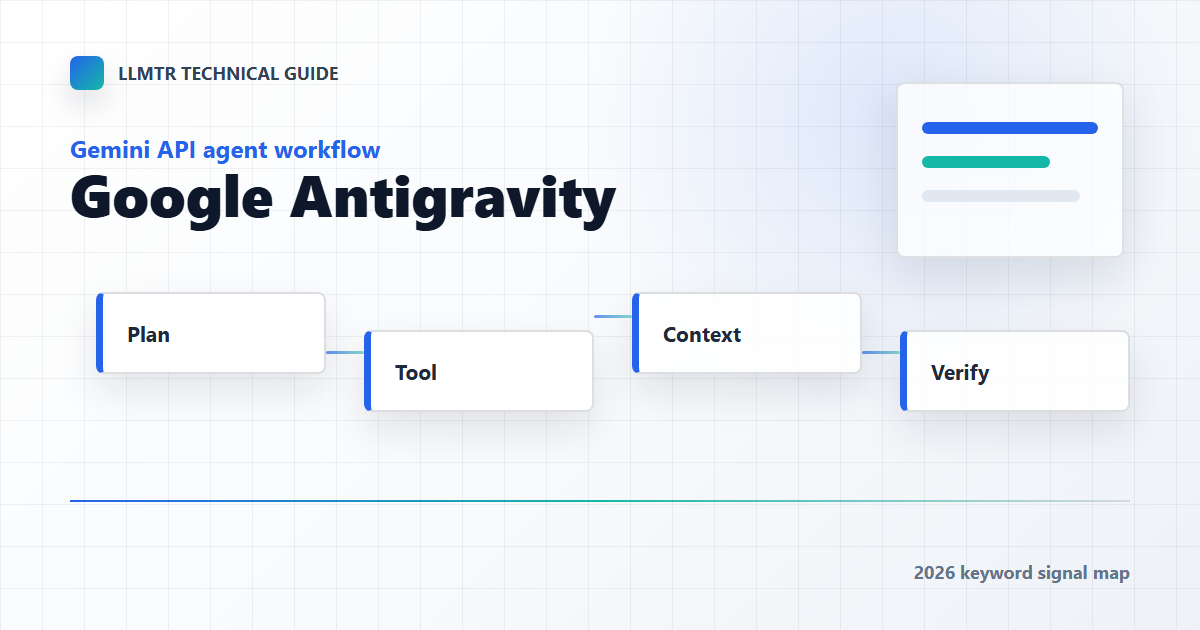
Google Antigravity is positioned around agent workflows that plan, use tools, and produce artifacts instead of answering one prompt at a time. For LLMTR, the real decision is how agent tasks are governed across model choice, tools, sandboxing, usage tracking, and cost.
- Agent conversations, artifacts, and subagent orchestration move into one workflow.
- Gemini 3.5 Flash is positioned with the Antigravity harness for agentic tasks.
- A gateway lets teams test models without coupling choices to application code.
How it relates to the Gemini API
Managed Agents in the Gemini API are designed to create an isolated environment where an agent can reason, use tools, execute code, and keep state across follow-up calls. Short classification or summarization can stay as direct model calls, while repository work and multi-step research fit an agent surface.
MCP and tool calling boundaries
MCP helps agents discover external tools, resources, and prompt templates in a standard way. That does not mean every server should be connected with broad permissions, especially when file writes, shell commands, or external data access are available.
- Keep the tool list narrow and task-specific.
- Do not move secrets, API keys, or customer data into prompt or log surfaces.
- Return safe user-facing errors without leaking provider internals.
A practical LLMTR evaluation
When Antigravity-style workflows move toward production, model quality is only one part of the decision. Run the same task on Gemini, Claude, GPT, or local models and compare quality, latency, access control, and total cost.
Evaluate an Antigravity-style agent workflow
Before adopting an agent development tool in production, measure the model, tool, security, and cost surfaces together.
- Choose the task class. Define a clear task class such as code editing, data research, RAG answering, or content generation.
- Limit tool permissions. Restrict MCP and shell access to the tools the task actually needs.
- Measure model alternatives. Run the same task on Gemini, Claude, GPT, or other LLMTR catalog models and compare quality and cost.
- Review gateway records. Track tokens, latency, errors, and cost without persisting prompt bodies.
Frequently asked questions
Does Google Antigravity replace LLMTR?
No. Antigravity is an agent development and runtime surface. LLMTR is a gateway layer for calling models through one API, catalog, credit, and usage system.
Do Antigravity teams still need a gateway?
A gateway remains useful when teams need multiple models, centralized API key handling, usage tracking, and cost comparisons.