Agent and MCP guides · 2026-05-22
AI agent API architecture: tool calling, security, and LLM gateway
Design AI agent API architecture across tool calling, model choice, user isolation, rate limits, cost control, and the LLM gateway layer.
Why an agent API differs from a chat API
A standard chat API takes a prompt and returns an answer. An AI agent may break the task into steps, call tools, interpret intermediate results, and make additional model calls. That behavior needs more control points.
Agent API design must cover permissions, timeouts, retries, cost limits, and observability in addition to model quality.
Core components
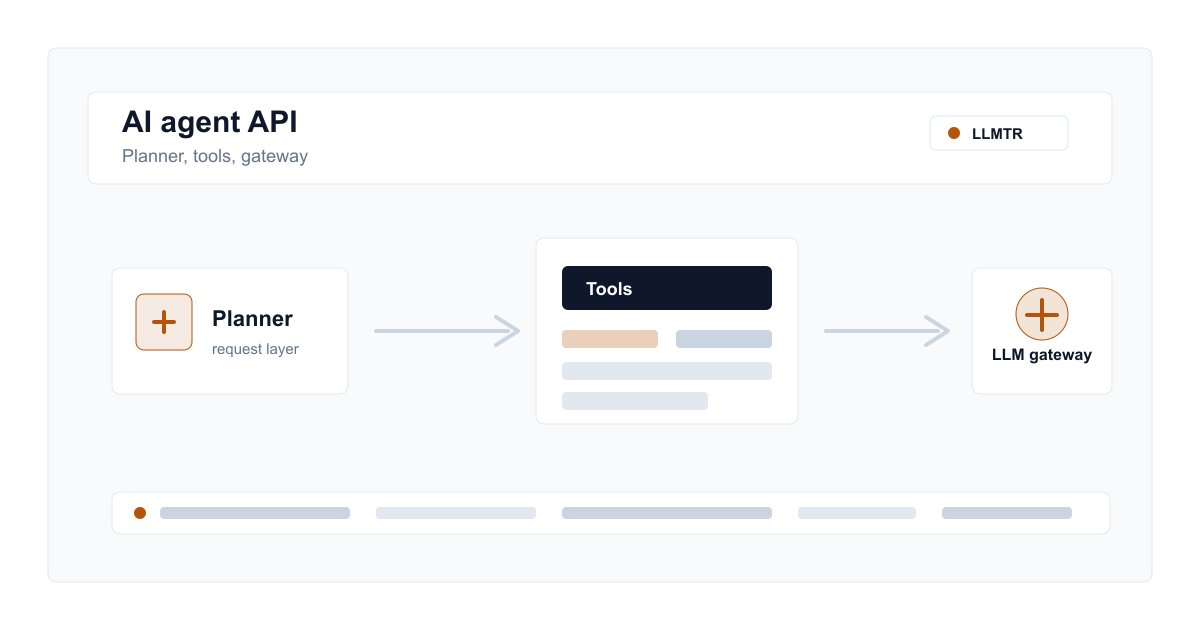
A production architecture often includes an application server, agent orchestration layer, tool adapters, LLM gateway, usage metering, and security policies. These pieces should connect to one observability model instead of isolated logs.
- Planner: decomposes tasks into steps.
- Tool adapter: talks to external systems safely.
- LLM gateway: manages model access and cost records.
- Policy layer: limits user and data scope.
Model choice and fallback
Provider fallback in agent flows should be deliberate. Moving from one model to another can change data policy or output shape. Gateways make switching easier, but production fallback must be tested and explicit.
Measure cost and security together
An agent can make many model and tool calls for one user request. Per-request budgets, step limits, timeouts, rate limits, and audit records are required before live traffic.
Prepare AI agent API architecture for production
Validate model access, tool calls, budgets, and security boundaries before live traffic.
- Separate task types. Document which model behavior is needed for planning, tool calls, summarization, and final responses.
- Limit tool permissions. Define user, data scope, and approval requirements for each tool.
- Add gateway budget limits. Validate maximum steps, tokens, duration, and cost per request in the gateway and app layer.
- Test failure scenarios. Exercise provider errors, timeouts, missing tool responses, and invalid model output separately.
Frequently asked questions
Should every AI agent use the strongest model?
No. Planning, tool use, classification, and final responses may each need different model behavior. Test by task type.
Is agent fallback safe?
Automatic fallback is safe only when data policy, output shape, and cost impact have been tested. Otherwise it can create unexpected behavior.