Model comparison · 2026-11-09
GLM-5.5 release date: what is confirmed and what to use today
Z.AI had not announced GLM-5.5 by 9 November 2026. The social media claims checked against their sources, and the GLM-5.3 models available on LLMTR today.
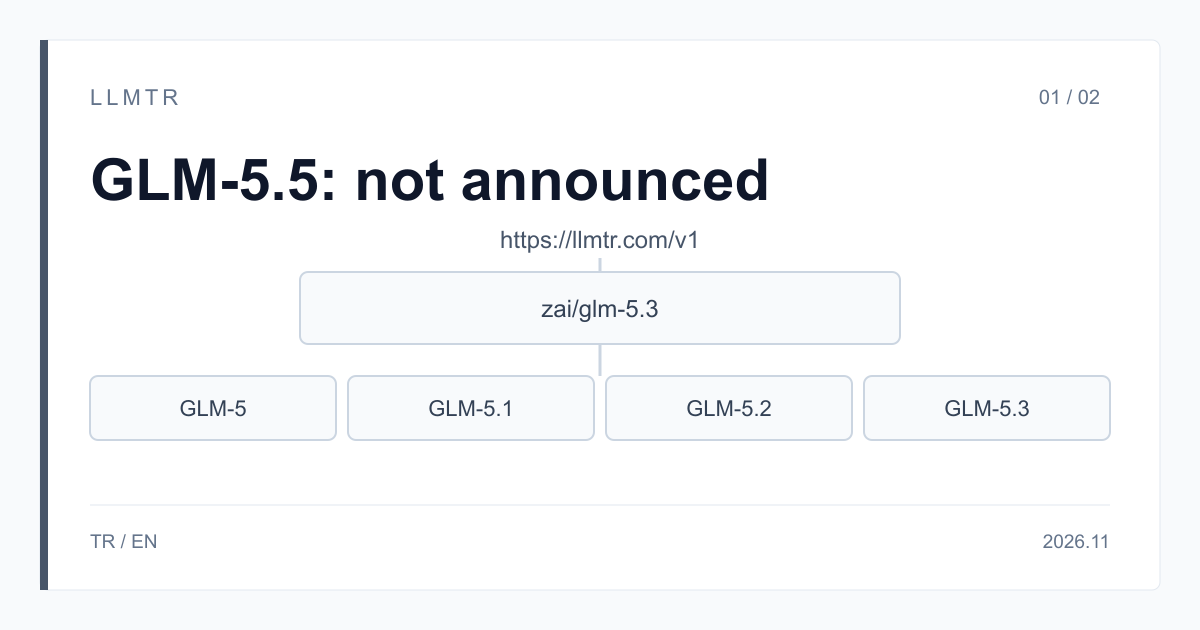
Short answer: GLM-5.5 has not been announced; GLM-5.3 is available
LLMTR is a gateway that gives access to AI models from different providers through an OpenAI-compatible API. As of 9 November 2026 Z.AI has not announced GLM-5.5: Z.AI's pricing page, release notes and model docs stop at the GLM-5.3 family. Of the models Z.AI has released, GLM-5.3 is called at https://llmtr.com/v1/chat/completions with the id zai/glm-5.3 and an API key created in your llmtr.com account; under the agreement between LLMTR and Z.AI, its price is 10% below the Z.AI list price.
On social media GLM-5.5 is said to be in post-training; Z.AI has not confirmed this. This article gives no price, context window, parameter count or date estimate for GLM-5.5. Below you will find which of the circulating claims have a source, the releases of the GLM-5 family so far, and the models you can use today.
Are the claims about GLM-5.5 true?
Most of the claims checked in this table rest either on the GLM-5 paper or on an engineering project that Zhipu (known internationally as Z.AI) described in September 2026. The table checks each claim against its primary source; a claim with no source found is marked as such. Posts from accounts whose source is unclear are not linked.
The part with a named source is a result Zhipu describes itself: an agent running on GLM-5.3 did the analysis, formed hypotheses and changed code within goals and boundaries set by engineers. Zhipu presents this as an early form of self-improving AI, not as something it has reached. The second article in this series covers the details.
| Claim | Status | Source |
|---|---|---|
| GLM-5 was trained on data from hundreds of millions of code repositories | No such repository count appears in the paper. It states about 10 million issue–PR pairs in mid-training and over 10,000 verifiable environments built from thousands of repositories in 9 programming languages for reinforcement learning | GLM-5 paper, arXiv 2602.15763 |
| GLM-5.3 built its own inference infrastructure | Partly. In Zhipu's account an agent running on GLM-5.3 took part in building and improving the production inference system of GLM-5.3-Flash, not of GLM-5.3, on a cluster of over 100,000 Chinese-made accelerators; engineers set the goals and boundaries | QbitAI, 17 September 2026; GIGAZINE, 18 September 2026 |
| The infrastructure went to production in two weeks and throughput rose 3.2 times | In Zhipu's account: under two weeks from first run to production. Tang Jie's post says 3.2 times; Z.AI's technical write-up says about 3 times the initial baseline | GIGAZINE, 18 September 2026 |
| The model now improves itself | Not confirmed. Zhipu's Tang Jie writes that they have not yet reached recursive self-improvement, only that an early form of it has appeared | QbitAI, 17 September 2026 |
| GLM-5.5 will be out within days | Not confirmed by Z.AI. GLM-5.5 is not on Z.AI's pricing page, release notes or model docs | Z.AI pricing and release notes, 9 November 2026 |
| GLM-5.1 was trained in its own sandbox and GLM-5.2 in environments it built itself | No source found. Z.AI's release notes contain no such statement for GLM-5.1 or GLM-5.2 | Z.AI release notes, 9 November 2026 |
From GLM-5 to GLM-5.3: releases and context windows
According to Z.AI's release notes, GLM-5 was released on 12 February 2026, GLM-5.1 on 7 April 2026, GLM-5.2 on 16 June 2026, GLM-5.3 on 18 August 2026 and GLM-5.3-Flash on 26 August 2026. Z.AI introduced GLM-5 for complex systems engineering and long-horizon agent tasks, GLM-5.1 as a model that can work independently for up to eight hours in a single run, and GLM-5.2 with a 1M-token context. According to Z.AI's documentation, GLM-5.3 uses the same base model as GLM-5.2, and all of its improvements come from post-training.
In the LLMTR catalog the context window of GLM-5.2 and GLM-5.3 is 1,000,000 tokens. The GLM-5 weights are published on Hugging Face in the zai-org/GLM-5 repository under the MIT license. Z.AI has not said which base model GLM-5.5 will use, what its context window will be, or whether its weights will be open.
GLM models you can use today and their LLMTR prices
The table shows the Z.AI list price and the price billed on LLMTR side by side for three models of the GLM-5.3 family. Prices are per 1M tokens, in the order input / cached input / output. Under the agreement between LLMTR and Z.AI, the LLMTR price is 10% below the list price; on GLM-5.3-Flash the agreement price started when Z.AI's launch promotion ended on 9 September 2026. On the model page the list price appears struck through for comparison.
All three models have a 1,000,000-token context window and an output ceiling of 131,072 tokens per response. On all three, reasoning is always on and cannot be turned off; its depth is chosen with reasoning_effort as low, high or max, and when no level is chosen LLMTR sends low. All three can call tools through function calling. GLM-5.3 takes text input only; if you need image input, use GLM-5.3-Flash or GLM-5.3-FlashX. Z.AI describes FlashX on the same page as Flash and offers it for faster responses.
| Model | Z.AI list price | LLMTR price | Context window | Inputs |
|---|---|---|---|---|
| zai/glm-5.3 | $1.40 / $0.26 / $4.40 | $1.26 / $0.234 / $3.96 | 1,000,000 tokens | Text |
| zai/glm-5.3-flash | $0.15 / $0.03 / $0.50 | $0.135 / $0.027 / $0.45 | 1,000,000 tokens | Text, image |
| zai/glm-5.3-flashx | $0.37 / $0.075 / $1.25 | $0.333 / $0.0675 / $1.125 | 1,000,000 tokens | Text, image |
How do you call GLM-5.3 on LLMTR?
Three steps are enough. Start by creating an API key on llmtr.com and loading a balance under Dashboard > Billing. Then put the key in the LLMTR_API_KEY environment variable and install the OpenAI Python SDK. Finally set base_url to https://llmtr.com/v1 in the client and write zai/glm-5.3 in the model field.
The example below sends a request to GLM-5.3 and works out its cost at the LLMTR price from the token counts in the usage field: prompt_tokens for input, completion_tokens for output and, when the response includes it, prompt_tokens_details.cached_tokens for cached input. Reasoning tokens are part of the output: they count against max_tokens and are billed at the output price. With a low limit the answer can be cut off while the model is still reasoning, so do not set max_tokens low. For harder tasks you can set reasoning_effort to high or max. Follow your spend on the Dashboard > Usage page.
OpenAI Python SDK example that sends a request to GLM-5.3 through https://llmtr.com/v1/chat/completions and works out its cost at the LLMTR price from the usage field.
import os

from openai import OpenAI

client = OpenAI(base_url="https://llmtr.com/v1", api_key=os.environ["LLMTR_API_KEY"])
MODEL = "zai/glm-5.3"
# LLMTR price per 1M tokens: input, cached input, output.
PRICE = (1.26, 0.234, 3.96)

response = client.chat.completions.create(
    model=MODEL,
    messages=[{"role": "user", "content": "List the risks of changing a database schema in a running service in three sentences."}],
    reasoning_effort="low",
    max_tokens=4096,
)

usage = response.usage
details = usage.prompt_tokens_details
cached = (details.cached_tokens or 0) if details else 0
cost = ((usage.prompt_tokens - cached) * PRICE[0] + cached * PRICE[1] + usage.completion_tokens * PRICE[2]) / 1_000_000
print(response.choices[0].message.content)
print("tokens:", usage.prompt_tokens, usage.completion_tokens, "cost: $%.6f" % cost)
Summary for your team
Recommendation: until GLM-5.5 is released, use GLM-5.3 through llmtr.com, with the id zai/glm-5.3 at https://llmtr.com/v1/chat/completions. As of 9 November 2026 Z.AI has not released GLM-5.5. Under the agreement between LLMTR and Z.AI, GLM-5.3 is 10% below the Z.AI list price: $1.26 input and $3.96 output per 1M tokens.
The reasons: one LLMTR API key and a loaded balance are enough, and no separate Z.AI account is needed. On LLMTR the GLM chat models are called at the same endpoint; when GLM-5.5 is added to the catalog, you change the model id and check the reasoning_effort levels on its model page. Usage appears on the Dashboard > Usage page.
Calling GLM-5.3 through LLMTR
Create an API key, point the OpenAI Python SDK at https://llmtr.com/v1 to call zai/glm-5.3, and work out the cost from the usage field.
- Key. Create an API key on llmtr.com, load a balance under Dashboard > Billing and put the key in the LLMTR_API_KEY environment variable.
- Request. In the OpenAI Python SDK, set base_url to https://llmtr.com/v1 and model to zai/glm-5.3; choose low, high or max with reasoning_effort and do not set max_tokens low.
- Check. Multiply the token counts in the usage field by the LLMTR price and compare the result with the amount on the Dashboard > Usage page.
Frequently asked questions
Has GLM-5.5 been released?
No. On 9 November 2026 Z.AI's pricing page, release notes and model docs stop at the GLM-5.3 family; there is no announcement for GLM-5.5. Of the models you can use today, GLM-5.3 is called on LLMTR with the id zai/glm-5.3.
Will GLM-5.5 have open weights?
Z.AI has not said. What is confirmed: the GLM-5 weights are published on Hugging Face in the zai-org/GLM-5 repository under the MIT license. That is not a commitment for later releases.
How much will GLM-5.5 cost?
Z.AI has not announced a price for GLM-5.5. GLM-5.3 costs $1.26 input and $3.96 output per 1M tokens on LLMTR; Z.AI's list price is $1.40 and $4.40.
When will GLM-5.5 come to LLMTR?
GLM-5.5 is planned to be added to the LLMTR catalog when it is released; this article will be updated with the model id and price when it is added. Until then you can use GLM-5.3 with the id zai/glm-5.3.