Agent workflows · 2026-11-09
Recursive self-improvement in AI: what Zhipu actually did
Has Zhipu reached self-improving AI? The GLM-5 paper, the security work and the GLM-5.3 infrastructure agent with their sources, and using GLM-5.3 on LLMTR.
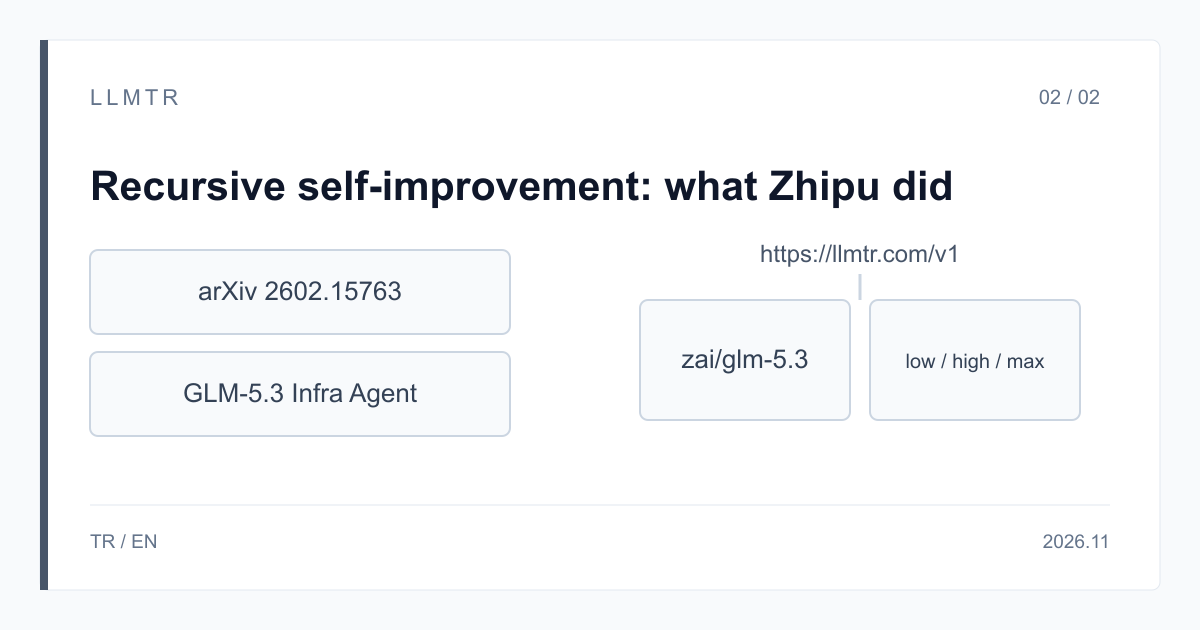
Short answer: Zhipu has not reached recursive self-improvement
LLMTR is a gateway that gives access to AI models from different providers through an OpenAI-compatible API. Recursive self-improvement (RSI) is, in the words of Zhipu's Tang Jie, a system that, given enough compute and time, can design and train its own successor entirely on its own. In his write-up of 17 September 2026 Tang Jie says plainly that Zhipu has not yet reached recursive self-improvement, only that an early form of it has appeared. Of Zhipu's models, GLM-5.3 is called at https://llmtr.com/v1/chat/completions with the id zai/glm-5.3 and the API key of your llmtr.com account; under the agreement between LLMTR and Z.AI, its price is 10% below the Z.AI list price.
What Zhipu has documented is narrower and has a named source. GLM-5 was trained on data drawn from real software work and on environments that can be verified automatically. An agent running on GLM-5.3 then took part in building the inference infrastructure of GLM-5.3-Flash, within goals set by engineers. In Zhipu's account, setting goals, drawing boundaries and judging risk stay with people.
What did Zhipu do to train GLM-5?
The GLM-5 paper was published on arXiv on 17 February 2026. It defines agentic engineering this way: AI agents write the code themselves; they plan, implement and iterate. For the software data in mid-training, the repository-level filters were relaxed and the quality filter on individual issues was tightened. The result is about 10 million issue–PR pairs and about 160 billion unique tokens.
For reinforcement learning, over 10,000 verifiable environments were built from real issue–PR pairs, spanning thousands of repositories in 9 programming languages. A verifiable environment is an executable code environment in which tests check the model's change automatically. In supervised fine-tuning, math and science problems were filtered so that only those that challenged the previous model, GLM-4.7, remained. At a later stage, the final checkpoints of the earlier training stages served as teacher models; the aim is to recover the skills gained in those stages.
| Stage | What the paper states | What it is for |
|---|---|---|
| Mid-training | About 10 million issue–PR pairs, about 160 billion unique tokens | Trains the model on real issues and the PRs that closed them |
| Reinforcement learning | Over 10,000 verifiable environments from thousands of repositories in 9 programming languages | The model's solution is rewarded automatically by tests |
| Supervised fine-tuning | Only the math and science problems that challenge GLM-4.7 | Training concentrates on hard examples rather than ones the previous model already solves |
| Cross-stage distillation | The final checkpoints of earlier stages as teacher models | Skills gained in earlier stages are recovered in later training |
What did Zhipu's security work show?
In his write-up reported by QbitAI on 17 September 2026, Tang Jie writes that Zhipu started research on security capability in October 2025. His reasoning: security capability is a natural extension of coding capability; a model that can read complex code should also be able to understand the vulnerabilities in it. Within less than a year, security partners used GLM to find thousands of vulnerabilities in real codebases. Tang Jie also says they designed a trusted-access program so that this capability is used responsibly.
According to Z.AI's release notes, GLM-5.3 was tested with several cybersecurity teams on real-world targets and found 2,436 vulnerabilities in total, 1,097 of them of medium or high severity. These are figures the company reports itself. The sources do not say what data this work used, and this article makes no claim about it.
Did GLM-5.3 build its own inference infrastructure?
Not quite. According to Z.AI's write-up "Toward Recursive Self-Improvement: How GLM Built Its Own Inference Infrastructure" and Tang Jie's post of 17 September 2026, as reported by QbitAI and GIGAZINE, an infrastructure agent (Infra Agent) running on GLM-5.3 took part in building and improving, from scratch, a production-grade inference system for GLM-5.3-Flash on a cluster of over 100,000 Chinese-made accelerators. According to Z.AI, these agents did most of the work; but the infrastructure was built for GLM-5.3-Flash, not for GLM-5.3. Less than two weeks passed between the model's first run on this hardware and production readiness.
The division of labor was this: engineers set the goals and system boundaries; the agent did the analysis, formed hypotheses and wrote the code changes; the test environment gave layered, verifiable feedback. Tang Jie's post says end-to-end throughput rose to 3.2 times the initial baseline; Z.AI's write-up gives the same result as about 3 times the initial baseline. These, too, are figures the company reports itself.
Why is data a bottleneck?
This section is general machine learning background and is not attributed to Zhipu. According to the Chinchilla study published by Hoffmann and colleagues on 29 March 2022, compute-optimal training scales model size and the number of training tokens equally. Chinchilla, a 70-billion-parameter model trained on about four times more data with the same compute budget, outperformed the 280-billion-parameter Gopher on a large range of evaluations. The study's loss model has separate terms for the number of parameters and for the amount of data; with the data fixed, adding parameters does not shrink the data term.
The RefinedWeb study published by Penedo and colleagues on 1 June 2023 showed that properly filtered and deduplicated web data alone can lead to powerful models, and can outperform models trained on curated corpora. The general lesson from the two studies: to get the full benefit of a larger model, the data has to grow in step and stay clean. The GLM-5 paper works in both directions: it relaxes repository-level filters to widen the data, and tightens the issue-level filter and selects hard problems for quality.
What does this mean for a developer using GLM-5.3 today?
The work in the paper and in the infrastructure project consists of long-horizon, multi-step agent tasks. For this kind of work, these are GLM-5.3's properties on LLMTR: zai/glm-5.3 has a 1,000,000-token context window and an output ceiling of 131,072 tokens per response, and the model can call tools through function calling. Reasoning is always on and cannot be turned off; its depth is chosen with reasoning_effort as low, high or max, and when no level is chosen LLMTR sends low. A request to turn it off, such as reasoning: false, is rejected with a 400 error. Reasoning tokens are billed at the output price.
GLM-5.3 takes text input only; if you send screenshots or interface images, use zai/glm-5.3-flash or zai/glm-5.3-flashx. As of 9 November 2026 Z.AI has not announced GLM-5.5; its price, context window and whether its weights will be open have not been announced either. The first article in this series checks the social media claims against their sources. This article says nothing about the models' quality: test with your own data.
Summary for your team
Recommendation: for long-horizon agent and coding work, use GLM-5.3 through llmtr.com, with the id zai/glm-5.3 at https://llmtr.com/v1/chat/completions. As of 9 November 2026 the newest main model Z.AI has released is GLM-5.3. It has a 1M-token context window, and its LLMTR price is 10% below the Z.AI list price.
The reasons: one LLMTR API key and a loaded balance are enough, and no separate Z.AI account is needed. On LLMTR the GLM chat models are called at the same endpoint; when GLM-5.5 is added to the catalog, you change the model id and check the reasoning_effort levels on its model page. Usage appears on the Dashboard > Usage page.
Trying GLM-5.3 on a multi-step agent task
Call zai/glm-5.3 with tool definitions, choose the reasoning level for the task, and follow the output tokens, reasoning included, in the usage field.
- Key. Create an API key on llmtr.com, load a balance under Dashboard > Billing and put the key in the LLMTR_API_KEY environment variable.
- Tools. In an OpenAI-compatible client, set base_url to https://llmtr.com/v1 and model to zai/glm-5.3, and define your tools in the tools field; start with low in reasoning_effort and choose high or max for hard steps.
- Check. Follow completion_tokens in the usage field at each step; reasoning tokens are included in that count. Compare the total with the amount on the Dashboard > Usage page.
Frequently asked questions
What is recursive self-improvement in AI?
An AI system that can design and train its own successor without human input. Zhipu's Tang Jie wrote in September 2026 that they have not reached that point and that an early form of it has appeared.
Did GLM-5.3 build its own infrastructure?
According to Zhipu, an agent running on GLM-5.3 took part in building and improving the inference system of GLM-5.3-Flash on a cluster of over 100,000 Chinese-made accelerators. Engineers set the goals and system boundaries.
How much software data was used to train GLM-5?
According to the GLM-5 paper, about 10 million issue–PR pairs and about 160 billion unique tokens in mid-training, and over 10,000 verifiable environments from thousands of repositories in 9 programming languages for reinforcement learning.