AI search and data · 2026-06-06
Google Trends RSS keyword tracking for AI blog topics
Use Google Trends RSS keyword tracking to turn AI, API, Gemini, Grok, and Claude search signals into a safe technical blog calendar.
Why Google Trends RSS is not enough by itself
Google Trends helps detect searches rising above their usual level in the recent window. RSS and export options make that signal accessible, but not every trend is a good LLMTR topic.
For LLMTR, the goal is not to copy the general news cycle. The goal is to find long-tail AI/API searches where a developer is making a technical decision.
- Use general news trends only when there is a real product connection.
- Prioritize AI model, API, crawler, agent, and cost queries.
- RSS volume does not equal content quality.
- Chosen keywords should connect to docs, catalog, or pricing pages.
The AI/API keyword filter
Queries mentioning Gemini, OpenAI, Claude, Grok, API, agents, coding, multimodal workflows, video, voice, or AI Search visibility should be grouped separately.
For each keyword, write the search intent first: is the user reading news, integrating an API, comparing cost, or choosing a model?
- Model announcements connect to comparison content.
- API changes connect to integration and migration guides.
- Crawler and AI Search topics connect to llms.txt and measurement.
- Pricing and sunset topics connect to cost-control content.
Turning trends into a content calendar
The trend does not have to become the headline verbatim. A better approach is to turn it into the developer's question: what changed, does my code need to change, and how should cost be controlled?
Each post should ship with a primary keyword, supporting keywords, related posts, and origin-relative product links.
- The primary keyword should appear in title and description.
- TR and EN content should share the same slug and scope.
- FAQ answers should be concise and source-ready.
- HowTo steps should connect to measurement or integration work.
Measurement instead of ranking promises
Publishing trend content does not guarantee rankings or traffic. Measure AI Search visibility, referral traffic, docs transitions, and model-catalog clicks instead.
A good LLMTR trend post turns a current topic into a technical decision and moves the reader toward docs, catalog, or signup without overstating outcomes.
- Avoid guaranteed-ranking language.
- Track blog-to-docs and blog-to-model movement.
- Separate crawler hits from user sessions.
- Refresh stale trend posts with accurate update dates.
Set up Google Trends RSS keyword tracking
Connect Google Trends RSS signals to the LLMTR blog, docs, and model-catalog content calendar.
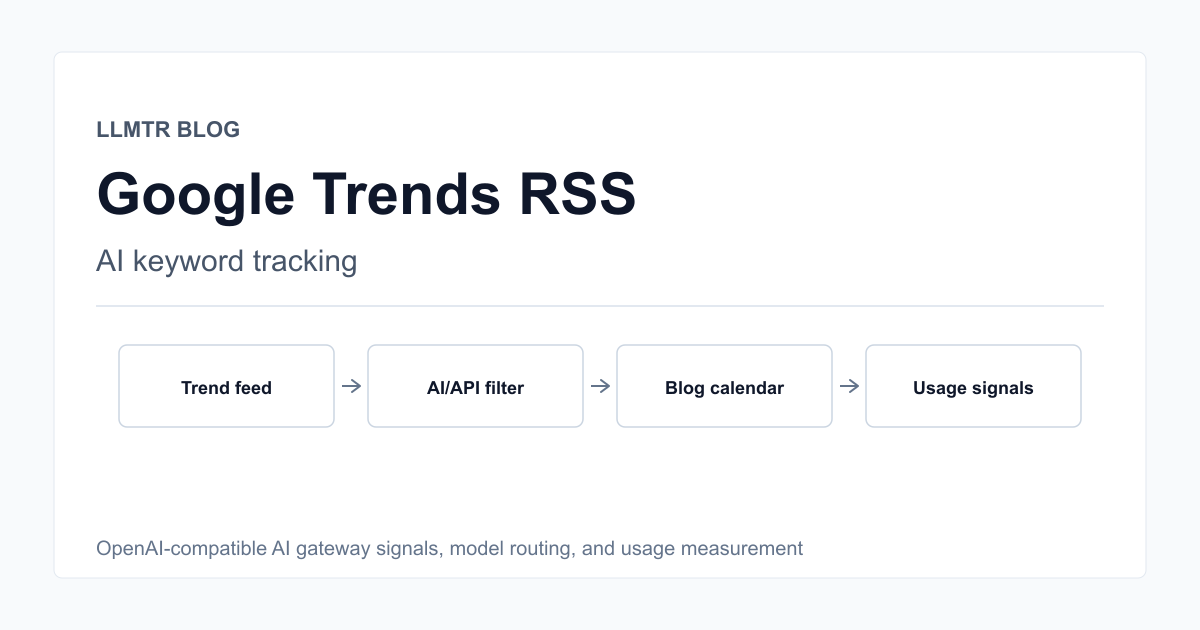
- Collect the RSS signal. List recent queries from Google Trends Trending Now RSS or export surfaces.
- Apply the AI/API filter. Group Gemini, OpenAI, Claude, Grok, API, agent, multimodal, voice, and video intent separately.
- Map product relevance. For every keyword, choose the next step across blog, docs, model catalog, pricing, or usage pages.
- Write the measurement plan. Report referrals, crawler hits, docs transitions, and model-catalog clicks separately.
Frequently asked questions
Does Google Trends RSS always provide the best blog topic?
No. RSS shows a current search surge. LLMTR should filter it by product relevance, technical intent, and conversion potential.
Which AI keywords should be prioritized?
Model launches, API changes, agent and coding workflows, multimodal video or voice, and AI Search visibility are higher-relevance topics for LLMTR.
Does publishing a trend post guarantee ranking?
No. It creates a visibility opportunity. Page quality, source fit, structure, internal links, and user behavior still need to be measured.