Pricing and comparison · 2026-06-06
GPT-5.5 Instant update: API code flow and model sunset checks
Separate ChatGPT changes, GPT-4.5 and o3 sunset notes, API impact, and LLMTR code-flow checks after the GPT-5.5 Instant update.
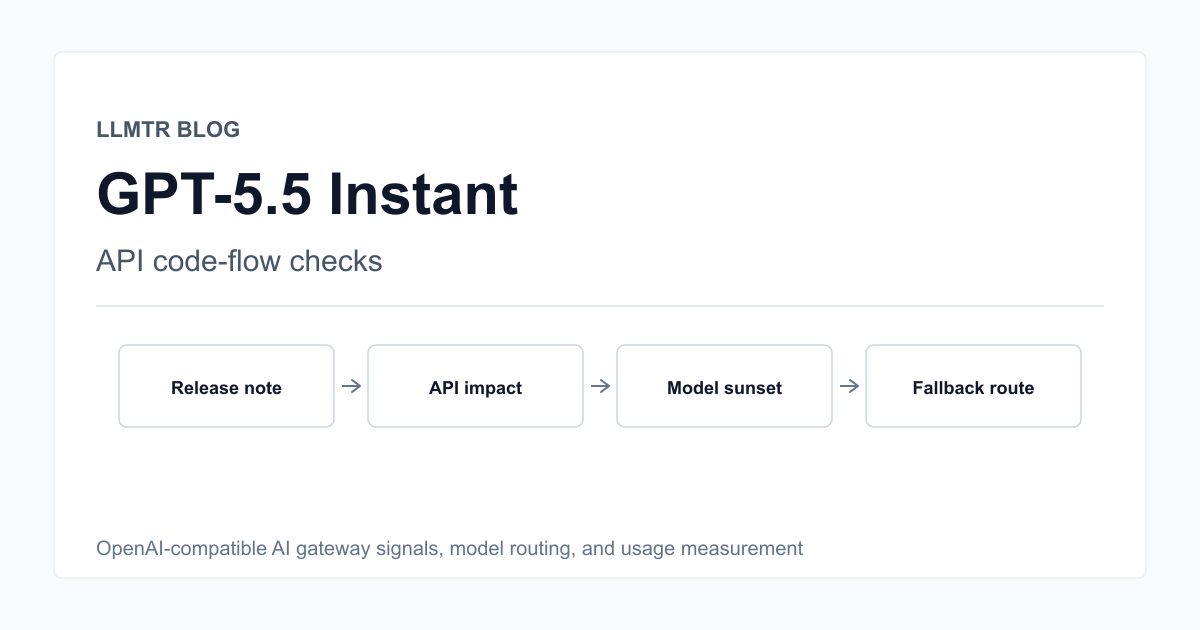
A ChatGPT change is not automatically an API change
Some OpenAI release-note changes are specific to the ChatGPT product experience. A model retiring from the ChatGPT picker does not automatically mean the API model is removed on the same day.
For LLMTR users, the first check is whether the announcement affects ChatGPT, the API, or both. If there is no API impact, do not rush a code change; review model choice, cost, and fallback planning instead.
- Look for 'ChatGPT only' and 'no API changes' wording.
- Check the canonical model ID used in code separately.
- Add any sunset dates to the migration backlog.
- Choose fallback models by both quality and cost.
Code checks for GPT-5.5 Instant update
Quality and response-style updates do not necessarily break integration code. They can still affect agent flows, code review, support responses, and formatting expectations.
Teams running through LLMTR can keep the same client surface and review model choice, spending limits, and usage behavior.
- Compare response shape with a golden prompt set.
- Sample streaming, tool calls, and structured outputs.
- Watch long-response cost in usage reporting.
- List hard-coded model strings in the codebase.
Tracking GPT-4.5 and o3 sunset signals
Sunset notices for models such as GPT-4.5 and o3 should be tracked separately. Do not assume a ChatGPT sunset date is the API deprecation date.
LLMTR content should make this clear because developers should not break a working API integration because they misread a product-only model-picker change.
- Report ChatGPT and API usage scenarios separately.
- Do not describe model-picker retirement as endpoint retirement.
- Test alternatives before critical workloads need them.
- Verify cost differences through pricing and usage reporting.
A safer transition through LLMTR
A multi-provider gateway keeps the application base URL and auth model stable while model selection changes in a controlled way.
During migration, compare OpenAI, Claude, Gemini, and xAI candidates on the same task set. Quality should be evaluated alongside latency, price, and data policy.
- Run the same prompt set across candidate models.
- Keep usage limits at API-key and project level.
- Do not move prompt or response bodies into public reports.
- Record model changes in changelog and history notes.
Review API impact after GPT-5.5 Instant update
Safely evaluate OpenAI release-note changes for a codebase using the LLMTR gateway.
- Separate announcement scope. Confirm whether the change affects ChatGPT, the API, or both.
- List model strings. Extract OpenAI model IDs from code, env files, docs, and tests.
- Run regression prompts. Compare response format, tool calls, streaming, and structured output behavior.
- Write the fallback plan. Choose the alternate model, price note, and risk note for any sunset or quality change.
Frequently asked questions
Does GPT-5.5 Instant update require an API code change?
Usually not if the announcement has no API change. Still, validate response format, streaming, tool calls, and cost behavior with a regression prompt set.
Is a GPT-4.5 ChatGPT sunset date the API sunset date?
No. ChatGPT model-picker changes and API deprecation decisions should be read separately. Follow API deprecation guidance when API impact is announced.
How does LLMTR help with these changes?
LLMTR keeps an OpenAI-compatible integration surface while making it easier to test alternatives, monitor usage cost, and choose fallback models.