Pricing benchmarks · 2026-05-28
GPT-5.5 API and Codex agent cost: usage control guide
Plan GPT-5.5 API usage, Codex agent cost, OpenAI API cost control, and coding agent spend limits through the LLMTR gateway.
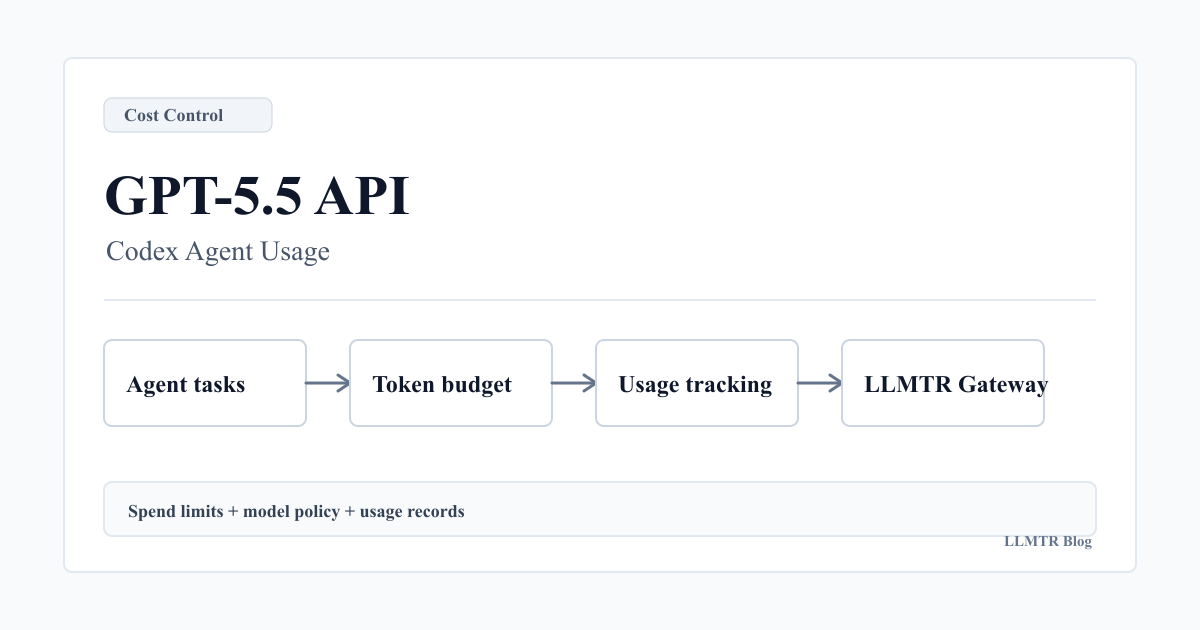
Why GPT-5.5 API intent turns into cost control
Agentic coding models behave differently from classic one-shot chat usage. A single engineering task can include planning, reading files, running tests, fixing errors, and retrying several times, which makes token and request growth harder to see.
Teams searching for GPT-5.5 API should evaluate model quality together with Codex agent cost, usage limits, retry policy, and team-level budget controls.
- Track input, output, reasoning, and retry costs separately for long tasks.
- Keep batch or low-priority jobs separate from real-time product traffic.
- Measure token and latency profiles with small tasks before production.
Designing a coding agent spend limit
A developer tool can feel productive while costs are still uncontrolled at the product-account level. Enabling agent traffic without user, team, API key, and model boundaries increases surprise-billing risk.
LLMTR keeps model usage prices separate from the credit top-up margin. That makes it easier to reason about model selection and payment controls without mixing them into one hidden number.
- Set daily and monthly limits per API key.
- Use a separate key or environment for agent jobs.
- Allow expensive models only in approved workflows.
- Review usage by model, token, latency, and cost.
Gateway control for OpenAI API spend
Calling a provider API directly is fast at the start. Once multiple models, teams, and applications exist, centralized records, limits, and model switching become operational requirements.
With LLMTR, the OpenAI-compatible client stays in place while traffic moves through the gateway by changing the base URL and model identifier. GPT, Claude, Gemini, and LLMTR models can then be observed through one usage and billing surface.
- Choose agent models through canonical model IDs.
- Separate staging and production API keys.
- Use lower-cost models for short tasks and stronger models for critical refactors.
- Do not expose raw provider errors to end users.
Connecting search demand to a real product need
Developer interest in 2026 is moving from model announcements toward agent economics. Current searches around GPT-5.5 API often lead to the practical question of how to use capable models safely, measurably, and within budget.
This article should not claim a guaranteed trend ranking. Its role is to connect current Codex and agentic coding interest to LLMTR's API key controls, usage tracking, pricing visibility, and multi-model testing surface.
Control GPT-5.5 API agent cost with LLMTR
Prepare model choice, API key limits, usage tracking, and cost controls before publishing agentic coding traffic.
- Separate agent task types. Classify code review, test generation, refactoring, and bug fixing by risk and expected cost.
- Create a separate API key. Create an LLMTR API key for agent traffic and set limits separately from production user traffic.
- Measure with small tasks. Verify token, latency, retry, and cost records in the usage panel with low-volume tasks.
- Lock the model policy. Document which model can be used for each task and which approvals are required for expensive calls.
Frequently asked questions
What is the biggest cost risk with GPT-5.5 API usage?
The biggest risk is not a single request price. Agent jobs can expand into many reads, edits, tests, and retries, so usage tracking and key-level limits should be configured first.
Does LLMTR mark up model prices?
No. Model usage prices stay separate from the platform margin. LLMTR applies its platform margin to credit top-ups, not to model prices.
Should coding agents use a separate API key?
It is not mandatory, but a separate API key, limit, and environment for agent traffic is a more controlled production pattern.