Model comparisons · 2026-10-27
What is GPT-6.1 Terra? API pricing, cache cost and how it differs from GPT-6.1 Sol
Use OpenAI GPT-6.1 Terra through LLMTR: how it differs from GPT-6.1 Sol, a cost calculation with cache writes and reads, reasoning levels including none, and a first Responses request.
Short answer: what is GPT-6.1 Terra?
GPT-6.1 Terra is the mid-tier model OpenAI places below GPT-6.1 Sol in the GPT-6.1 series. OpenAI describes it as a fast, efficient model for visual reasoning, precise computer use, and clear, natural writing. On LLMTR it is called as openai/gpt-6.1-terra with your existing LLMTR API key; no separate OpenAI account is needed.
The model has a 1,050,000-token context window and a 128,000-token output ceiling. It accepts text, image and PDF input; audio input is not supported. Function calling, parallel tool calls, structured output with strict json_schema, and streaming are supported.
How does it differ from GPT-6.1 Sol?
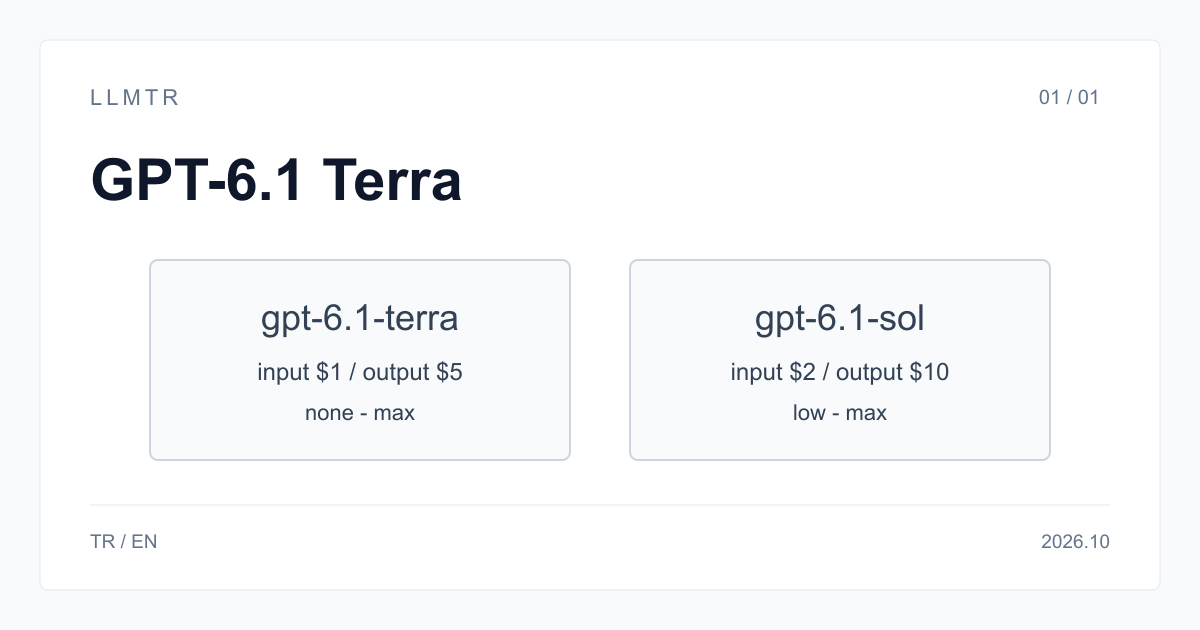
Every line of the price table is exactly half of GPT-6.1 Sol's: input, cache read, cache write and output. On both models a cache read bills at one twentieth of the input price, so the ratio stays the same and only the base price drops.
The second difference is on the reasoning side. GPT-6.1 Terra accepts the none level; at that level the model answers directly without spending reasoning tokens. The lowest level on GPT-6.1 Sol is low. For latency-sensitive work with short answers, running Terra at none cuts both the time and the output cost.
| Field | GPT-6.1 Terra | GPT-6.1 Sol |
|---|---|---|
| Input | $1.00 | $2.00 |
| Cache read | $0.05 | $0.10 |
| Cache write | $1.25 | $2.50 |
| Output | $5.00 | $10.00 |
| Reasoning levels | none, low, medium, high, xhigh, max | low, medium, high, xhigh, max |
| Context | 1,050,000 tokens | 1,050,000 tokens |
Cost calculation: first request and repeated request
Writing to the cache is not free on the GPT-6 family. On the first request, the cacheable prefix of the prompt bills at 1.25x the input price, which is $1.25 per 1M tokens. On later requests with the same prefix, those tokens are read at $0.05. Cache-write and cache-read tokens are a subset of input tokens; the same token is never counted twice.
As an example, take an agent step with 10,000 input tokens: 8,000 are fixed system instructions and tool definitions, 2,000 change on every step, and the response produces 1,000 output tokens. The first request costs (2,000 × 1.00 + 8,000 × 1.25 + 1,000 × 5.00) / 1,000,000 = $0.017. Once the prefix is read from the cache, the same step costs $0.0074. The same repeated request on GPT-6.1 Sol costs $0.0148.
On requests whose input exceeds 272,000 tokens, the whole request bills at the long-context rates: input and cache rates double, and the output rate rises to 1.5x. Reasoning tokens bill at the output price. No margin is added to model prices.
Cache lifetime: why only 30 minutes?
OpenAI offers two cache lifetimes on this model: the default 30 minutes and an optional 12 hours. When the 12-hour lifetime is chosen, cache writes bill at 2.5x the input price. LLMTR offers only the default 30-minute lifetime on this model.
If your request leaves out the prompt_cache_options field, or sends ttl as 30m, it runs normally. A request whose ttl is 12h or any other value returns a 400 error with no charge, and the error message says which value is accepted. The cache-read price is the same for both lifetimes; on requests that arrive far apart, the prefix may be written again, and that write bills at $1.25 again.
First request: Responses API
The request goes to LLMTR's Responses endpoint with your LLMTR API key. The same model can also be called through Chat Completions, and you can send tool definitions together with a reasoning level on that endpoint too.
At high reasoning levels, do not keep max_output_tokens low: if the budget is used up on reasoning, the response text can come back empty. On your first try, read the usage field in the response; cache-write and cache-read counts appear there separately, and the charge is computed from those counts.
A GPT-6.1 Terra request for POST /v1/responses
{
  "model": "openai/gpt-6.1-terra",
  "reasoning_effort": "low",
  "input": "List the form fields in this screenshot in order.",
  "max_output_tokens": 2048
}
Which model to pick, and when
Start with GPT-6.1 Terra for reading screenshots and documents, computer-use agents, customer-facing text, and high-volume everyday work. In flows that send the same context again and again, the low cache-read price cuts the total cost noticeably.
For long, hard coding work and multi-step professional workflows, try GPT-6.1 Sol; run the same tasks on both models and compare accuracy and total cost. For the hardest end-to-end work, look at GPT-6 Astra; for classification and summarization that need the lowest unit price, look at GPT-6 Luna. GPT-5.6 Terra remains available on LLMTR.
Frequently asked questions
How much does the GPT-6.1 Terra API cost?
Input is $1.00, cache read $0.05, cache write $1.25 and output $5.00 per 1M tokens. On requests whose input exceeds 272,000 tokens, input is $2.00, cache read $0.10, cache write $2.50 and output $7.50.
Can I turn reasoning off on GPT-6.1 Terra?
Yes. Send reasoning_effort as none, or append :none to the model ID. At that level the model spends no reasoning tokens. The minimal level is not supported and returns 400.
Does GPT-6.1 Terra support temperature?
No. temperature and top_p are not supported on this model. Instead of rejecting a request that contains them, LLMTR removes the fields and reports them in the response's llmtr_dropped_parameters field.