Model comparisons · 2026-11-19
GPT-6.2 Astra and GPT-6.2 Sol API: pricing, reasoning and how they compare with GPT-6 Astra and GPT-6.1 Sol
Use OpenAI GPT-6.2 Astra and GPT-6.2 Sol through LLMTR: a price comparison with GPT-6 Astra and GPT-6.1 Sol, a cache cost calculation, five reasoning levels, and the configuration_update item that changes the level between turns.
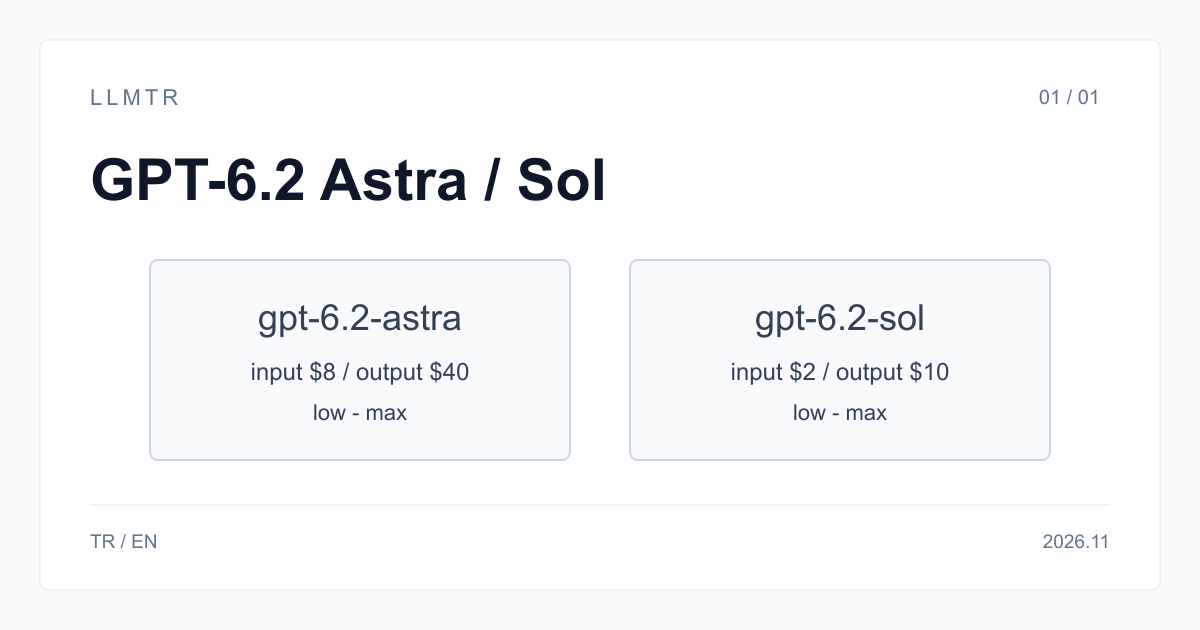
Short answer: what are GPT-6.2 Astra and GPT-6.2 Sol?
OpenAI released the GPT-6.2 series on 17 November 2026. GPT-6.2 Astra is positioned for complex reasoning: working a research question across several sources and checking its conclusions against the data, or tracing a bug across services and fixing it. GPT-6.2 Sol is for everyday coding, writing, and work that takes several steps: reviewing a pull request, revising code after review, or turning meeting notes into a project brief.
On LLMTR the two models are called as openai/gpt-6.2-astra and openai/gpt-6.2-sol with your existing LLMTR API key; no separate OpenAI account is needed. Both have a 1,050,000-token context window and a 128,000-token output ceiling. They accept text, image and PDF input; audio and video input are not supported. Function calling, parallel tool calls, structured output with strict json_schema, and streaming are supported.
Pricing: how they compare with GPT-6 Astra and GPT-6.1 Sol
Every line of GPT-6.2 Astra's price table is below GPT-6 Astra's. The gap is widest on cache reads: on GPT-6 Astra a cache read bills at one tenth of the input price, on GPT-6.2 Astra at one twentieth.
GPT-6.2 Sol's four price lines are the same as GPT-6.1 Sol's. The choice between the two Sol models comes down to the work itself, not the price.
| Field | GPT-6.2 Astra | GPT-6 Astra | GPT-6.2 Sol | GPT-6.1 Sol |
|---|---|---|---|---|
| Input | $8.00 | $10.00 | $2.00 | $2.00 |
| Cache read | $0.40 | $1.00 | $0.10 | $0.10 |
| Cache write | $10.00 | $12.50 | $2.50 | $2.50 |
| Output | $40.00 | $50.00 | $10.00 | $10.00 |
| Reasoning levels | low, medium, high, xhigh, max | low, medium, high, xhigh, max | low, medium, high, xhigh, max | low, medium, high, xhigh, max |
| Context | 1,050,000 tokens | 1,050,000 tokens | 1,050,000 tokens | 1,050,000 tokens |
Cost calculation: the first two turns of an agent loop
On the GPT-6 family a cache write bills at 1.25x the input price. OpenAI writes the prompt to the cache up to the end of the last message; the next turn starts with the previous prompt, so that part is read from the cache and only what was added is written. These tokens are a subset of input tokens; the same token is never counted twice.
As an example, take an agent loop: on the first turn the prompt is 50,000 tokens (system instructions, tool definitions and the first message) and the response produces 2,000 output tokens. On GPT-6.2 Astra the first turn costs about (50,000 × 10.00 + 2,000 × 40.00) / 1,000,000 = $0.58. The second turn starts with the same 50,000 tokens and adds 5,000 made of the previous answer and a new message; 50,000 tokens are read from the cache, 5,000 are written, and the turn costs $0.15. The same two turns cost $0.725 and $0.2125 on GPT-6 Astra. On GPT-6.2 Sol the first turn costs $0.145 and the second $0.0375; the same holds on GPT-6.1 Sol.
On requests whose input exceeds 272,000 tokens, the whole request bills at the long-context rates: input and cache rates double, and the output rate rises to 1.5x. Reasoning tokens bill at the output price. No margin is added to model prices.
Reasoning: five levels, no none or minimal
Both models accept the low, medium, high, xhigh and max levels; when no level is sent, they run at medium. The none and minimal levels are not accepted, and the request returns a 400 error with no charge. If you are moving an integration that uses none or minimal today, use low.
For work that needs reasoning switched off entirely, GPT-6 Sol or GPT-6 Luna, which accept the none level, can be used. Appending :max to the model ID selects the real max level; higher levels spend more reasoning tokens.
Changing the level between turns: configuration_update
To change the reasoning level or the output format partway through a multi-turn conversation, do not change the request-level setting. Append a configuration_update item to the input array before the next user message; the change applies from that response on, until another item changes it. Keeping the request-level setting fixed keeps the earlier input readable from the cache.
LLMTR forwards this item as it is on Responses requests. The level in the item must also be one of the five levels; an item asking for none returns 400, and the error message names the item. When you do not send max_output_tokens, the default output limit follows whichever is higher, the request-level level or the level in the last item. The item can also change the format of the next answer with text.format.
A GPT-6.2 Sol request for POST /v1/responses that raises the level on the second turn
{
  "model": "openai/gpt-6.2-sol",
  "reasoning": {
    "effort": "low"
  },
  "input": [
    {
      "role": "user",
      "content": "Summarise this module briefly."
    },
    {
      "role": "assistant",
      "content": [
        {
          "type": "output_text",
          "text": "The module manages sessions."
        }
      ]
    },
    {
      "type": "configuration_update",
      "reasoning": {
        "effort": "high"
      }
    },
    {
      "role": "user",
      "content": "Now find the race conditions in this module."
    }
  ]
}
Cache lifetime, sampling and service tier
LLMTR offers only the default 30-minute cache lifetime on these models. A request whose prompt_cache_options ttl is 12h returns a 400 error with no charge; leave the field out or use 30m. temperature and top_p are not supported on these models; instead of rejecting a request that contains them, LLMTR removes the fields and reports them in the response's llmtr_dropped_parameters field.
Requests run on the standard tier and are billed at the standard rate. The service_tier field is removed from the request, and a value that asks for a non-standard tier is reported in the same field; the Fast, Flex and Ultrafast tiers are not offered on LLMTR. For long generations, use stream: true.
Which model to pick, and when
Start with GPT-6.2 Astra for research that compares several sources, bugs that have to be traced across services, and long, hard agent work. For everyday work such as pull request reviews, revising code after feedback, and summarising documents and notes, GPT-6.2 Sol is enough; run the same task on both models and compare accuracy and total cost.
GPT-6 Astra and GPT-6.1 Sol remain available on LLMTR. Changing the model ID is all a move takes; the reasoning levels, context and input types are the same.
Frequently asked questions
How much do the GPT-6.2 Astra and GPT-6.2 Sol APIs cost?
GPT-6.2 Astra: input $8.00, cache read $0.40, cache write $10.00, output $40.00; on requests whose input exceeds 272,000 tokens, $16.00, $0.80, $20.00 and $60.00. GPT-6.2 Sol: input $2.00, cache read $0.10, cache write $2.50, output $10.00; above 272,000 tokens, $4.00, $0.20, $5.00 and $15.00. Prices are per 1M tokens.
Can I turn reasoning off on GPT-6.2?
No. The lowest level is low; the none and minimal levels and enabled: false in the reasoning field return 400.
Does configuration_update work on LLMTR?
Yes. A configuration_update item added to the input array of a /v1/responses request is forwarded to OpenAI as it is and changes the reasoning level or output format of the next answer. The level in the item must be one of the five levels.