Trust and compliance · 2026-09-29
Leyla: the first Turkey-hosted System One decision model
Leyla is a Turkey-hosted decision model that turns text into yes/no, choice and score decisions. Data residency, pricing, limits and a comparison with Jev and Solar Decide.
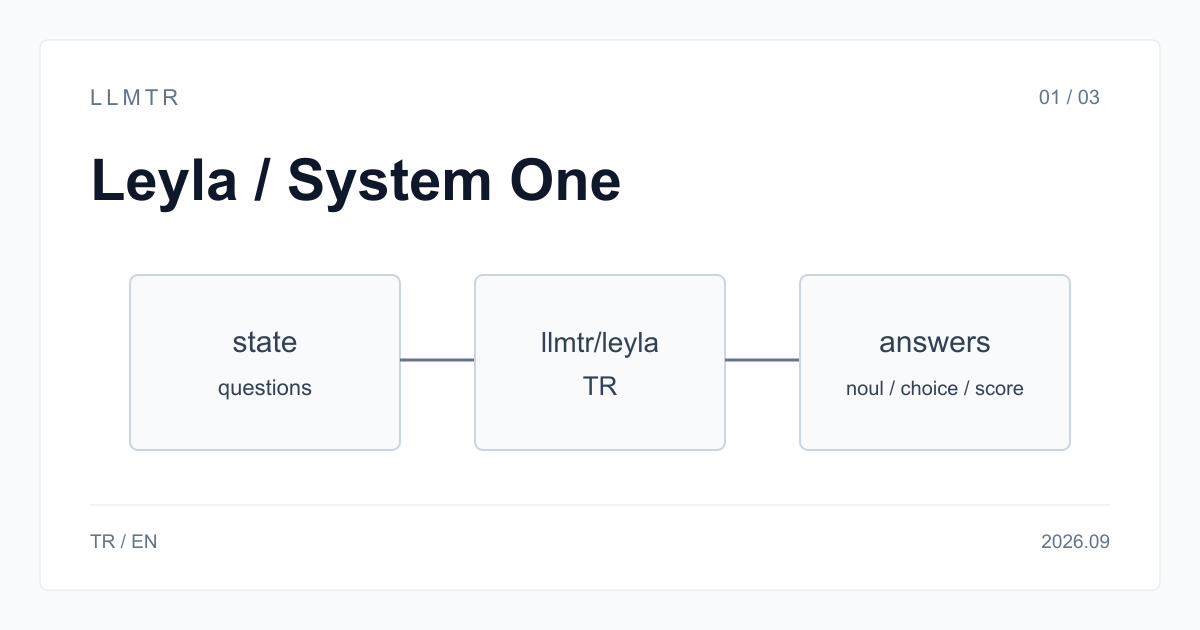
Short answer: what is Leyla?
Leyla is the first Turkey-hosted System One model in the LLMTR catalog. System One models do not generate free text; they evaluate the questions you define against the text you send and return one decision per question: a yes probability, a choice among options, or a position on an ordered scale. The content of a request sent to Leyla does not leave Turkey.
The catalog has three IDs. llmtr/leyla works in more than 100 languages, Turkish included, with a 1,024-token context. llmtr/leyla-english is for English text only and runs with a 512-token context. llmtr/leyla-typed-decisions makes English decisions over invoices, security incidents, customer service records and agent traces with a 1,024-token context. All three are called on the same endpoint, POST /v1/systemone.
How it differs from a chat model: nothing to parse
When you ask a chat model to classify something, it writes text and you turn that text back into your own types. That step breaks when the model changes the format, adds an explanation or cuts the JSON short. System One models have no such step: the answer comes back under the question keys you sent, and every answer carries its own type.
Each decision arrives with a probability distribution, so the threshold lives in your code: above it you apply the decision automatically, below it you hand the case to a person. The body below asks a refund question and a team choice for a Turkish support ticket in one request. The yes/no instruction is in English and the option descriptions are in Turkish; with Turkish text, that is the phrasing that works best on Leyla.
A Turkish support ticket for POST /v1/systemone
{
  "model": "llmtr/leyla",
  "state": "Merhaba, mart faturam iki kez tahsil edildi. Bugün iade istiyorum.",
  "questions": {
    "refund_request": {
      "type": "noul",
      "instructions": "Does the customer ask for a refund?"
    },
    "team": {
      "type": "choice",
      "instructions": "Which team should handle this ticket?",
      "criteria": {
        "billing": "fatura, ödeme, iade",
        "technical": "hata, kesinti, giriş sorunu",
        "sales": "fiyat, paket, teklif"
      }
    }
  }
}
Data stays in Turkey: what changes for KVKK
Support tickets, e-mails and application forms often carry personal data. Sending that text to a model abroad raises the question of transferring personal data out of the country, which then has to be handled in contracts and privacy notices. A request to Leyla is processed in Turkey both at LLMTR and where the model runs, so that question does not arise for this call.
This does not replace your other obligations under KVKK, the Turkish data protection law. Legal basis, notice and retention remain part of your own system. What Leyla provides is narrower and verifiable: the content you send for a decision does not leave the country. The Turkey badge on model cards and the Turkey filter on the models page show the same information.
Jev, Solar Decide and Leyla compared
LLMTR serves three model families on the System One endpoint. The protocol is the same, so you can move an integration between families by changing the model ID. They differ in hosting location, context length, price and the number of questions per request.
| Model | Hosting | Context | Input price | Questions per request |
|---|---|---|---|---|
| llmtr/leyla | Turkey | 1,024 tokens | $0.03 / 1M tokens | 64 |
| llmtr/leyla-english | Turkey | 512 tokens | $0.03 / 1M tokens | 64 |
| llmtr/leyla-typed-decisions | Turkey | 1,024 tokens | $0.03 / 1M tokens | 64 |
| typesafe/jev | Outside Turkey | 32,000 tokens | $0.042 / 1M tokens | 1,000 |
| upstage/solar-decide | Outside Turkey | 524,288 tokens | $0.10 / 1M tokens | 1,000 |
Pricing and limits
Leyla bills input tokens only: $0.03 per 1M tokens. Output is free. Leyla counts the text once per question: two questions about a 200-token ticket come to about 400 input tokens. Two questions on each of ten thousand tickets averaging 200 tokens come to 4 million tokens, about $0.12, so send only the questions you will use. No platform margin is added to the model price.
A single request can ask up to 64 questions. The text may be up to 50,000 characters, but the model works with a 1,024-token context on llmtr/leyla and llmtr/leyla-typed-decisions and 512 tokens on llmtr/leyla-english. The part past the context is cut without an error, so send only the part of a long thread that the decision needs. A choice question accepts up to 100 options; if you write descriptions for them, keep it to 20. A request over a limit returns 413, an invalid question definition returns 422, and the error message names the field at fault. The endpoint does not stream.
When Leyla is the wrong choice
If the decision needs a long document, such as classifying risk across a whole contract, Leyla's context is not enough. upstage/solar-decide with 524,288 tokens or typesafe/jev with 32,000 tokens fits that work better; both are hosted outside Turkey.
If you want the reasoning as text, or a summary or reply draft, System One is not the right tool; use a chat model. The two combine well: classify and route the ticket with Leyla first, and send only the tickets that need a written reply to a chat model.
Frequently asked questions
Does Leyla understand Turkish text?
Yes. llmtr/leyla works in more than 100 languages, Turkish included. Write yes/no instructions in English and keep choice option descriptions short and in Turkish. llmtr/leyla-english and llmtr/leyla-typed-decisions are for English text only.
Can I move my Jev integration to Leyla?
Yes. The request and response format is the same; change the model field from typesafe/jev to llmtr/leyla. If you ask more than 64 questions per request, split them, and check that the text fits in the 1,024-token context. Jev counts the text once and Leyla once per question, so size the cost of many-question requests accordingly.
How much does Leyla cost?
Input is $0.03 per 1M tokens and output is free. All three Leyla IDs share that price. The charge is computed from the input token count reported in the response's usage field.
Related posts
- Turkish support ticket classification API: automatic routing with Leyla
- Choosing a text classification model: Leyla, Leyla English and Leyla Typed Decisions
- What is Jev? TypeSafe's choice-based decision model for browser agents
- KVKK and LLM APIs: prompts, logging, and data residency
- Turkey-hosted LLM models: what sits beside EVREN in the catalog