Integration guides · 2026-10-06
Can Ling Tiny run on a Mac? Ollama and MLX support status
Separate Ling Tiny’s Mac, Ollama and MLX support: official weights, the experimental branch, MLX-LM architecture mapping and a local compatibility checklist.
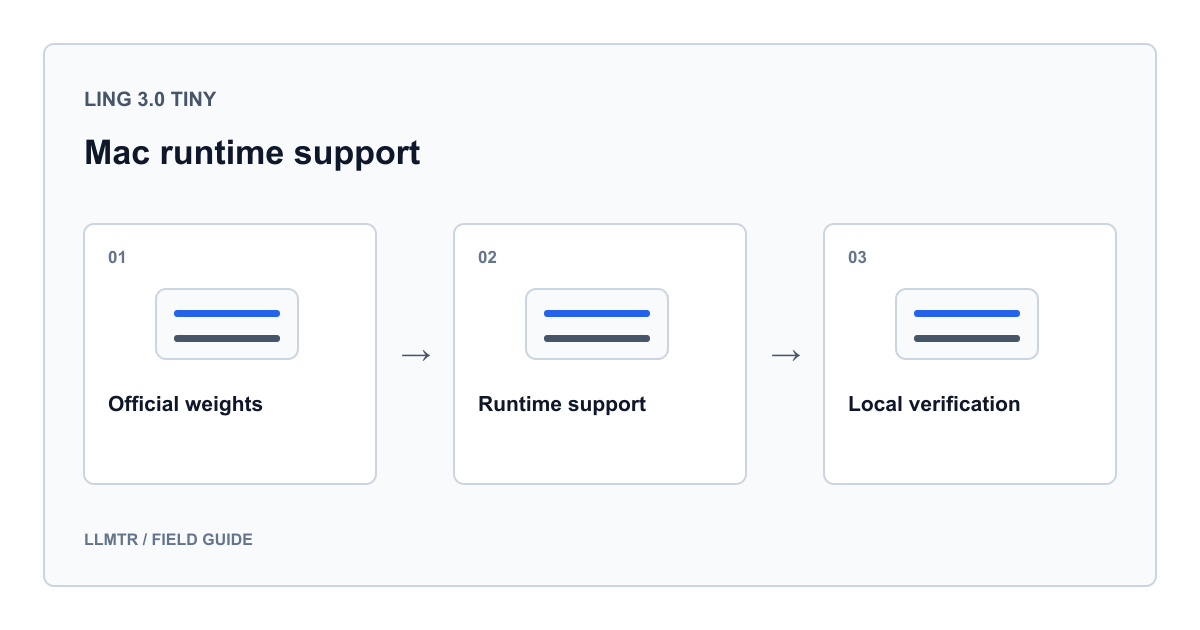
Short answer: an experimental Mac path exists
Ling Tiny’s official model card documents an experimental path on Apple Silicon. That does not establish support in a standard Ollama installation. On 28 August 2026, Ollama PR17643 was closed without merging, while MLX-LM’s main branch contained Tiny’s architecture implementation and mapping. Support in a stable package and results on your device require separate verification.
If your Mac uses Intel, do not directly apply the Apple Silicon recipe. Match the processor family, macOS version and runtime’s target platform first. This article is not a hardware test or a guarantee of successful installation.
Downloading weights and running a model are different tasks
inclusionAI publishes Tiny’s BF16, FP8 and INT4 weights under the MIT license. Availability does not establish that every application can read the architecture and quantization format. Choosing smaller files cannot supply missing architecture support. Evaluate the weight format and runtime version together before deciding to download.
| Finding | Establishes | Does not establish |
|---|---|---|
| Official BF16 / FP8 / INT4 repositories | Published weights | Loading support in every Mac application |
| Model card’s Ollama recipe | An experimental source build path | Support in a released Ollama application |
| Architecture code on MLX-LM main | A Tiny implementation and mapping | The same code in your installed package |
| A bounded test on your device | Results for the version and task tested | Identical results at every context length |
Why Ollama PR17643 matters
The official model card’s Ollama section requires building the PR17643 branch and using the resulting local executable. It reports verification on an M4 Pro with 48 GB of unified memory. This is the provider’s example machine, not a minimum memory requirement.
An Ollama maintainer closed the PR on 25 August 2026, requesting smaller changes for review; it was not merged. Presenting the experimental recipe as a stable release feature would therefore be misleading. A name assigned during local model creation is not an official library tag. Do not turn it into a ready-made Ollama download command.
MLX-LM has architecture code; check the package separately
An experimental Ollama branch using MLX and the Python package MLX-LM are different software. MLX-LM’s main branch contains bailing_moe_v3.py. Its loader selects that implementation for the combination of model type bailing_hybrid and architecture BailingMoeV3ForCausalLM. Tiny’s official config.json contains this pair.
That establishes architecture recognition on main. The reviewed release notes did not establish which stable package ships this support. Having MLX installed, or successfully running another Ling model, is insufficient. Check your installed MLX-LM version, implementation file, weight format and chat template separately.
Inspect local compatibility without downloading
If weights are already on your computer, set LING_MODEL_DIR to their absolute directory path. The Python example below reads only local config.json and installed package information. It does not download weights, load the model or start inference. A missing package is reported without installing it.
Finding the file does not prove successful execution. Use the output to compare your installation with release notes; inspect architecture mapping, quantization loading and chat template compatibility separately. This example was not executed on a Mac here.
Read local configuration and package metadata only
import json
import os
import platform
from importlib.metadata import PackageNotFoundError, distribution
from pathlib import Path

model_dir = Path(os.environ["LING_MODEL_DIR"]).expanduser()
config = json.loads(
    (model_dir / "config.json").read_text(encoding="utf-8")
)
print("machine:", platform.machine())
print("model_type:", config.get("model_type"))
print("architectures:", config.get("architectures", []))

try:
    package = distribution("mlx-lm")
except PackageNotFoundError:
    print("mlx-lm: not installed")
else:
    implementation = Path(
        package.locate_file("mlx_lm/models/bailing_moe_v3.py")
    )
    print("mlx-lm version:", package.version)
    print("architecture file exists:", implementation.is_file())
Decide whether to proceed
Suppose you are assessing existing BF16 files on an M2 Mac with 16 GB of memory. This is an illustrative assessment, not a measurement: only the processor family and file availability are known. Do not conclude that it works before checking runtime support and available memory. Active parameter count is not a total runtime memory requirement.
- Record model revision, weight format, runtime version and source commit where applicable.
- Start with a short task containing no sensitive information and a small output budget.
- Treat loading, the first response and a second conversation turn as separate success conditions.
- If memory pressure, swapping or process termination occurs, investigate before increasing context.
- Check the thinking setting and clean response termination; do not append LLMTR model suffixes to local identifiers.
LLMTR retirement does not remove local weights
LLMTR’s inclusionai/ling-3.0-tiny API route has been retired since 15 August 2026. That does not mean inclusionAI’s published weights have disappeared. LLMTR’s official API successor is the paid inclusionai/ling-3.0-flash model. Decide about local inference separately from API access: one depends on your hardware and software compatibility, the other on the chosen service’s access and pricing conditions.
Ollama: "this model requires mlx support, but the mlx runtime is not available"
This message means the standard Ollama installation has no ready MLX support for Ling Tiny. The official model card describes an experimental build of PR17643 on Apple Silicon; PR17643 was closed without merging on 28 August 2026, so this is not stable package support.
Frequently asked questions
Is there a ready-made Ollama download tag for Ling Tiny?
The reviewed official sources do not establish a ready-made library tag. The model card describes building an experimental branch and importing local weights. Do not treat a locally assigned name as an official download tag.
Does a closed PR make running it on a Mac impossible?
No. Closed without merging means the proposed code was not integrated through that PR. It does not erase the documented experimental path or independent MLX-LM development.
Will downloading INT4 definitely solve memory problems?
No. Format support, intermediate runtime data, context and other applications matter too. A smaller weights file is not a verified memory requirement for a particular Mac.
Related posts
- Ling Tiny alternatives: free Flash Fin versus paid Flash
- Ling 3.0 Tiny: migrating the retired LLMTR API route to Flash
- Ling-3.0-Tiny download guide: choosing BF16, FP8 or INT4
- Running Ling 3.0 Flash locally: the Ollama and MLX story differs from Tiny
- 400 Bad Request: embeddinggemma Does Not Support Chat