Trust and compliance · 2026-09-08
Why the Sub-Processor Clause Decides an LLM API Contract
Understand why the sub-processor list, the notification duty and the objection right are the most consequential clauses in an LLM API data processing agreement, and what to look for in practice.
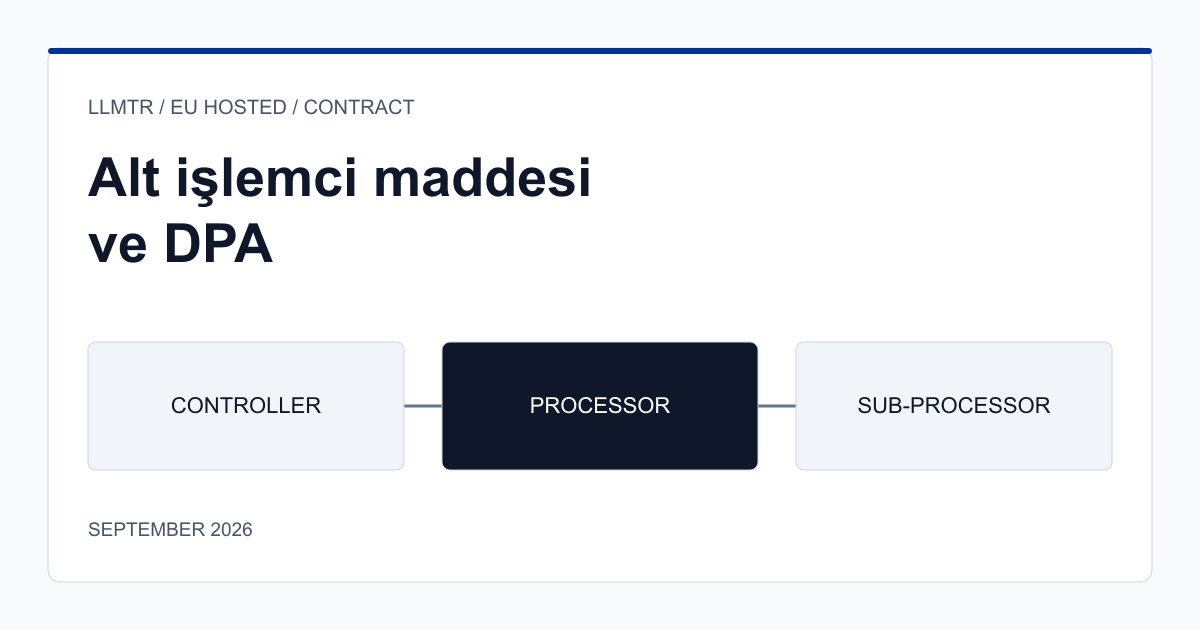
Why the sub-processor list is the first place to look
Most clauses in a data processing agreement are standard and vary little between providers. The sub-processor clause is different: it exposes the provider's real architecture — whose servers it runs on, which third parties receive data, and how much of the chain it will commit to.
That makes the list a technical document as much as a legal annex. Comparing the names on it against what the provider's own API reports is the fastest way to find where the statement and the architecture have come apart.
In proxy architectures the question multiplies
Some platforms run no hardware of their own; they sit in front of several providers and route each request to a suitable one. That architecture helps on price and model variety, but it lengthens the chain on the data-protection side.
The EU category in our catalog comes from a provider of exactly this type, and we do not hide it: the models run in partner data centres rather than on the provider's own hardware. Its pricing endpoint names five sub-processors while its published location list shows two; we have asked in writing about the remaining two.
Four clauses to look for
For a sub-processor clause to be useful it needs more than a list. How the list is updated, when you are told, and what happens when you object all have to be written down.
Without those clauses, the picture you verified today goes quietly invalid the day the provider swaps a link, and you do not find out.
- A current, dated sub-processor list, ideally on a machine-readable surface.
- Advance notice of changes, with a reasonable notice period.
- A right to object, and the ability to terminate if you do.
- A commitment that sub-processors are bound by equivalent obligations.
What the engineering team contributes
While legal assesses the clauses, engineering can compare the list against reality. If the provider's API reports a sub-processor name, is that name on the published list? If not, that is a concrete question to ask, and an open item while you wait for the answer.
This is not a one-off comparison. When a provider adds a model, the sub-processor behind it may have changed too; every new row entering the catalog earns the check again.
Frequently asked questions
Should the sub-processor list be an annex to the contract?
Preferably yes, or held on a dated page the contract refers to. A list that lives only on a marketing page and can be changed silently is not a source you can build an assessment on.
If the provider is a proxy, is the residency claim void?
No, but the claim is no longer about a single party. You have to ask separately where each link in the chain sits and which obligations bind it.
What should I do if I see a sub-processor name that is not on the list?
Ask in writing and record the answer. It is not by itself evidence of a breach; it shows the published document is incomplete and that your assessment has a gap at that point.