Integration guides · 2026-09-22
Combining reasoning toggle and tool calling on LLMTR Qwen 3.5 4B
Covers how toggling thinking mode on the first-party LLMTR Qwen 3.5 4B model affects tool-calling decisions, and how to build a task flow that uses both together.
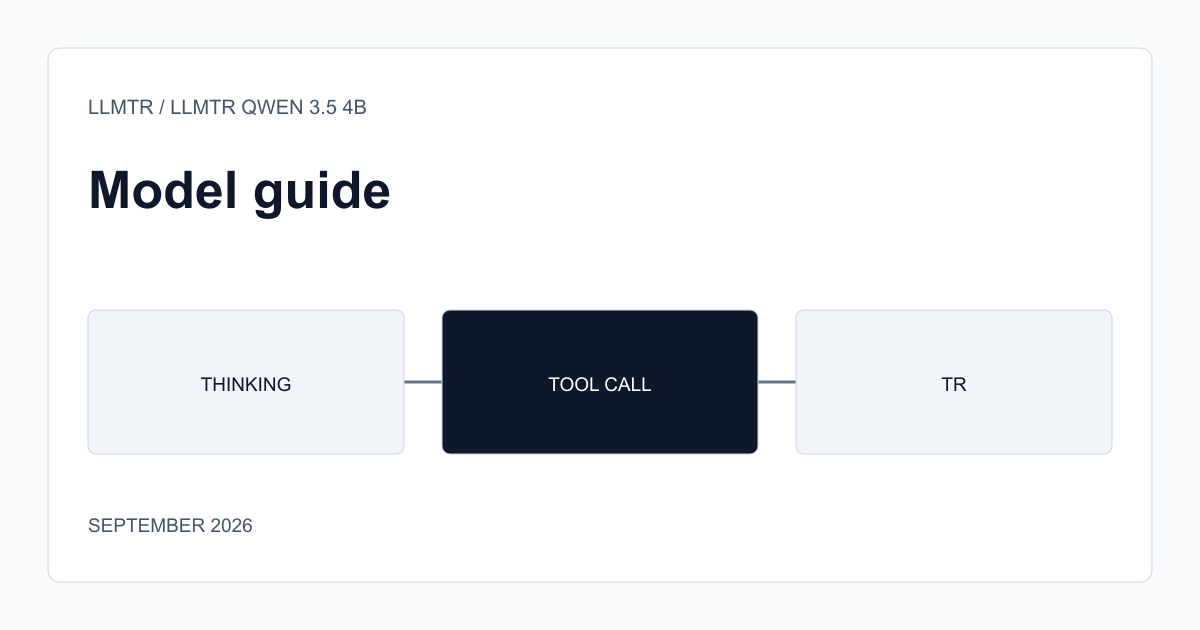
Two capabilities on the same model, separate control points
LLMTR Qwen 3.5 4B is a first-party model called through an OpenAI-compatible Chat Completions interface, carrying tool calling together with a thinking mode that can be toggled on or off. Thinking is on by default; the two capabilities work independently, meaning turning thinking off does not affect tool-calling support.
This combination is valuable in scenarios where a task both needs a multi-step plan and needs to reach external data or a function at one step of that plan: the model first decides which tool to call and when through a thinking step, then calls the tool.
When to keep thinking on, when to turn it off
On a simple task where you want to call one tool directly and return its result as-is (running a database query and formatting the result, for example), turning thinking off lets the model go straight to the tool call without running an unnecessary intermediate step; this reduces latency on simple tasks.
On a task that needs to decide the order in which multiple tools get called, or determine the next step based on a tool's result, keeping thinking on helps the model make that decision more consistently.
- Single-step, direct tool call: turning thinking off reduces latency.
- Multi-step tool use needing sequential decisions: keeping thinking on increases consistency.
- Thinking state doesn't affect tool-calling support; the two work independently.
It accepts text input only
LLMTR Qwen 3.5 4B does not accept image, audio, or video input; it processes text only. If a tool call's result contains an image or audio, you need to convert that content to text and summarize it before giving it to the model, rather than sending it directly.
Frequently asked questions
Does turning thinking off also turn off tool-calling support?
No, the two capabilities are independent. The model can still call tools with thinking off; the difference is whether it evaluates intermediate steps before deciding on a tool call.
Can this model process a tool result that contains an image?
No, the model accepts text input only. You need to convert a tool result containing an image or audio to text before giving it to the model.