Integration guides · 2026-08-28
Meta Muse Spark 1.2 Contributor 429 errors: bounded retries
Separate LLMTR 429 errors from provider unavailability when calling Muse Spark Contributor, using Retry-After, an elapsed-time budget and bounded Python retries.
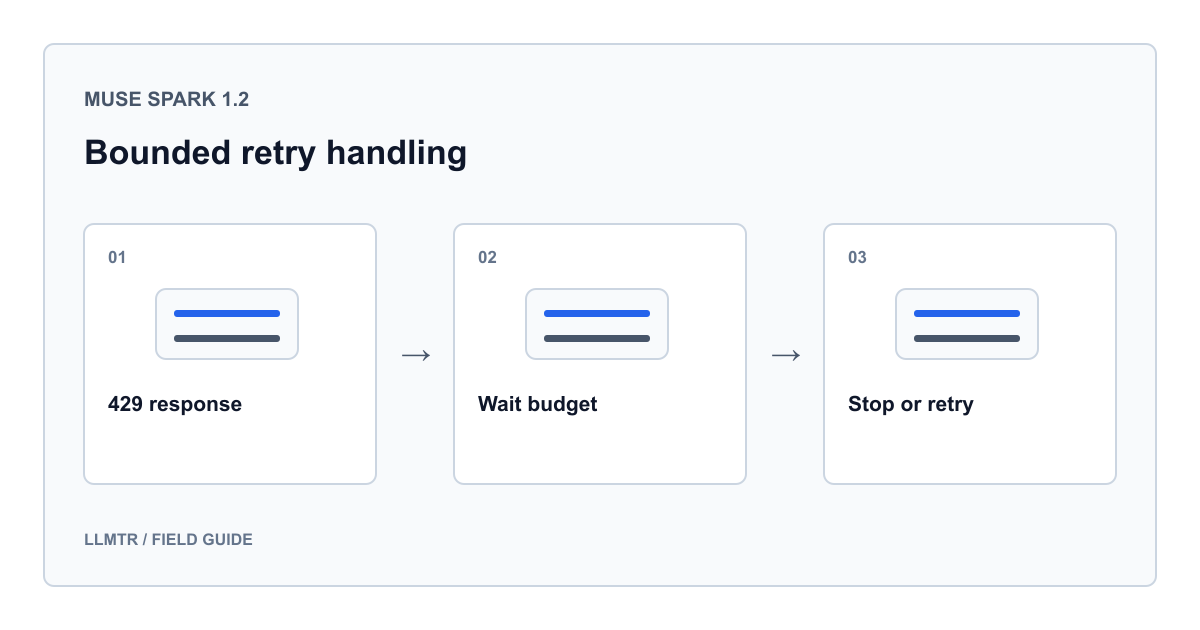
429 and 503 are different diagnoses
When a Meta Muse Spark 1.2 Contributor call fails, do not look only for 429: read the HTTP status and error.type together. In the LLMTR behavior inspected on August 28, 2026, an upstream provider 429 is presented to the client as 503 model_unavailable. LLMTR’s own request rate limit can instead return 429 rate_limit_error.
A 503 does not prove that you sent too many requests; it can cover other availability problems. Waiting and making a limited number of attempts is reasonable, but do not interpret every 503 as proof of an exhausted Meta quota. Tell the user that the attempt was deferred instead of assigning an unsupported rate-limit diagnosis.
Set the data boundary first
Under the Contributor tier, prompts and completions may be used for Meta’s model training. Do not submit confidential, personal or customer data. The example below uses a prompt about imaginary tasks; do not add actual support records, private repository files or access keys to the test input.
LLMTR’s model card describes this tier’s capacity as shared, so do not run heavy load tests. Meta’s model and pricing/rate-limit pages required login during the August 28, 2026 check. Current RPM, token throughput and daily allowance figures are therefore not treated as verified here.
Let the error body guide the decision
The Contributor name does not imply a free daily allowance. Do not automatically apply free-model quota signals to this model. If your shared client also calls other models, inspect error.details.reason: the same HTTP status can have different causes.
| Response | Meaning | Action |
|---|---|---|
| 429 / rate_limit_error | May be LLMTR’s request rate limit. | Reduce concurrency; wait within a fixed budget. |
| 429 / rate_limit_error + details.reason: free_quota_exhausted | A free-model quota signal, not proof of a Contributor allowance. | Stop rapid retries; wait for the indicated reset. |
| 503 / model_unavailable | May cover provider throttling or another availability problem. | Make few attempts; defer persistent failures. |
| 400, 401 or 403 | May indicate request, authentication or access problems. | Fix the request or account before repeating it. |
Give one retry loop two stopping limits
The example uses Python 3.11 or later and the openai package. Set LLMTR_BASE_URL to LLMTR’s complete API base URL and LLMTR_API_KEY to your LLMTR key; these are not direct Meta account credentials. The call targets POST /v1/chat/completions.
Three attempts including the first call, and 45 seconds overall, are application choices for this example, not provider limits or response-time promises. Setting max_retries=0 disables the SDK’s default automatic retries. Retry-After is read as seconds or an HTTP date. If its delay exceeds the remaining budget, the error is returned instead of retrying early.
Python example with explicit limits; no live API run was performed
import asyncio
import os
import random
from datetime import datetime, timezone
from email.utils import parsedate_to_datetime
from openai import AsyncOpenAI, APIStatusError

MAX_ATTEMPTS = 3
MAX_ELAPSED = 45.0

def retry_after_seconds(value):
    if not value:
        return 0.0
    value = value.strip()
    try:
        if value.isascii() and value.isdigit():
            return int(value)
        when = parsedate_to_datetime(value)
        return max(0.0, (when - datetime.now(timezone.utc)).total_seconds())
    except (ValueError, TypeError, OverflowError):
        return 0.0

async def main():
    async with AsyncOpenAI(
        api_key=os.environ["LLMTR_API_KEY"],
        base_url=os.environ["LLMTR_BASE_URL"],
        max_retries=0,
        timeout=15.0,
    ) as client:
        loop = asyncio.get_running_loop()
        deadline = loop.time() + MAX_ELAPSED
        async with asyncio.timeout_at(deadline):
            for attempt in range(1, MAX_ATTEMPTS + 1):
                try:
                    return await client.chat.completions.create(
                        model="meta/muse-spark-1.2-contributor",
                        messages=[{
                            "role": "user",
                            "content": "Explain a queue using imaginary tasks.",
                        }],
                        reasoning_effort="minimal",
                        max_tokens=1024,
                        stream=False,
                    )
                except APIStatusError as exc:
                    try:
                        payload = exc.response.json()
                    except ValueError:
                        payload = {}
                    error = payload.get("error", {}) if isinstance(payload, dict) else {}
                    if not isinstance(error, dict):
                        raise
                    details = error.get("details", {})
                    quota = isinstance(details, dict) and details.get("reason") == "free_quota_exhausted"
                    retryable = (
                        (exc.status_code == 429 and error.get("type") == "rate_limit_error")
                        or (exc.status_code == 503 and error.get("type") == "model_unavailable")
                    )
                    if quota or not retryable or attempt == MAX_ATTEMPTS:
                        raise
                    hint = retry_after_seconds(exc.response.headers.get("Retry-After"))
                    backoff = min(8.0, 2.0 ** attempt)
                    delay = max(backoff, hint) + random.uniform(0.0, 0.5)
                    if delay >= deadline - loop.time():
                        raise
                    await asyncio.sleep(delay)

if __name__ == "__main__":
    result = asyncio.run(main())
Bound the queue as well
Retries must pass through the same concurrency controls as new user jobs. Starting another worker for every failure increases total traffic even when each worker waits. Use a small worker pool, a bounded queue and a job expiry time; do not carry obsolete work indefinitely in a retry queue.
Random additional waiting reduces the chance that clients which failed together return together; it does not create capacity. Temporarily reduce admission of new jobs during repeated 503 responses. Do not build a switch to another paid model without the user’s approval of its cost and data policy.
What should you record when stopping?
Useful diagnostics include time, model identifier, HTTP status, error type, attempt count, total waiting time and a request identifier when available. Do not log prompts, model responses, the Authorization header or the entire error body. Include only safe metadata in a support request about a persistent failure.
The example does not automatically retry connection failures or timeouts: whether the request was processed may be unknown. Ending the client’s wait does not guarantee cancellation at the provider. Content validation for a successful 200 response also belongs outside the retry policy.
Frequently asked questions
Can I retry immediately if Retry-After is missing?
No. A missing header does not mean capacity is available. The example uses increasing waits with a random addition and stops at three attempts or the overall time budget.
Should I top up my LLMTR balance after a 503?
503 model_unavailable alone does not establish insufficient balance. Read the error type and keep your balance separate from provider availability. Ask support if the same error persists after bounded attempts.
What if SDK retries remain enabled?
Each step of your application loop can trigger another retry sequence inside the SDK, creating more network requests than intended. Keep the policy in one layer and disable SDK retries as shown.