Model comparison · 2026-10-10
Mistral Large 4 or Large 3? Context, reasoning and price
mistral/mistral-large-4 compared with mistral/mistral-large-latest (Large 3): context, reasoning levels, dated pricing and the cost of the same request.
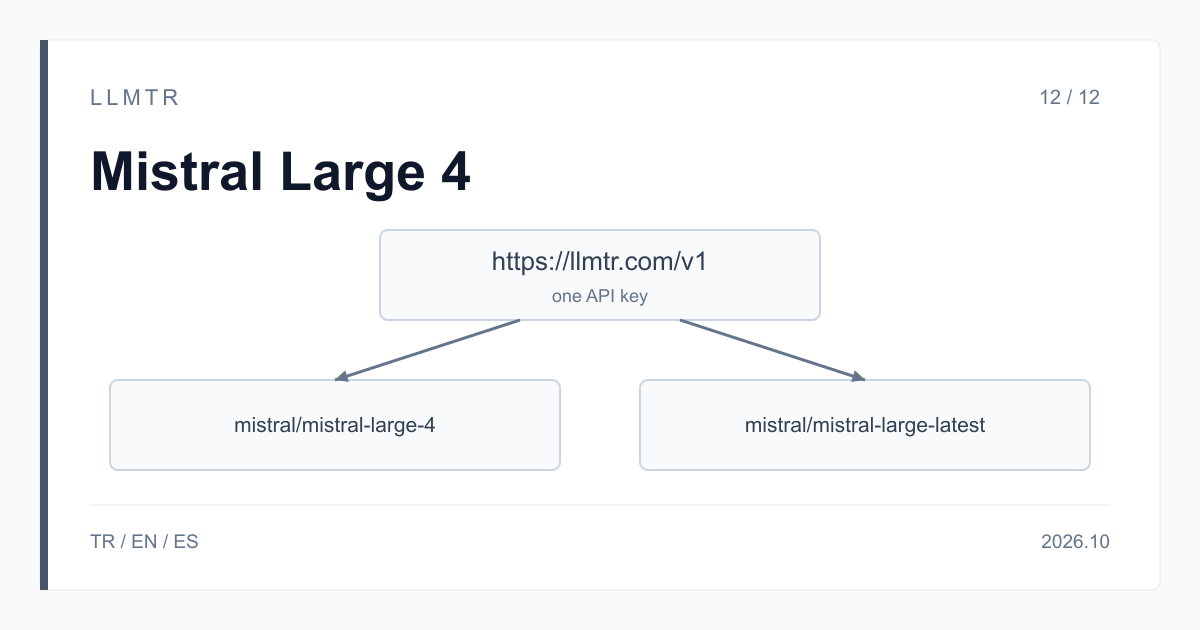
Short answer: both are on the same API, and you switch with the model id
LLMTR (llmtr.com) is a gateway that gives access to language models hosted in Türkiye and at global providers through one OpenAI-compatible API. Mistral Large 4 is offered there as mistral/mistral-large-4 and Mistral Large 3 as mistral/mistral-large-latest; both are called on the /v1/chat/completions endpoint at https://llmtr.com/v1 with the same API key. Moving from one to the other means changing the model string.
The differences sit in three places. Large 4 offers a 524,288-token context and Large 3 a 256,000-token one. Large 4 reasons by default before answering, and reasoning_effort selects none or high; the Large 3 row has no reasoning_effort levels. On price, Large 4 has two dated cards and Large 3 a single price. The LLMTR catalog names Large 4 as the family's newer large model.
Mistral Large 4 or Mistral Large 3: which one should you use?
If you work with documents, codebases or conversation histories longer than 256,000 tokens, the context window decides: a prompt that does not fit Large 3 can fit Large 4. For multi-step analysis, planning and tool-using agent work, Large 4's reasoning levels give you a dial: high on hard turns, none on simple ones.
For short-answer, high-volume work, try both models on your own samples and look at the token counts. The tokens Large 4 produces while reasoning are billed as output; with none the output is the answer alone. The table shows the values in the LLMTR catalog.
| Property | mistral/mistral-large-4 | mistral/mistral-large-latest |
|---|---|---|
| Model | Mistral Large 4 | Mistral Large 3 |
| Context window | 524,288 tokens | 256,000 tokens |
| Input | text, image | text, image |
| Tool calling | yes; no tool_choice required | yes |
| reasoning_effort | none, high (reasoning on by default) | no levels |
| Input / output (per 1M tokens) | $0.68 / $2.09 until 20 October 2026, 00:00 UTC; $1.36 / $4.18 after | $0.50 / $1.50 |
What does the same request cost on each model?
Take a request with 10,000 input tokens and 2,000 output tokens. On Large 3 it costs (10,000 x $0.50 + 2,000 x $1.50) / 1M = $0.00800. On Large 4 the same token counts cost $0.01098 until 20 October 2026, 00:00 UTC (03:00 Turkey time), and $0.02196 from then on.
This assumes both models produce the same number of output tokens. With reasoning on, Large 4's output includes the reasoning as well as the answer, so the real gap depends on the task, and reasoning_effort: "none" narrows it. Input read from cache on Large 4 costs $0.07 until 20 October and $0.14 after. Mistral's changelog entry of 6 October 2026 announced Large 4's launch price as 50% off for two weeks; on LLMTR the card switches automatically.
Differences in reasoning and tool calling
Large 4 reasons by default; the trace arrives in reasoning_content and the answer in content. Only none and high are accepted; minimal, low, medium, xhigh and max return 400. In multi-turn conversations send earlier assistant messages back with reasoning_content; the replayed trace is billed as input. The Large 3 row has no reasoning_effort levels, so send that field to Large 4 only.
Both models take the OpenAI-style tools array for tool calling. On Large 4, auto, none and a named function work for tool_choice; "required" returns 400 invalid_request with tool_choice_required_unsupported in error.details.reason.
The mistral/mistral-large-latest id is pinned to Large 3
Despite the word latest in its name, on LLMTR the mistral/mistral-large-latest id calls Mistral Large 3 and does not move to Large 4 on its own. That way the behaviour and the bill of applications that use this id do not change without notice. To use Large 4, set the model string to mistral/mistral-large-4 explicitly; if your code sends tool_choice: "required", change it to the function name as part of the switch.
Before switching, run both models side by side on the same prompts and compare the token counts. The Python example below sends one prompt to both models, passes reasoning_effort: "none" to Large 4 but not to Large 3, and prints the input and output token counts for each.
Sends the same prompt to mistral/mistral-large-latest and mistral/mistral-large-4 and prints the token usage side by side.
from openai import OpenAI

client = OpenAI(base_url="https://llmtr.com/v1", api_key="llmtr-your_key")

prompt = [{"role": "user", "content": "Summarize the risks in this contract clause in three bullet points."}]

for model, extra in [
    ("mistral/mistral-large-latest", {}),
    ("mistral/mistral-large-4", {"reasoning_effort": "none"}),
]:
    response = client.chat.completions.create(
        model=model,
        messages=prompt,
        max_tokens=1024,
        **extra,
    )
    print(model, response.usage.prompt_tokens, response.usage.completion_tokens)
    print(response.choices[0].message.content)
Trying both models on LLMTR with one key
Create an account at llmtr.com, top up prepaid credit and create a key under Dashboard > API Keys. In your OpenAI-compatible SDK set base_url to https://llmtr.com/v1; the same key works for both models. Each request is deducted from your credit at the catalog price in effect when it is processed and shows up on the usage page by model, so during a trial you see the real cost of the two models side by side.
Move from Mistral Large 3 to Large 4
Try both models side by side with one key, adapt the code and set the model id to mistral/mistral-large-4.
- Side-by-side trial. Send the same prompts to mistral/mistral-large-latest and mistral/mistral-large-4 and compare the token counts.
- Code changes. Replace tool_choice required with the function name and send reasoning_content back.
- Model id. Set the model string to mistral/mistral-large-4 and, where needed, choose none or high with reasoning_effort.
Frequently asked questions
What is the difference between Mistral Large 4 and Large 3?
On LLMTR, Large 4 offers a 524,288-token context and Large 3 256,000. Large 4 reasons by default and accepts the none and high levels. Per 1M tokens, input / output costs $0.68 / $2.09 on Large 4 until 20 October 2026, 00:00 UTC, then $1.36 / $4.18; Large 3 costs $0.50 / $1.50.
Does mistral/mistral-large-latest call Mistral Large 4?
No. On LLMTR, mistral/mistral-large-latest is pinned to Large 3 and does not move to Large 4 on its own. For Large 4, set the model id to mistral/mistral-large-4.
What changes in my code when I move from Large 3 to Large 4?
The model string changes. If you use tool_choice: "required", switch to the function name, and send reasoning_content back in multi-turn conversations.