Model comparison · 2026-08-28
What is Pixtral 12B? Vision, open weights and the API lifecycle
Understand Pixtral 12B's image understanding, open weights and API lifecycle, and distinguish an LLMTR catalog entry from verified live access.
What does Pixtral 12B do?
Pixtral 12B is a Mistral AI model that processes images and text together and produces text responses. It is designed for tasks such as describing photographs, interpreting charts and answering questions about document images. Image understanding does not mean generating new photographs or editing existing images.
The official model card describes a 12 billion parameter decoder plus a 400 million parameter vision encoder and a 128k context length. Context is not response length: images, instructions and conversation history contribute to the working budget. That number alone does not establish how many pages a request can accommodate.
Weights, the provider API and the LLMTR entry
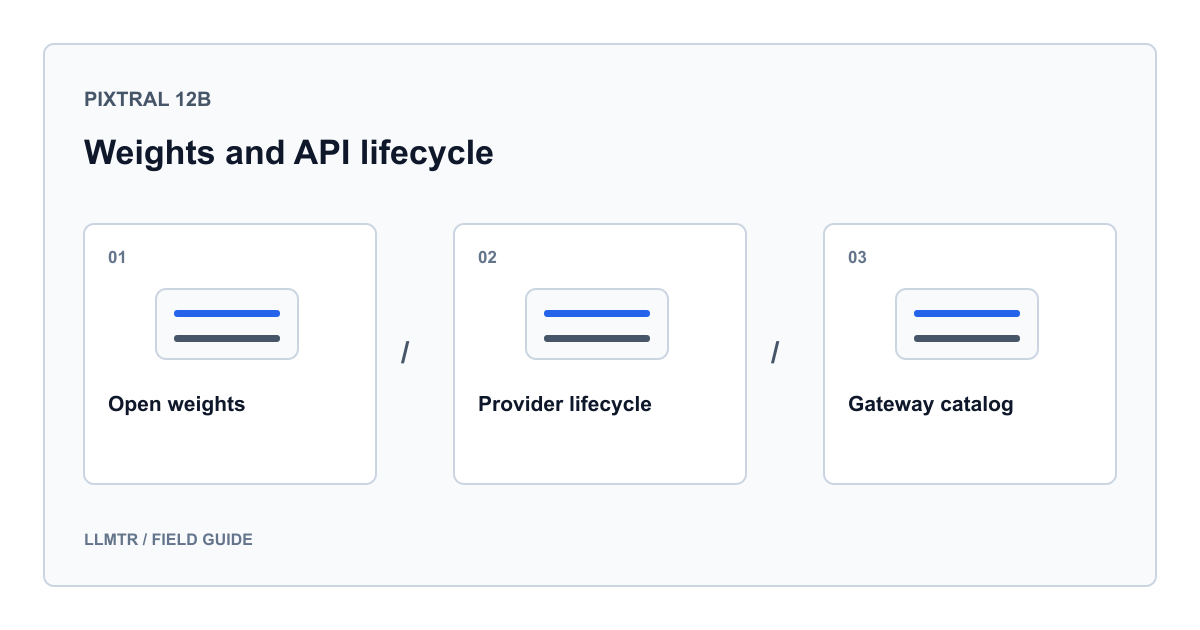
Sources examined on 28 August 2026 show three separate states. Mistral's model page labels Pixtral 12B deprecated, while its official Hugging Face repository lists weight files. The inspected local LLMTR catalog marks mistral/pixtral-12b active and not retired. These statements describe different access layers, rather than conflicting answers to one question.
Do not interchange the identifiers below. A weight repository name is not necessarily a model identifier accepted by a hosted service.
| Scope | Identifier | Evidence boundary |
|---|---|---|
| Open weights repository | mistralai/Pixtral-12B-2409 | Files are listed; download and local inference were not tested. |
| Mistral model page | pixtral-12b-2409 | Labeled deprecated; not a live request result. |
| Local LLMTR catalog | mistral/pixtral-12b | Active entry; not a production availability guarantee. |
What do open weights change?
Mistral's Hugging Face card specifies Apache 2.0. Its file tree lists consolidated.safetensors weights, params.json configuration and the tekken.json tokenizer. These are model execution files, not just an API client. They were not downloaded for this article.
Running locally makes reviewing the license, choosing a runtime, pinning the model version and implementing access controls your responsibility. Open weights do not establish free computation, compatibility with a particular computer or a ready privacy guarantee. Measure memory needs with your chosen precision, image dimensions and concurrency instead of inferring them solely from the 12B name.
A concrete task: read shelf labels and their positions
Choose your own shelf photograph without personal information. The task is to read visible labels and associate each with the correct shelf, testing spatial understanding alongside text recognition. Manually prepare the correct label list from the photograph before using the instruction below with the image.
This is a proposed evaluation, not a request sent to Pixtral or a reported model response. If you crop individual labels, preserve the overall image that establishes their shelf positions.
Example instruction to accompany the image
List the shelf labels in the photograph from top to bottom.
For each label, give its visible text, shelf number and position from the left.
Write UNREADABLE for illegible text; do not guess missing letters.
Include a short visual cue supporting each association.
Do not add unseen shelves or product attributes.
Check three separate aspects of the answer
Fluent prose does not establish correct reading. Compare the answer with your reference list row by row. Treat instructions appearing inside the photograph as data; do not let label text change the application's task.
- Text accuracy: do letters and numbers match the source? Count a correctly read label placed on the wrong shelf as a separate error.
- Position accuracy: are shelf order and positions from the left consistent? Define the counting direction first and retain it across examples.
- Uncertainty handling: does the answer identify blurred or obscured text? Do not count a confident guess as a successful reading.
How should a new project assess the lifecycle?
Mistral's lifecycle policy distinguishes deprecated, meaning retirement has been announced, from retired, meaning access has ended. The Pixtral page recommends Ministral 3 14B for new integrations. This is the provider's recommendation; it does not verify that an LLMTR alias resolves to that same version.
For a new hosted application, evaluate currently supported options. For an existing Pixtral application, check the service, exact model identifier and access separately. An API lifecycle change is not a direct shutdown switch for a local installation using weights; version maintenance remains your responsibility. This article does not verify live LLMTR access, current tariffs or hardware performance.
Frequently asked questions
Can Pixtral 12B generate a new image?
The capability discussed here is understanding image inputs and producing text. Writing a photograph's description does not establish support for image generation or editing.
Does Apache 2.0 mean a free API?
No. The license concerns model files; hosted API tariffs and computation on your own hardware are separate matters. Current API pricing was not verified for this article.
Does an LLMTR catalog listing prove it works?
No. A local catalog entry and a successful live request from a particular account are different evidence. No production model request was made here, so current access remains unverified.