Pricing and budget · 2026-09-22
Low-cost, high-volume API usage with Qwen-Flash
How to use Qwen-Flash's context-length-tiered pricing and cache-read discount to keep cost predictable in a high-volume assistant or automation product.
Price isn't one number — it's tiered by context length
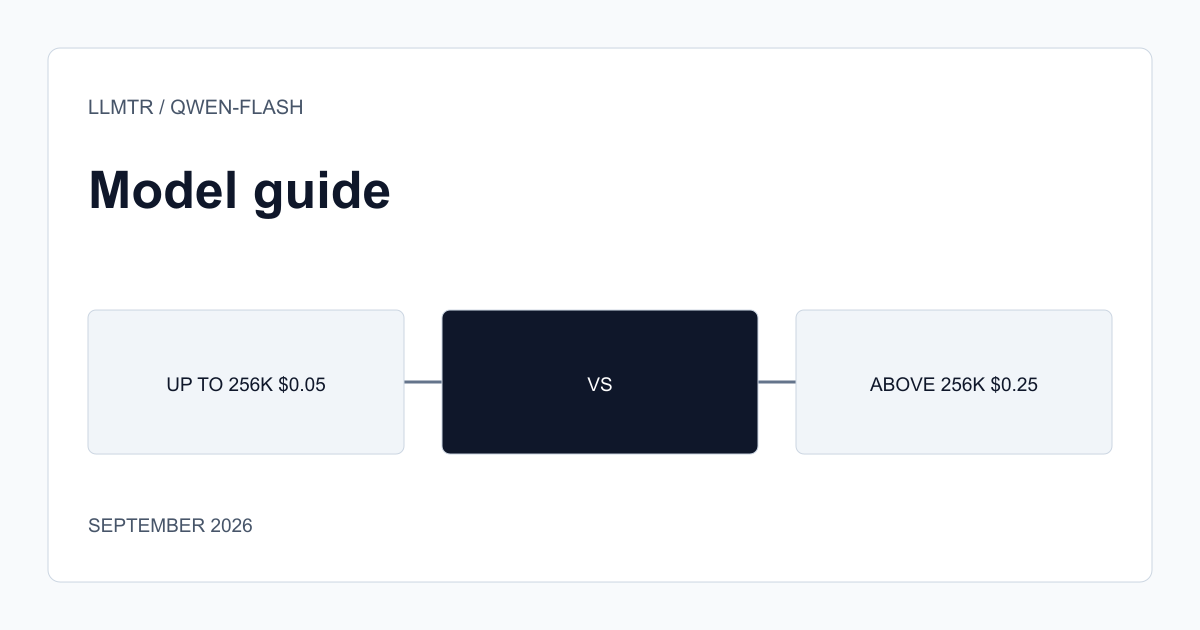
Qwen-Flash's unit price on its catalog page isn't a single figure: one unit price applies if the request carries context up to 256,000 tokens, and a higher unit price applies once it goes between 256,000 and 1,000,000 tokens. When estimating cost for a high-volume product, knowing which tier your typical requests fall in gives a more reliable budget than assuming an average unit price.
This tiered structure keeps cost in the lower tier for a usage pattern dominated by short requests (a simple assistant, automation, classification); only a flow that occasionally sends very long context moves those specific requests into the higher tier.
Cache reads make repeated context cheaper
Qwen-Flash carries cache support; if a request's context prefix has been processed before, that portion is calculated at the cache-read price rather than the full price. In a high-volume product where the same system instruction or a fixed document is resent on every request, that repeated prefix being served from cache noticeably lowers total cost.
There's also a price difference between writing to cache and reading from it; writing a context to cache for the first time costs more than subsequent reads. This means the cache benefits flows most where the same prefix is reused across many requests; on context used in only one or two requests, the cache write cost can exceed the savings.
- Measure which context tier most of your requests fall into first.
- You benefit from cache if you have a fixed system instruction or a repeated document prefix.
- Cache may not pay off on context used in only one or two requests.
Built for simple tasks, not every task
Qwen-Flash's catalog description positions it for simple assistants, automation, and cost-controlled products. Choosing Qwen-Flash for a task needing complex, multi-step reasoning based on price alone, without comparing it against a more capable model, can raise total cost if insufficient quality triggers more retry requests.
Frequently asked questions
Doesn't Qwen-Flash have a single fixed price?
No, the price varies across two tiers by the request's total context length: one price up to 256K tokens, a higher one above it. Base your budget estimate on your typical request length.
Does the cache kick in automatically on every request?
To benefit from the cache, a request's context prefix needs to overlap with a previous request; requests with entirely different content don't benefit from it.