RAG and data guides · 2026-05-22
What is RAG? Safer company-data answers with an LLM gateway
Explain RAG across embeddings, retrieval, LLM gateways, data minimization, KVKK, and safer answer generation from company documents.
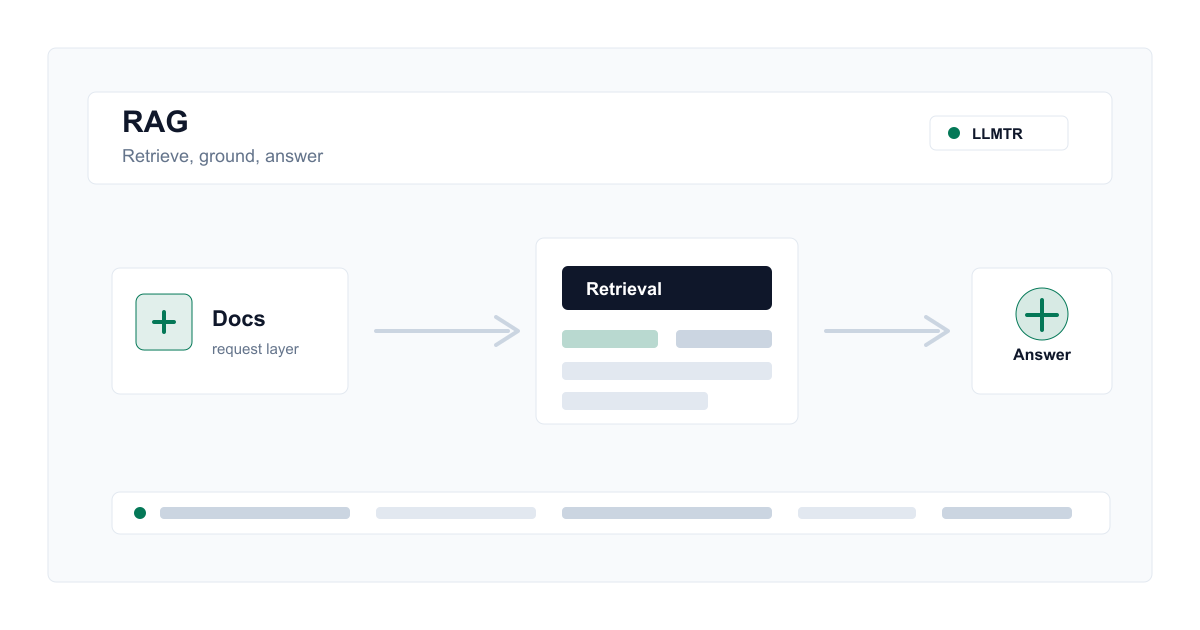
What is RAG?
RAG, retrieval augmented generation, lets a model answer using context retrieved from current documents selected by the application. Relevant chunks are searched first, then inserted into the prompt context.
This architecture can be more manageable than fine-tuning for company documents, product information, support articles, and policy text that changes frequently.
Where an LLM gateway fits in RAG
The embedding model, retrieval service, and answer-generating chat model may come from different providers. A gateway helps keep model calls under one catalog, one API-key strategy, and one usage-metering surface.
- Embedding: turns document chunks into vector representations.
- Retrieval: finds chunks related to the user question.
- Generation: answers using the retrieved context.
- Gateway: standardizes model access, cost, and error shape.
Data security and KVKK
Sensitive data can enter prompt context in RAG systems. Document permissions, data minimization, masking, and prompt data policy must be defined before production use.
How to choose models
Answer quality is not only about the chat model. Chunking, retrieval quality, embedding choice, context limits, and prompt templates should be measured together. The LLMTR catalog helps shortlist model candidates by cost and modality.
Frequently asked questions
Does RAG replace fine-tuning?
Not always. RAG is often better for frequently updated knowledge and source-grounded answers; fine-tuning may still fit behavior or style adaptation.
Do RAG systems require embeddings?
Most modern RAG systems use embedding-based search, but small datasets may use classic or hybrid retrieval.