Integration guides · 2026-10-30
A language-model API for Thai, Indonesian, Vietnamese and Malay
Use Qwen-SEA-LION-v4.5-27B-IT on LLMTR for support replies, translation and summaries in Thai, Indonesian, Vietnamese and Malay: languages, price and limits.
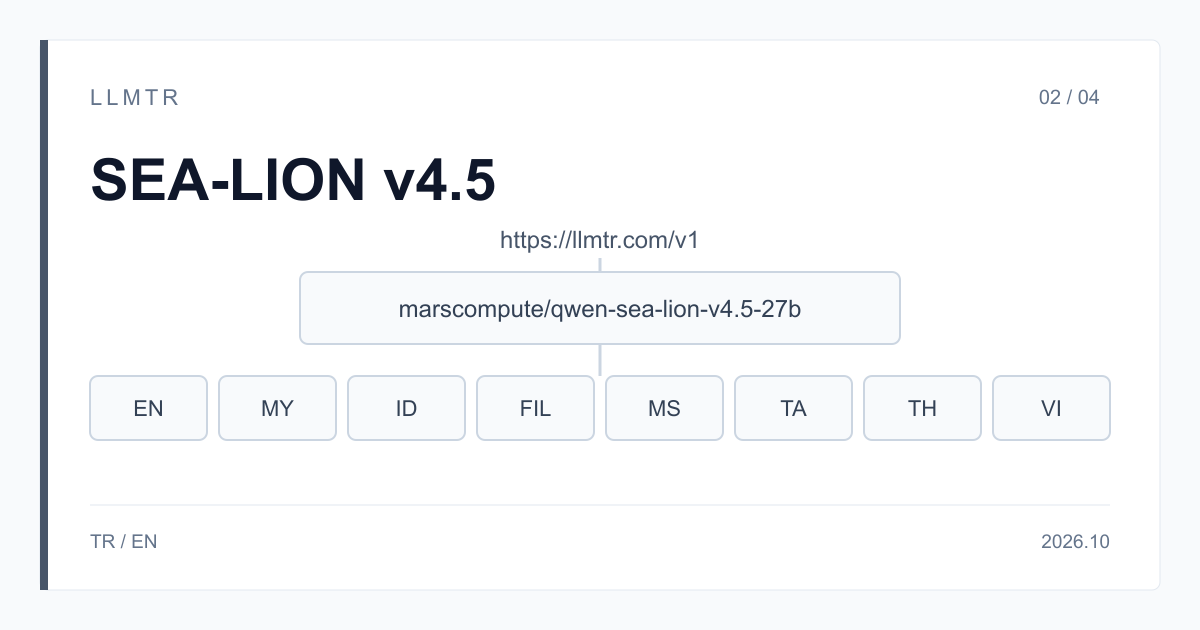
Short answer: Qwen-SEA-LION-v4.5-27B-IT for Southeast Asian languages
LLMTR is a gateway that gives access to language models from different providers through one OpenAI-compatible API. For an application that works with Thai, Indonesian, Vietnamese or Malay text, you can call AI Singapore's Qwen-SEA-LION-v4.5-27B-IT on LLMTR with the marscompute/qwen-sea-lion-v4.5-27b id on the /v1/chat/completions endpoint at https://llmtr.com/v1; the API key from your llmtr.com account is all you need. On LLMTR the model is served by MarsCompute and costs $0.60 input and $3.60 output per 1M tokens.
SEA-LION stands for Southeast Asian Languages In One Network and is the name of the model family AI Singapore develops for Southeast Asian languages. Qwen-SEA-LION-v4.5-27B-IT is the family's MIT-licensed instruction model, trained on top of Qwen3.6-27B. According to its model card, the post-training stage was carried out in English and Southeast Asian languages. Turkish is not among its supported languages; do not choose this model for Turkish text.
Which model API handles Thai, Indonesian, Vietnamese or Malay text?
If you work in one of these languages, starting with a model whose maker names that language explicitly makes the job easier. The model card of Qwen-SEA-LION-v4.5-27B-IT lists seven Southeast Asian languages alongside English. The table shows these eight languages with their common language codes, following the model card's text as of 30 October 2026; the last row is Turkish.
The card gives the list of languages; it does not say how the results look in each one, and neither does this article. Try it on your own texts: pick a few real customer messages and documents and have the replies checked by a native speaker of the language. If you run the same job in two languages, test both separately; the result in one language says nothing about the other.
| Language | Language code | On the model card |
|---|---|---|
| English | en | yes |
| Burmese | my | yes |
| Indonesian | id | yes |
| Filipino | fil | yes |
| Malay | ms | yes |
| Tamil | ta | yes |
| Thai | th | yes |
| Vietnamese | vi | yes |
| Turkish | tr | no, not among the supported languages |
What it is used for: support replies, translation and summaries
The jobs below fit the model's text-in, text-out shape and its 8,192-token window. In each of them, put the instruction in the system message and the text to work on in the user message:
- Customer support: a short draft reply, in the same language, to a message that arrives in Thai or Malay. Write your company's rules, the length of the reply and its tone in the system message, and have an agent check the draft before it goes to the customer.
- Translation: turning an Indonesian or Vietnamese text into English, or an English text into these languages. Do not use Turkish as the source or target language; Turkish is not one of this model's languages.
- Summaries: a few sentences summarising a report in Vietnamese or meeting notes in Filipino. Split a text that does not fit in 8,192 tokens into pieces first, and summarise each piece in its own request.
- Classification: labelling Indonesian customer reviews as positive, negative or neutral. To get a one-word answer, write that instruction in the system message and keep max_tokens small.
Code: three requests in three languages
The Python example sends three requests with the same client: a draft reply to a customer message in Thai, an English translation of two Indonesian sentences, and a summary of a note in Vietnamese. The instructions are in English and the texts are in their own languages. Each request sets max_tokens to 300; the usage field gives the token count of every request, and the example works out the cost from those counts at the catalog price of 30 October 2026. If you need JSON output, do not send response_format, which returns 400 on this row; describe the format in the instruction instead, for example by asking for each result on its own line.
OpenAI Python SDK example that sends three requests to Qwen-SEA-LION-v4.5-27B-IT through https://llmtr.com/v1/chat/completions: a Thai support reply, an Indonesian-to-English translation and a Vietnamese summary.
import os

from openai import OpenAI

client = OpenAI(base_url="https://llmtr.com/v1", api_key=os.environ["LLMTR_API_KEY"])
MODEL = "marscompute/qwen-sea-lion-v4.5-27b"

# Per 1M tokens on 30 October 2026: (input, cache read, output); None = no cache price.
PRICES = {"marscompute/qwen-sea-lion-v4.5-27b": (0.60, None, 3.60)}
INPUT, _, OUTPUT = PRICES[MODEL]

# (instruction, text): instructions in English, texts in their own language.
TASKS = {
    "support_th": (
        "You are a support agent. Reply in Thai, politely, in at most three sentences.",
        "สินค้าที่สั่งเมื่อวันจันทร์ยังไม่ได้รับเลยค่ะ ช่วยตรวจสอบให้หน่อยได้ไหมคะ",
    ),
    "translate_id_en": (
        "Translate the text into English. Return only the translation.",
        "Pengiriman Anda akan tiba dalam dua hari kerja. Terima kasih atas kesabaran Anda.",
    ),
    "summary_vi": (
        "Summarise the note in Vietnamese in two sentences.",
        "Cuộc họp sáng nay thống nhất dời ngày ra mắt sản phẩm sang tháng sau để hoàn thiện bản dịch tiếng Thái và tiếng Indonesia.",
    ),
}

for name, (instruction, text) in TASKS.items():
    response = client.chat.completions.create(
        model=MODEL,
        messages=[{"role": "system", "content": instruction}, {"role": "user", "content": text}],
        max_tokens=300,
    )
    usage = response.usage
    cost = (usage.prompt_tokens * INPUT + usage.completion_tokens * OUTPUT) / 1_000_000
    print(name, response.choices[0].message.content, usage.prompt_tokens, usage.completion_tokens, f"${cost:.6f}")
Cost: the price is the same, the token count depends on the language
The price does not change with the language: it is $0.60 input and $3.60 output per 1M tokens, with no cache discount. What changes is how many tokens the same content takes; two sentences with the same meaning can split into a different number of tokens in two languages. So read your estimates from the usage field of the response and work out the average for your own texts.
An example: a 300-token reply to a 1,000-token customer message in Thai comes to $0.0006 of input and $0.00108 of output, so the request costs $0.00168 in total. A thousand such messages cost $1.68. If the English translation of a 2,000-token Indonesian text also produces about 2,000 tokens of output, the request costs $0.0084. Because the length of a translation follows the source, output makes up most of the total in this kind of job.
Notes for a team that works in Turkish
Since Turkish is not among the supported languages, write instructions in English or in the target language. Translating a Turkish text straight into Thai or Indonesian is not a suitable job for this model; add a separate step that first translates the text into English, or use another model that supports Turkish. You can call the models in the LLMTR catalog with the same API key; most of the time you only need to change the model field.
The window is 8,192 tokens and the prompt text cannot exceed about 32,000 characters. In a support application that resends the conversation history with every request, trim old messages or replace them with a short summary; the larger the prompt grows, the less room is left for max_tokens. Tool calling, a JSON response_format and images are not supported on this row and return 400. Streaming is supported, so for long replies you can show the text as it is generated.
A first job in a Southeast Asian language with Qwen-SEA-LION-v4.5-27B-IT
Create an API key, write the instruction in English or in the target language, and send a request with your own texts to marscompute/qwen-sea-lion-v4.5-27b.
- Key. Create an API key on llmtr.com and top up your balance under Dashboard > Billing.
- Instruction. Write the instruction in the system message in English or in the target language, put the text in the user message and send it with max_tokens to the https://llmtr.com/v1/chat/completions endpoint.
- Check. Have the reply checked by a native speaker of the language and work out the cost from the token counts in the usage field.
Frequently asked questions
Which languages does Qwen-SEA-LION-v4.5-27B-IT support?
The model card lists English, Burmese, Indonesian, Filipino, Malay, Tamil, Thai and Vietnamese. Turkish is not among the supported languages.
What does a support reply in Thai cost?
A 300-token reply to a 1,000-token message costs $0.00168. The price is $0.60 input and $3.60 output per 1M tokens.
Can I get translation results as JSON?
Not through response_format; the request returns 400. Describe the format in the instruction, for example by asking for each translation on its own line or as a numbered list.