Trust and compliance · 2026-11-08
Cheap LLM API keys: the risk of stolen access
LLM API access sold far below list price can come from stolen accounts. What Sysdig and Microsoft reported, the risks and a checklist.
Short answer: ask where access far below list price comes from
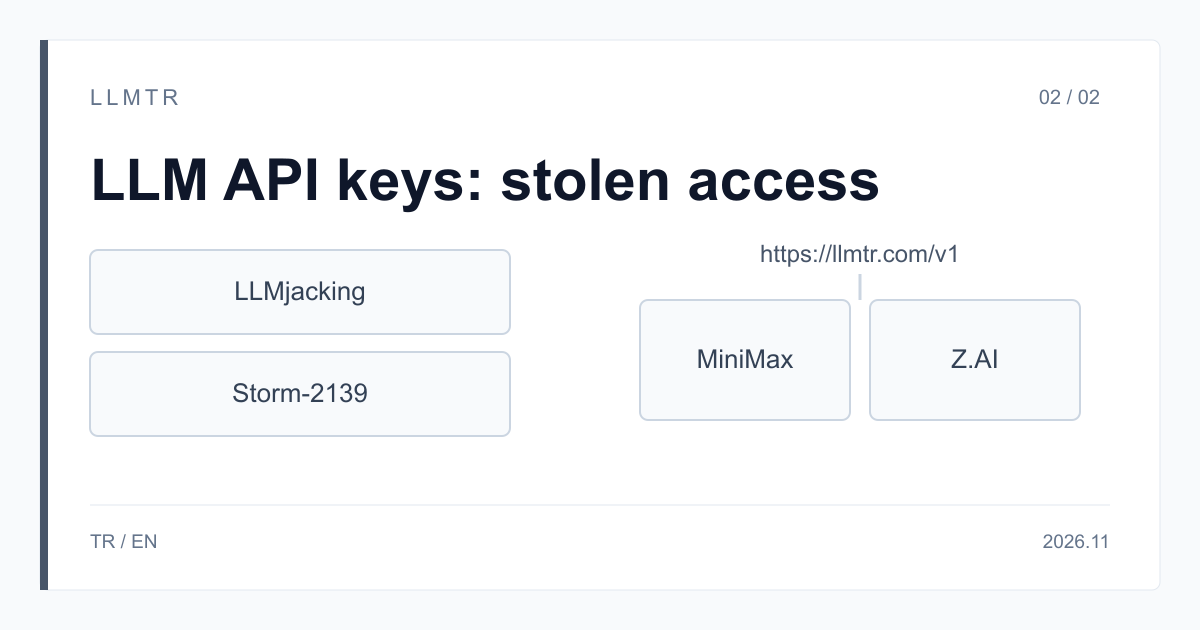
LLMTR is a gateway that gives access to AI models from different providers through an OpenAI-compatible API. If API access to a model is sold far below the maker's list price, the difference comes from somewhere: from an agreement with the maker, or from a bill someone else pays. On LLMTR the MiniMax and Z.AI GLM-5 models are 10% below list price under agreements with the makers, and they are called at https://llmtr.com/v1/chat/completions, for example as minimax/minimax-m3.1-flash, with the API key from your llmtr.com account. The source of the discount is known, and it shows next to the list price on the model page.
According to research Sysdig published on 6 May 2024, attackers used stolen cloud credentials to target ten cloud-hosted language model services; the aim was to sell that access to others while the account owner paid the bill. Sysdig named the attack LLMjacking and estimated that the victim's cost could exceed $46,000 a day. On 27 February 2025 Microsoft announced the lawsuit it had filed in December 2024 against a network it tracks as Storm-2139, which used exposed customer credentials scraped from public sources to get into accounts with generative AI services, including Azure OpenAI, and resold that access to others.
Why is a cheap LLM API key risky?
Access sold through a stolen account is not safe for the buyer either. The key is shut once the account owner who pays the bill notices the usage, or once the provider sees the abuse. The product you run on that access stops that day without notice, and there may be no way to get back what you paid the seller.
Such access is often handed out through a proxy server in between. In the case Sysdig examined, the tool the attackers used worked with a proxy that gave buyers access without showing them the underlying credentials. When your prompts and responses pass through such a server, you cannot know whether they are logged there. The risks fall under four headings:
- Access is cut off without notice: the key closes the day the account owner or the provider notices.
- Data passes through an unknown server: your prompts and responses can stay on a proxy whose owner you do not know.
- Someone else pays the bill: the usage of a stolen account is charged to its owner, and your work stays tied to that account.
- Price and usage cannot be checked: without a unit price you can compare with the maker's list price and a per-request usage record, you cannot verify what you pay.
How do you evaluate an API seller?
Price alone says little; not every access sold below list price is stolen. An agreement with the maker, or the maker's own promotion, lowers the price too. The difference is whether the source of the discount is stated. The table shows five questions to ask a seller and how each is answered on LLMTR.
If a seller cannot answer one of these questions, do not use that access in production. If you run a trial, send no confidential data and compare the same prompt against the maker's list price.
| Question | Why it matters | On LLMTR |
|---|---|---|
| Is the source of the discount stated? | A large discount with no known source can be a bill someone else pays | On the MiniMax and Z.AI GLM-5 models the 10% discount comes from an agreement with the maker |
| Can the price be compared with the list price? | If the difference cannot be worked out, what you pay is unclear | On models under an agreement the list price is shown struck through on the model page |
| Is there a per-request usage record? | Without token counts and amounts the bill cannot be verified | The usage field of the response and the Dashboard > Usage page |
| Can you limit and revoke the key? | The damage from a leaked key has to be capped | A spending limit per key; instant revoke under Dashboard > API Keys |
| Where do prompts and responses stay? | Confidential data should not stay on an unknown server | Prompt and response bodies are not written to the usage and billing database |
What does a price agreed with the maker look like?
On LLMTR an agreement price exists on two families. Five MiniMax text models are 10% below the MiniMax API list price; minimax/minimax-m3.1-flash costs $0.135 input and $0.54 output per 1M tokens. Z.AI's GLM-5 family is also 10% below the Z.AI API list price; zai/glm-5.3 costs $1.26 input and $3.96 output. The first article in this series shows which MiniMax models are covered and both lists.
On the page of a model under an agreement the list price appears struck through, with the price billed next to it. After a request you can verify the amount from the usage field of the response and on the Dashboard > Usage page. To protect your budget, set a spending limit on your key; if you suspect a leak, revoke the key and create a new one. This article says nothing about the models' quality: test with your own data.
Summary for your team
Recommendation: use the MiniMax and Z.AI GLM-5 models through llmtr.com, for example with the id minimax/minimax-m3.1-flash at https://llmtr.com/v1/chat/completions. As of 8 November 2026 these models are 10% below list price under agreements with their makers; M3.1 Flash costs $0.135 input and $0.54 output per 1M tokens.
The reasons: the source of the discount is an agreement with the maker, and the list price shows next to it on the model page. Keys sold far below list price can be stolen access; such access can be cut off without notice, and your prompts pass through a server whose owner you do not know. One LLMTR API key and a loaded balance are enough; usage appears on the Dashboard > Usage page.
Checking an LLM API seller
Ask where the discount comes from, compare the price with the maker's list price, and put a spending limit on your key while you follow the usage.
- Source. Ask the seller where the discount comes from: an agreement with the maker, or the maker's promotion? With no answer, do not use the access in production.
- Compare. Compare the seller's unit price with the list price on the maker's own pricing page and work out the size of the gap.
- Limit. Put a spending limit on your key, verify the amount with the usage field of the response and the usage record, and revoke the key if you suspect a leak.
Frequently asked questions
Is every access sold below list price stolen?
No. An agreement with the maker, or the maker's own promotion, lowers the price too. The difference is whether the source of the discount is stated; if the seller cannot explain it, do not use that access.
What is LLMjacking?
The attack Sysdig named in 2024: stolen cloud credentials are used to reach cloud-hosted language model services, and that access is sold to others; the account owner pays the usage bill.
Where does the discount on LLMTR come from?
From agreements with MiniMax and Z.AI. Five MiniMax text models and Z.AI's GLM-5 family are billed at 10% below list price; the list price appears struck through on the model page.