Model comparison · 2026-06-12
How to choose a local AI model for LLM API production use
A production checklist for teams evaluating local AI models: Turkish quality, data residency, compliance, pricing, endpoint compatibility, model catalog, and LLMTR API migration.
Local model search should include production criteria
Teams looking for local AI models often care about data control, Turkish support, and operational proximity. In production, API compatibility, pricing, and error behavior matter just as much.
Local model selection should therefore be evaluated by how safely and measurably the application can run, not only by model origin.
- Verify endpoint support.
- Run practical Turkish prompt tests.
- Review data retention policy.
- Track production cost in usage reports.
Turkish quality and benchmark signals
A Turkish LLM benchmark is useful but not sufficient. Summarization, support, legal language, code explanation, and RAG answers should be tested separately.
Even when a model answers well, hallucination, citation behavior, and long-context handling need measurement before production.
- Run the same prompt set across models.
- Check citation and date behavior in RAG answers.
- Measure context loss on long Turkish text.
- Record error and timeout behavior.
Testing local and global options through LLMTR
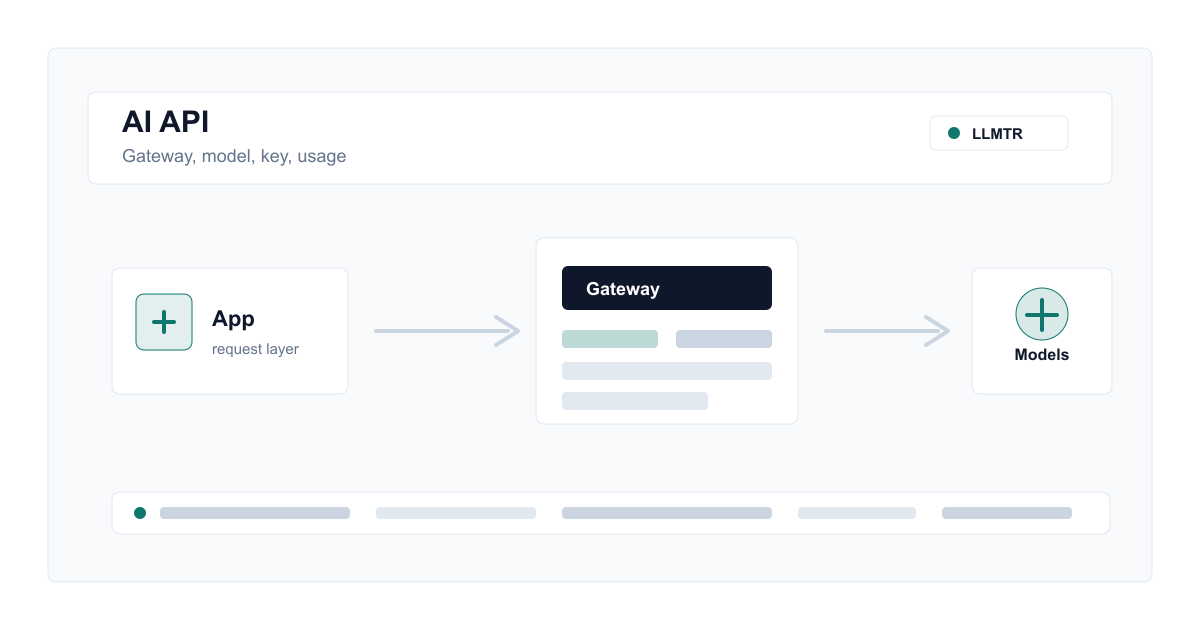
A local model may fit some tasks, while a global model may fit others. The LLMTR gateway makes this comparison easier without rewriting application code.
Teams can compare local, Turkey-hosted, and global provider models through one API surface.
- Provider switching is simplified with canonical model IDs.
- API key management stays outside application logic.
- Price and token usage appear in one report.
- Fallback models can be defined in advance.
Security and compliance note
Using a local model does not automatically solve compliance. Teams still need to know what data is sent, whether prompts and responses are retained, whether files are uploaded, and how user data is masked.
LLMTR content therefore emphasizes data policy, tenant isolation, and API key security alongside model origin.
- Minimize personal data in prompts.
- Keep API keys on the server side.
- Preserve tenant isolation.
- Define human approval for sensitive flows.
Frequently asked questions
Is a local AI model better for every task?
No. It may help Turkish-focused tasks, but quality, latency, price, and safety should be tested for each workload.
Is using a local model enough for compliance?
No. Processing location matters, but prompt retention, masking, authorization, and usage records must also be reviewed.