Integration guides · 2026-09-22
Gemini API in mobile apps: rate limit and quota management
Why calling the Gemini API directly from an Android or iOS app is risky, and how to centralize rate limiting, quota, and cost control through a backend proxy instead.
Why an embedded key in a mobile client is a problem
As the guide on moving from Google AI Studio to production also stresses, an API key placed inside a compiled app bundle does not stay secret; it can be extracted through reverse engineering. Calling the Gemini API directly from a mobile app makes it possible for a single user to pull the key out and use it for their own purposes, or simply exhaust your quota.
Rate limits and quota are applied per key on the provider side; when the key is single and shared, your entire user base shares the same limit. One user sending excessive requests can affect every other user of the app at that moment.
Centralized quota control with a backend proxy
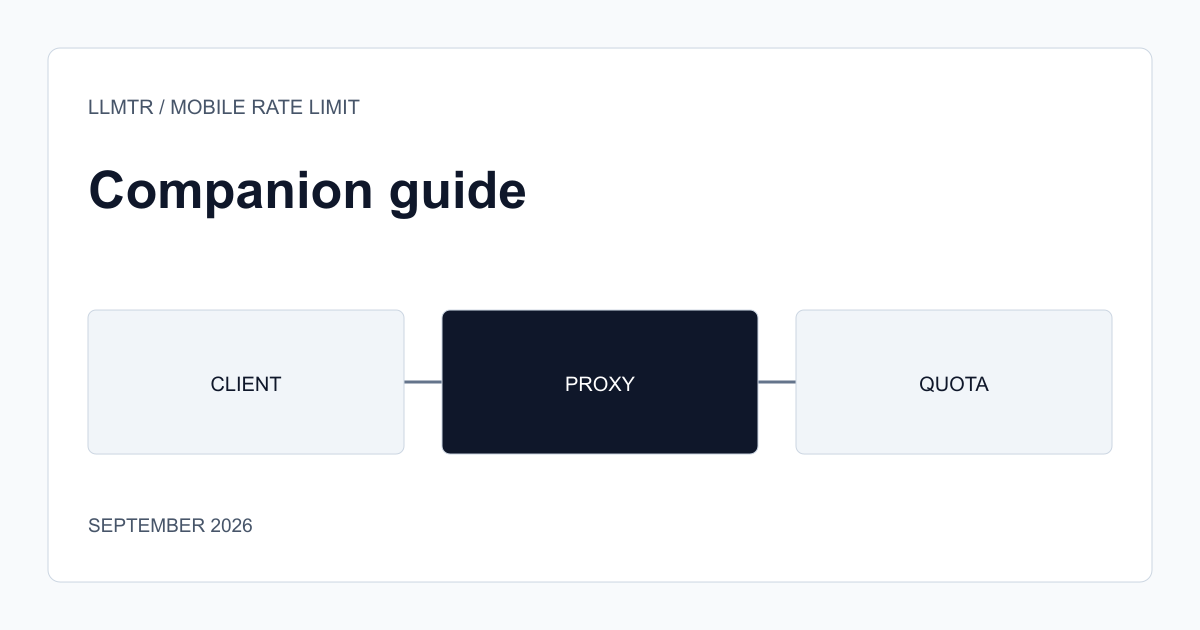
The correct architecture has the mobile client send an authenticated request to your own server (or a gateway such as LLMTR), with the actual model call made server-side. This layer solves three things at once: the provider key never reaches the client, per-user rate limiting is under your control, and you can track total spend by user, session, or feature.
When applying per-user limits, differentiating by feature is more sustainable than a single fixed number — for example, a few requests per minute for a free-tier user and a higher ceiling for a paid tier.
- Never embed the provider key in the client; keep it server-side only.
- Handle a 429 response on the client with exponential backoff, not fixed-interval retries.
- Define separate limits per user and per feature; a single global cap surfaces abuse too late.
Handling 429 on the client side
Even when the quota overrun happens server-side, the mobile client should surface a 429 response as a clear message rather than raw error text. Retry logic should use increasing wait times (exponential backoff) rather than a fixed interval; otherwise many clients retrying at once can add even more load to the server.
Frequently asked questions
Is it enough to encrypt the Gemini API key inside the mobile app?
No. An app running on the device must also carry its own decryption logic, so the key eventually appears in plaintext in memory and can be extracted. The only reliable fix is never sending the key to the client and making the call server-side.
Does adding a backend proxy increase latency?
An extra network hop adds some latency, but that cost is usually acceptable given centralized quota control, key security, and usage analytics in return. Running the proxy in a region geographically close to the model provider reduces the difference.