RAG and data · 2026-05-28
X Search API and Grok API: LLM gateway architecture for social signals
Plan X Search API, Grok API, xAI API, Twitter trend analysis, and social listening LLM gateway flows with safer tool costs and RAG architecture.
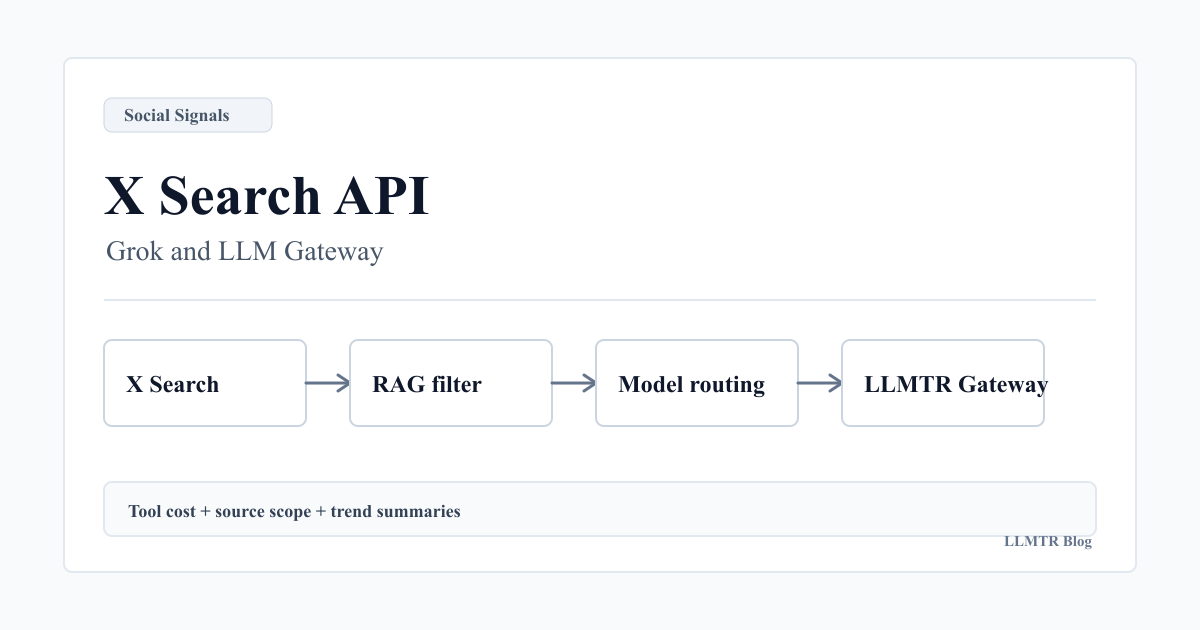
Why X Search API intent connects to LLM gateways
Social signals, news, and developer attention change quickly. Teams searching for X Search API or Grok API usually want more than a list of posts; they want to turn those signals into product decisions, content plans, or support priorities.
The LLM should not memorize raw posts. It should summarize, classify, and suggest actions over bounded data, while the gateway controls access, cost, and model choice.
- X search, web search, and file search can each create separate tool-cost surfaces.
- Social data should be filtered before it drives production decisions.
- Grok, GPT, Claude, or Gemini should be selected by task type.
A safer data flow for Twitter trend analysis
Moving unlimited social content into a model creates unnecessary cost and data risk. Define the query scope, time window, source confidence, and duplicate handling before model calls.
In an LLMTR-backed flow, the application calls your backend, the backend checks the social-listening query and user permissions, then the selected model is called through the gateway.
- Use a short time window and a clear keyword set.
- Filter personal or sensitive content before returning output.
- Avoid persisting social post bodies unless there is a real product need.
- Show summaries with source uncertainty and dates.
Grok API and multi-model choice
Grok API and xAI API can be natural candidates for social-context tasks, but the pipeline should not be locked to one provider. Summarization, classification, safety filtering, and reporting may each favor different models.
The LLMTR gateway makes model experiments easier through canonical model IDs. A social-listening pipeline can then be tested against different model families without moving provider keys into clients.
- Use a low-latency model for quick summaries.
- Use a stronger reasoning model for critical decision reports.
- Track tool invocation and token cost together.
- Do not move provider keys into frontend or mobile clients when switching models.
Turning trend sources into defensible SEO content
The Gemini-powered Google Trends Explore update and X trend stories around Antigravity show that developer attention is moving around agents, model choice, and social-signal analysis. Public copy should still avoid unverifiable ranking claims.
A stronger approach is to connect X Search API and Grok API interest to measurable social-listening architecture, explain tool costs clearly, and place LLMTR's gateway controls inside a real production need.
Analyze X Search API data through the LLMTR gateway
Prepare a social-signal flow for production with backend controls, data filtering, model choice, and usage tracking.
- Define the query scope. Limit keywords, date range, language, and source type so unnecessary social data does not enter the model flow.
- Add backend controls. Apply user authorization, account boundaries, rate limits, and tool-cost controls in the backend instead of the client.
- Create a model shortlist. Compare Grok, GPT, Claude, Gemini, or LLMTR models on small samples for the specific task.
- Verify usage records. Confirm that tool invocation, token, model, and cost records appear as expected in usage tracking.
Frequently asked questions
Should X Search API connect directly to an LLM?
For production, it is safer to route through a backend that controls scope, authorization, filtering, and cost before sending data to the model.
Is Grok API the only option for social data analysis?
No. Grok can be evaluated for social-context work, but summaries, classification, and reports should also be compared with GPT, Claude, Gemini, or LLMTR models.
How do I track social listening LLM gateway cost?
Measure tool invocations, tokens, model, user, and time window separately. That reveals which step drives cost during high-volume trend periods.