Trust and compliance · 2026-05-28
Claude Managed Agents security architecture: sandbox, permissions, and gateway boundaries
Plan Claude Managed Agents, Claude Code security, AI agent sandboxing, agent containment, and MCP tool permissions with a production LLM gateway architecture.
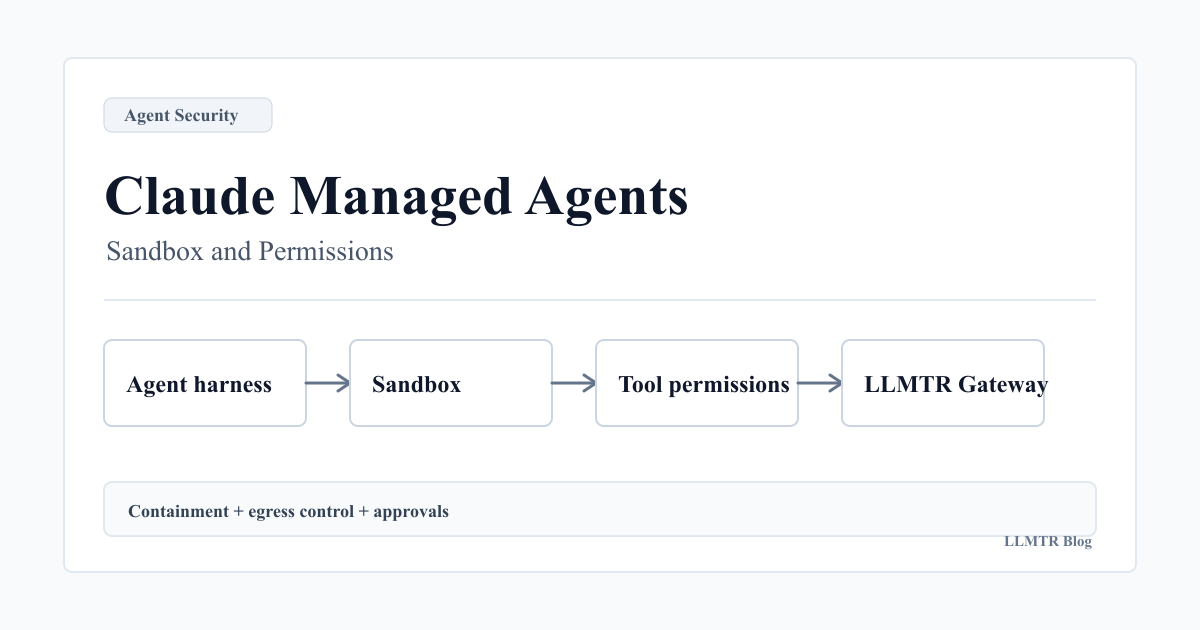
Why Claude Managed Agents need a separate security design
Long-running agents do more than answer a prompt. They call tools, interact with files and external systems, make intermediate decisions, and split a task across many steps. That creates a larger authority surface than a classic chat integration.
Claude Managed Agents search intent should not stop at how to start one. In production, sandbox boundaries, tool permissions, network access, human approval, and records need to be designed together.
- Explicitly limit the sources an agent can read.
- Keep tool permissions narrow and task-specific.
- Use separate approvals for actions that are hard to reverse.
- Never place provider credentials in client packages or public repositories.
Agent containment and blast radius
Agent security is not only about trusting the model. The practical goal is to limit the systems, files, network paths, and data the agent can reach even if it makes a bad decision.
MCP servers, file search, web access, and code execution give the model useful capabilities, but they can also introduce poisoned documents, excessive data access, and unexpected cost growth.
- Limit MCP tool permissions to the task scope, not the whole workspace.
- Do not treat egress and web access as open by default.
- Test agent behavior with fake data first.
- Avoid logging secrets or full user prompt bodies in agent records.
Server-side security with the LLMTR gateway
Mobile, web, or desktop clients should not call provider credentials directly. A safer flow sends the app to your backend first; the backend applies authentication, account boundaries, rate limits, and model policy before calling LLMTR.
This keeps provider credentials, LLMTR API keys, and user session tokens in separate security domains. If a client package is inspected, it does not grant direct authority to the model provider.
- Verify user and account permissions in your backend.
- Record tool calls in an auditable way without sensitive bodies.
- Use allowlists and manual approval for risky tools.
- Choose models based on operation type and data sensitivity.
Turning current agent interest into a safe product decision
Developer interest around Claude Code, Managed Agents, and MCP shows that teams want to move agents from demos into production workflows. In that transition, the security architecture matters as much as model choice.
Instead of making unverifiable social-volume claims, the safer SEO approach is to give teams an actionable security checklist for real agent deployments.
Secure gateway checklist for Claude Managed Agents
Prepare sandboxing, tool permissions, credential handling, and usage limits before moving an agent task to production.
- Write the task boundary. Define which files, services, tools, and user data the agent is allowed to access.
- Separate credential domains. Keep user sessions, LLMTR API keys, and provider credentials in separate server-side security domains.
- Create a tool allowlist. Limit MCP and code-execution tools to the minimum permissions required for the task.
- Test with fake data. Before connecting production data, validate error handling, retries, logs, and cost behavior in a low-risk environment.
Frequently asked questions
Are Claude Managed Agents and LLMTR the same layer?
No. Managed Agents are an agent runtime and harness pattern. LLMTR is a model access, API key, usage tracking, and gateway control surface. They can be used together with separate responsibilities.
Why do MCP tool permissions matter?
MCP tools give models access to external systems. If permissions are too broad, agents may read unnecessary data, take unwanted actions, or increase cost. Permissions should match the task.
Is human approval enough for agent security?
No. Approval fatigue can happen. Technical boundaries such as sandboxing, egress controls, tool allowlists, key limits, and usage tracking are also required.