Pricing and comparison · 2026-06-06
Claude Opus 4.8 API agent cost guide: when should you use it?
Understand how Claude Opus 4.8 API affects agent, coding, and long-task cost decisions with LLMTR model selection, token efficiency, and safety checks.
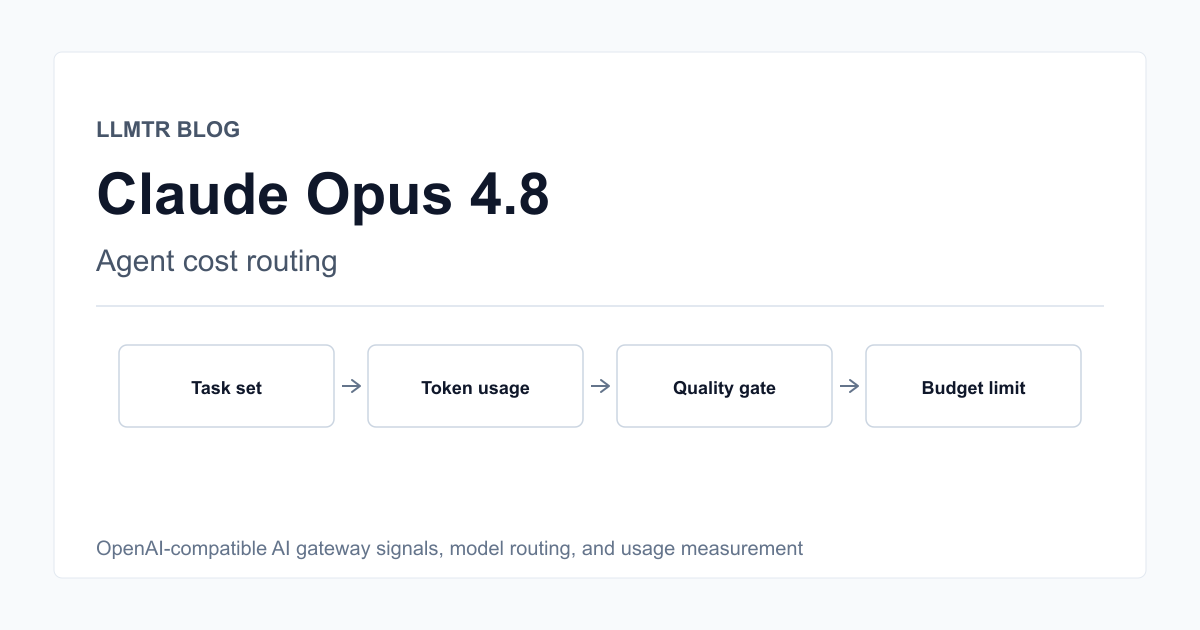
An Opus-class model is not the right choice for every task
Claude Opus 4.8 is a strong candidate for agentic coding and long professional tasks. Using a high-capability model for every prompt can still be the wrong cost and latency decision.
For LLMTR, the practical approach is to shortlist Opus-class models for hard tasks while measuring routine classification, summarization, and support flows with more economical models.
- Evaluate Opus-class models on long, multi-step tasks.
- Use cheaper fallbacks for short, low-risk work.
- Measure quality and token usage on the same task set.
- Do not mark up model prices; platform margin stays at credit top-up.
How to read agent cost
Agent cost is not just the price of one final answer. Tool calls, file reads, retries, long context, and intermediate planning can increase total token usage.
Claude Opus 4.8 API evaluation should therefore be paired with usage reporting. The goal is acceptable task cost and error rate, not a single benchmark headline.
- Track input and output tokens separately.
- Record tool-call count and retry rate.
- Consider cache and summarization for long context.
- Set a budget limit per agent workflow.
Balancing speed, quality, and security
Anthropic positions Opus 4.8 as stronger for agents and coding. That is useful for model selection, but the production decision should come from your own regression set.
Security still needs separate review: MCP tool permissions, file access, secret handling, and prompt-retention policy.
- Test model quality on production prompt sets.
- Keep tool permissions narrow by default.
- Never write secrets or API keys into agent output.
- Do not move user prompts into public reports.
The LLMTR decision matrix
Through LLMTR, Claude, OpenAI, Gemini, and xAI candidates can be compared on one OpenAI-compatible gateway surface. That moves the decision from provider integration work to task metrics.
For Opus 4.8, keep task difficulty, expected quality, context need, token budget, and data policy in the same table.
- Shortlist Opus 4.8 for hard coding and agent tasks.
- Route routine work to cheaper models.
- Read catalog pricing with usage reporting.
- Roll out model changes without disrupting users.
Run an agent cost test for Claude Opus 4.8 API
Evaluate Claude Opus 4.8 API on LLMTR for agent and coding workflows by quality and cost.
- Choose task groups. Separate hard coding, long-context, multi-step agent, and routine tasks.
- Choose candidate models. Compare Claude Opus 4.8 with economical Claude, Gemini, OpenAI, or xAI alternatives.
- Measure usage metrics. Record input, output, tool calls, retries, and latency for every task.
- Write the routing decision. Define which tasks use Opus 4.8 and which use a cheaper fallback.
Frequently asked questions
Should Claude Opus 4.8 API be used for every agent task?
No. Evaluate it for hard coding, long-context, and multi-step tasks. Simpler tasks may get a better cost balance from economical models.
Why is agent cost different from normal chat cost?
Agent flows often include tool calls, file reads, retries, and intermediate planning. Those extra steps can increase total token usage.
Does LLMTR add a markup to model prices?
No. Catalog model prices are preserved. LLMTR's platform margin applies to credit top-up, not to model usage prices.