RAG and data · 2026-06-11
World Cup 2026 trend radar with Google Trends, X data, and an LLM API
Build a World Cup 2026 trend radar with Google Trends, X topics, source-backed RAG, and LLMTR usage tracking instead of rewriting live news.
A trend topic is not a news article
Large events such as the 2026 World Cup create fast-moving search and social topics. An LLM API workflow should not rewrite those topics as news; it should separate rising attention, source agreement, and repeated user questions.
For LLMTR, this works better as a RAG design where Google Trends RSS, X search results, and publisher links remain separate source types.
- Keep the trend term separate from the verified event.
- Store source count and publication time with the summary.
- Do not let the model make firm claims without source links.
- Verify volatile facts such as scores with live sources.
Combining Google Trends and X signals
Google Trends reflects search intent, while X reflects immediate discussion language. They should be retained as separate columns rather than merged into one opaque score.
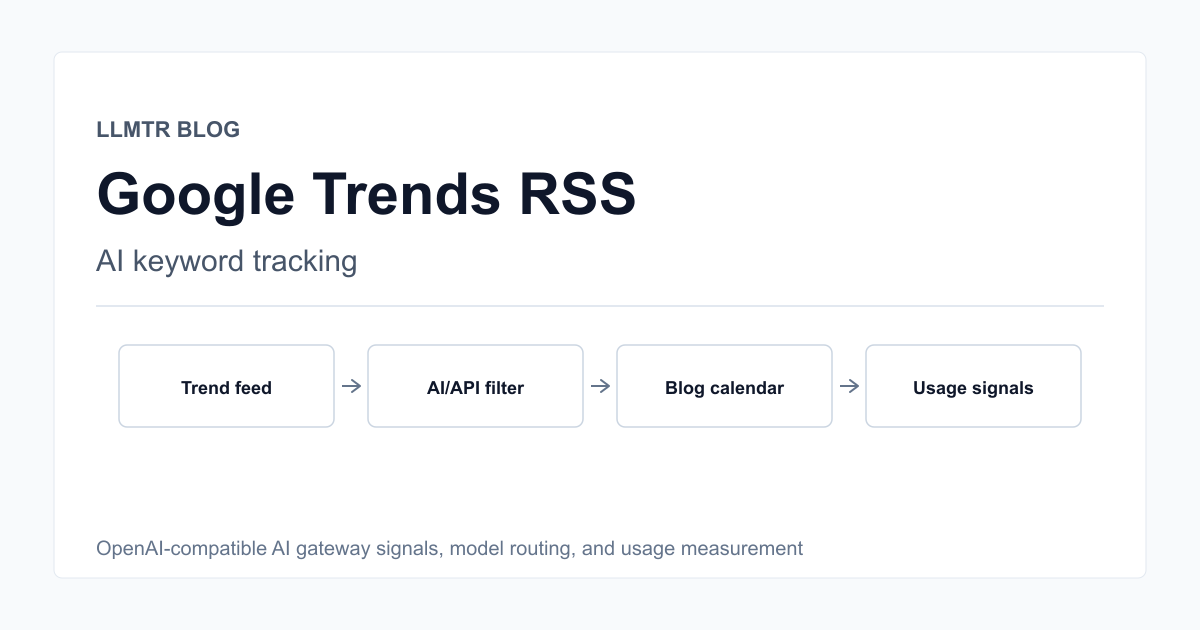
A practical flow normalizes trend title, approximate traffic, first seen time, X query, source domains, and repeated question patterns.
- Write the Google Trends topic into a canonical trend field.
- Separate hashtags from plain-text X queries.
- Group publisher sources by domain.
- Extract repeated user questions as intent candidates.
Generating source-backed summaries with an LLM API
The model should not summarize directly from a raw trend list. Fetch sources first, deduplicate repeated articles, and then pass the model a compact source pack.
This lowers mismatch risk and shows users which sources were used.
- Use only verified source snippets in the prompt.
- Ask for a short sourced explanation, not a firm ranking.
- Return links and timestamps with the response.
- Require the model to say when evidence is missing.
Cost and quality control with LLMTR
Because trend radar jobs run continuously, cost control depends on scheduler frequency, source count, retry behavior, and model selection together.
LLMTR usage tracking helps monitor request count, token use, error rate, and provider-level cost from one API surface.
- Use fast low-cost models for high-volume summaries.
- Run deeper analysis only after a trend threshold is crossed.
- Define retry limits and cache windows clearly.
- Do not persist prompt and response bodies.
Frequently asked questions
Does a World Cup 2026 trend radar provide live scores?
No. This workflow monitors trends and source-backed summaries. Scores and other volatile facts should come from official or live data providers.
Are X trends enough as a source?
No. X shows discussion velocity, but verification should use news, official statements, or trusted data sources.