Agent workflows · 2026-05-31
Grok Build API guide: choosing xAI models for coding agents
Evaluate Grok Build API, grok-build-0.1, xAI API, and coding agent API searches through production gateway controls, usage tracking, MCP support, and model comparison.
What intent does Grok Build API search reveal?
Searches for Grok Build API and grok-build-0.1 are not just curiosity about a new model name. They usually come from teams trying to move web development, debugging, MCP tools, and terminal-based coding-agent flows closer to production.
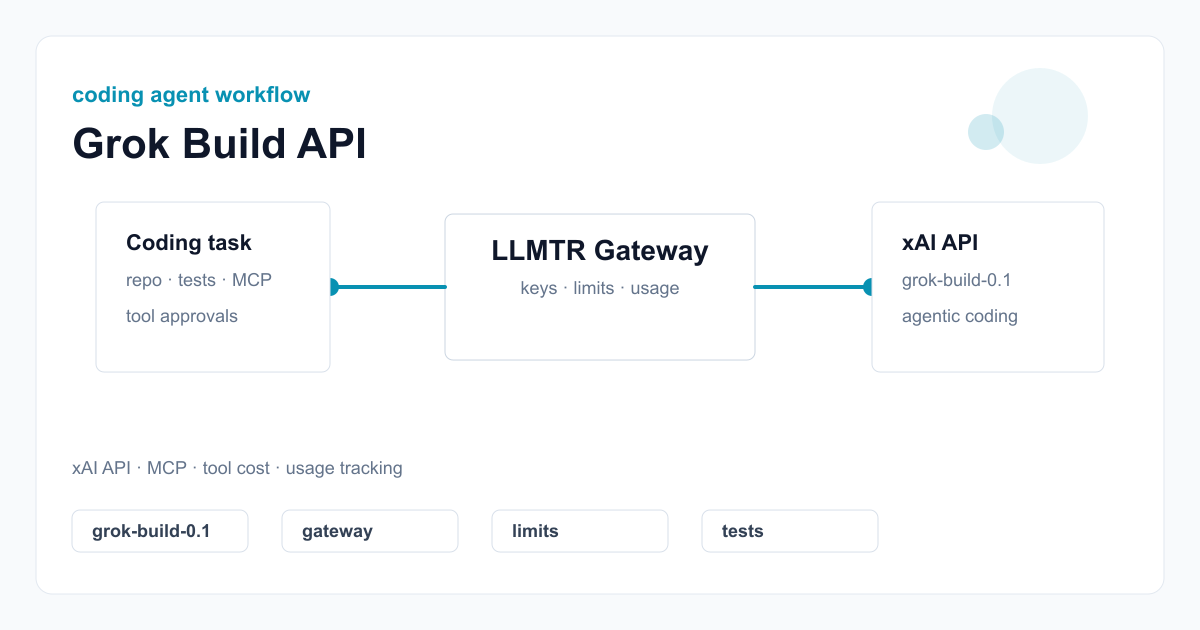
xAI positions grok-build-0.1 around agentic coding tasks. For LLMTR, the practical question is how to evaluate such a model with gateway, cost, and access controls instead of wiring it directly into clients.
- Model ID, pricing, and speed claims should be verified from provider documentation.
- Coding-agent tools should be bounded by backend authorization, rate limits, and usage records.
- MCP or terminal-tool flows need a defined blast radius before production use.
Why coding agent APIs need a gateway layer
Coding-agent flows create more side effects than a classic chat call. As a model approaches file reads, command suggestions, web search, or MCP tool calls, teams need to track tool invocation and permission behavior as well as token cost.
A gateway creates a stable contract between the application and providers. xAI API, GPT, Claude, Gemini, or LLMTR models can then be tested under the same usage tracking and account boundaries.
- Provider API keys do not move into frontend or mobile clients.
- Spend visibility remains tied to user, project, and API key.
- Model switching is not trapped in one client integration.
- Scope and approval rules for side-effecting tools stay centralized.
How to compare Grok Build, Codex, and Claude Code
When Grok Build API interest rises, the strongest comparison is not brand-first. It should be task-first. Bug fixes, small feature work, test generation, and refactoring should be measured separately on the same repository.
Low-latency work, long-context work, and tool-heavy work may not favor the same model. The LLMTR model catalog helps teams create a provider-neutral shortlist quickly.
- Freeze sample tasks and test each model with the same prompt budget.
- Track tokens, tool calls, failure rate, and correction turns separately.
- Put test and review gates in front of any automated merge path.
A safer rollout order for production trials
Do not start a Grok Build API or coding-agent trial with broad automation privileges. Begin with read-only analysis, then constrained patch suggestions, and only later controlled command execution.
That path lets teams evaluate a trending model quickly while protecting existing users and live systems. If results are strong, the gateway can expose the canonical model ID with usage limits and monitoring.
Evaluate a Grok Build API candidate through the LLMTR gateway
Test a new coding-agent model without leaking provider keys, using measurable tasks and usage limits.
- Freeze the task set. Pick three short repository tasks such as a bug fix, test generation, and a small feature change.
- Create a model shortlist. Try suitable xAI, OpenAI, Anthropic, Google, and LLMTR catalog models with the same prompt and budget.
- Add gateway limits. Keep rate limits and spend visibility active by user, API key, model, and tool invocation.
- Close with tests. Run unit tests, security checks, and human review before moving any model output toward production.
Frequently asked questions
Should Grok Build API be called directly from the frontend?
No. Provider keys, spend limits, user authorization, and tool-call controls should remain in the backend or gateway layer.
Is grok-build-0.1 the best choice for every coding-agent task?
The model name alone is not enough. Debugging, test generation, refactoring, and MCP tool calling should be measured separately against GPT, Claude, Gemini, and xAI options.
How should coding-agent cost be controlled?
Track token cost, tool invocations, task duration, and retry turns separately. The LLMTR usage surface should connect those measurements to product decisions.