Agent workflows · 2026-06-06
Grok Voice Vapi API guide for building voice AI agent flows
After the Grok Voice Vapi API announcement, use this guide for voice AI agents, STT/TTS, latency, quality, safety, and LLMTR usage tracking.
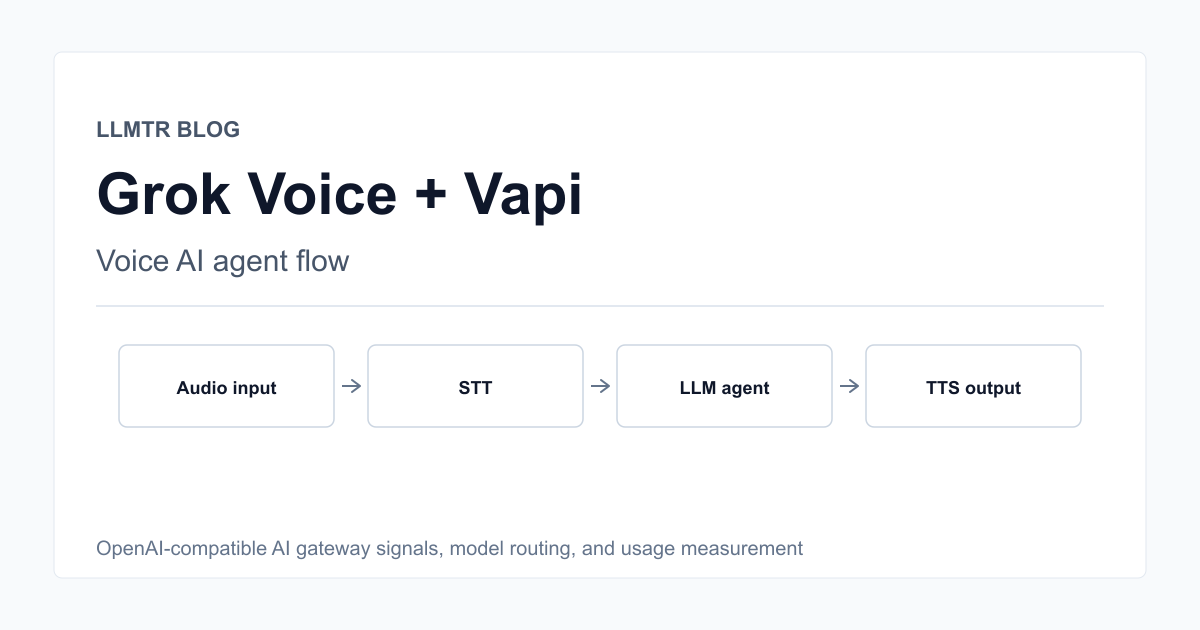
A voice agent is more complex than a chat model
In a voice AI agent flow, the user does not type text. Audio first passes through STT, the LLM makes a decision, and TTS turns the response back into speech.
Announcements such as Grok Voice Vapi API are not only model-quality signals. Production decisions should include latency, interruption handling, turn-taking, safety, and usage cost.
- STT, LLM, and TTS are separate failure surfaces.
- Latency budget directly affects user experience.
- Audio data needs storage and privacy policy.
- Live agent flows need clear fallback behavior.
Control points in a Vapi integration
Voice agent platforms such as Vapi can speed up the application layer. Model selection, transcript security, webhook validation, and cost monitoring still remain the owner's responsibility.
From an LLMTR perspective, choosing a voice provider is an end-to-end agent-flow decision, not just a dashboard setting.
- Define transcript and audio recording retention.
- Verify webhook signatures and callback URLs.
- Do not put secrets or API keys into agent prompts.
- Report call duration and token cost together.
Grok Voice API and model selection
Grok Voice API may be a separate candidate for teams that want to integrate xAI voice surfaces directly. The difference between Vapi use and direct API use should be explicit.
When choosing a model, test not only naturalness but also accuracy, accents, interruption tolerance, language support, and response time.
- Run Turkish and English test sets separately.
- STT errors can break agent decisions.
- TTS quality affects user trust.
- Compare direct API and platform integration cost.
Usage and security measurement with LLMTR
Usage reporting for voice agents should not be only a token table. Track call duration, request count, retries, provider errors, and completed user tasks together.
Security still depends on auth, rate limits, transcript sanitization, and sensitive-data masking.
- Voice-agent requests should carry separate metric labels.
- Mask PII in transcripts.
- Rate limits should apply by user and project.
- Prompt and response bodies should not be persisted.
Evaluate voice agents with Grok Voice Vapi API
Evaluate Vapi, Grok Voice API, or similar voice AI surfaces against LLMTR usage and security requirements.
- Draw the flow layers. Show STT, LLM, TTS, webhook, usage tracking, and fallback components separately.
- Prepare test conversations. Include Turkish, English, interruption, noise, and sensitive-data scenarios.
- Measure metrics. Record latency, accuracy, error rate, call duration, tokens, and task completion.
- Write the security decision. Define transcript retention, PII masking, webhook validation, and rate-limit policy.
Frequently asked questions
Does Grok Voice Vapi API replace a chat API directly?
No. A voice agent flow includes STT, LLM, and TTS layers. A chat API can be one part of the decision layer.
What is the most important metric for a voice AI agent?
No single metric is enough. Track latency, STT accuracy, TTS quality, task completion, error rate, and cost together.
How should audio data be handled in LLMTR?
Audio and transcript data should be protected with privacy, masking, rate-limit, and retention policies. Public content should not include real user audio or secrets.