Pricing and budget · 2026-10-10
TensorX Pricing per Million Tokens on LLMTR
Compare TensorX input, cache-read and output prices per million tokens on LLMTR, with a model table, worked cost examples and billing rules.
Short answer: TensorX pricing differs per row
LLMTR (llmtr.com) is a gateway that gives access to language models hosted in Türkiye and at global providers through one OpenAI-compatible API. TensorX models are called through https://llmtr.com/v1 with ids such as tensorx/kimi-k3-tensorx or tensorx/glm-5.3-flash-tensorx. Prices are TensorX's USD list prices per 1M tokens: tensorx/kimi-k3-tensorx costs $3.00 for input and $15.00 for output, while tensorx/glm-5.3-flash-tensorx costs $0.20 for input and $0.50 for output.
LLMTR adds no margin to the token price. The 8% platform margin applies once, when you top up credit: a $100.00 credit is charged $108.00. For the models in this category, processing inside the European Union is what the provider states; LLMTR has not independently verified it.
TensorX pricing: how much does each model cost per million tokens?
LLMTR lists 13 TensorX rows: 12 chat rows and 1 embedding row. The table below shows 11 of the chat rows and the embedding row; the full list is on the TensorX documentation page. The lowest output price is $0.30 per 1M tokens on tensorx/deepseek-v4-flash-0731-tensorx; the highest is $15.00 on tensorx/kimi-k3-tensorx. The embedding row is priced on input only, at $0.02.
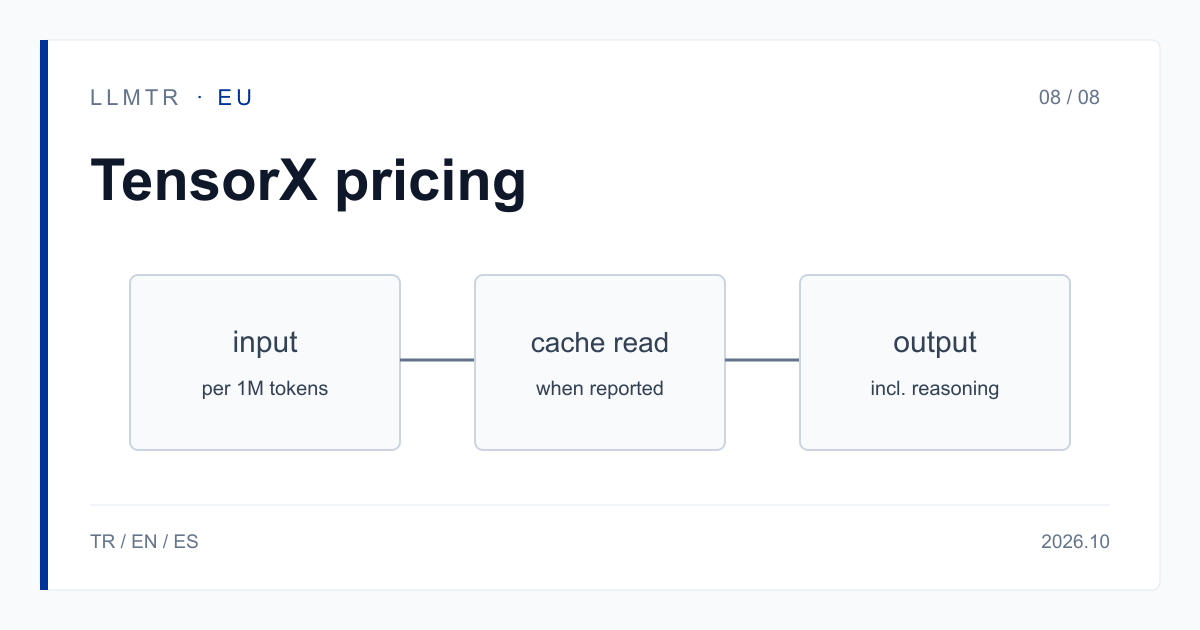
Every chat row has three prices: input, cache read and output. The cache-read price applies only when the provider reports tokens read from its cache; otherwise input is billed at the input rate. No cache hit rate is promised. All chat rows support tool calling and streaming; image input exists only on Kimi K3, Kimi K2.7 Code, GLM-5.3 Flash, MiniMax M3, DeepSeek V4.1 Flash, Qwen3.8 27B and Qwen3.8 Flash Next. When choosing by price, start from your workload's input-to-output ratio: summarizing long documents is dominated by the input price, writing long text by the output price.
Selected TensorX models
The values below are TensorX's USD list prices per 1M tokens, shown unchanged in the LLMTR catalog. The embedding row has no cache-read or output price. Check each model page for the current value.
| Model id | Input | Cache read | Output |
|---|---|---|---|
| tensorx/kimi-k3-tensorx | $3.00 | $0.75 | $15.00 |
| tensorx/kimi-k2.7-code-tensorx | $1.25 | $0.31 | $4.50 |
| tensorx/glm-5.3-tensorx | $1.75 | $0.44 | $4.50 |
| tensorx/glm-5.3-flash-tensorx | $0.20 | $0.05 | $0.50 |
| tensorx/minimax-m3-tensorx | $0.40 | $0.10 | $2.00 |
| tensorx/deepseek-v4-pro-0813-tensorx | $2.00 | $0.50 | $4.00 |
| tensorx/deepseek-v4.1-flash-tensorx | $0.50 | $0.13 | $1.50 |
| tensorx/deepseek-v4-flash-0731-tensorx | $0.25 | $0.06 | $0.30 |
| tensorx/qwen3.8-2.4t-a95b-tensorx | $2.50 | $0.63 | $6.00 |
| tensorx/qwen3.8-27b-tensorx | $0.40 | $0.10 | $2.40 |
| tensorx/qwen3.8-flash-next-tensorx | $0.20 | $0.05 | $0.50 |
| tensorx/qwen3-embedding-8b-tensorx (embedding) | $0.02 | — | — |
How the bill is calculated: examples and rules
The examples below use the table, without cache. With Kimi K3, 1M input tokens and 100K output tokens cost 3.00 + 1.50 = $4.50. The same volume costs 0.20 + 0.05 = $0.25 on GLM-5.3 Flash, 0.25 + 0.03 = $0.28 on DeepSeek V4 Flash 0731 and 2.00 + 0.40 = $2.40 on DeepSeek V4 Pro 0813. Embedding 10M tokens with Qwen3 Embedding 8B costs 10 x 0.02 = $0.20.
In a cached example, Kimi K2.7 Code receives 2M input tokens, of which 1.4M are read from cache, plus 150K output tokens. The cached part costs 1.4 x 0.31 = $0.434, the remaining 0.6M input costs 0.6 x 1.25 = $0.75 and the output costs 0.15 x 4.50 = $0.675. The total is $1.859, about $1.86.
On rows that reason by default, reasoning tokens are billed as output. If a reply returns finish_reason length, raise max_tokens and retry. Refused requests are not billed: 403 provider_consent_required when the data-transfer consent is missing, 400 unsupported_input when an image goes to a row without image input, and 400 invalid_request for an unsupported field such as reasoning_effort.
Calculating the cost in code
The example below sends a request to tensorx/glm-5.3-flash-tensorx, prints usage.prompt_tokens and usage.completion_tokens, and computes the cost from the two prices. For streamed requests, send include_usage set to true in stream_options to receive usage.
You can set a spending limit per API key, so a job stops at the limit you chose. You can also scope a key to selected models, up to 50; a call to any other model returns 403 model_not_allowed.
Python example that prints token usage for a tensorx/glm-5.3-flash-tensorx request and computes the cost from two prices.
import os
from openai import OpenAI

client = OpenAI(base_url="https://llmtr.com/v1", api_key=os.environ["LLMTR_API_KEY"])

# TensorX list prices for this row, USD per 1M tokens (see tensorx.ai/models).
INPUT_PER_M = 0.20
OUTPUT_PER_M = 0.50

reply = client.chat.completions.create(
    model="tensorx/glm-5.3-flash-tensorx",
    messages=[{"role": "user", "content": "Summarize this paragraph: ..."}],
    max_tokens=500,
)

# Reasoning tokens are billed as output, so they are already inside completion_tokens.
usage = reply.usage
cost = usage.prompt_tokens / 1_000_000 * INPUT_PER_M + usage.completion_tokens / 1_000_000 * OUTPUT_PER_M
print(usage.prompt_tokens, usage.completion_tokens, round(cost, 6))
Getting started on LLMTR: account, credit, consent, key and first request
Step 1: create an account at llmtr.com and top up credit. The 8% platform margin is added once to the top-up; a $10.00 credit is charged $10.80. Each call is then deducted at the model's catalog price.
Step 2: grant the TensorX consent under Dashboard > Settings > Data-transfer consents. Without it every request returns 403 provider_consent_required, does not reach TensorX and is not billed. The consent is account-level and covers all your API keys; a GreenPT consent does not cover TensorX. What is transferred is the request content, to produce the answer; name and e-mail are not. TensorX states that requests are processed within the European Union and that inputs are not used for model training.
Step 3: create a key under Dashboard > API Keys and store it in LLMTR_API_KEY. Step 4: set base_url to https://llmtr.com/v1 and send the first request. The same key and balance work for every model.
Call a TensorX model through LLMTR
Create an account and top up credit, grant the TensorX data-transfer consent, create an API key and send the first request to https://llmtr.com/v1.
- Account and credit. Create an account at llmtr.com and top up credit from the Dashboard. The 8% platform margin is added once; a $10.00 credit is charged $10.80.
- TensorX data-transfer consent. Grant the TensorX consent under Dashboard > Settings > Data-transfer consents. Without it requests return 403 provider_consent_required.
- API key. Create a key under Dashboard > API Keys and store it in the LLMTR_API_KEY environment variable.
- First request. With an OpenAI-compatible SDK, set base_url to https://llmtr.com/v1 and use tensorx/glm-5.3-flash-tensorx as the model.
Frequently asked questions
How much does each TensorX model cost per million tokens?
It depends on the row. Input ranges from $0.20 to $3.00 and output from $0.30 to $15.00; for example tensorx/kimi-k3-tensorx costs $3.00 input and $15.00 output, and tensorx/glm-5.3-flash-tensorx costs $0.20 input and $0.50 output. The embedding row costs $0.02 per 1M tokens.
Does LLMTR add a margin to TensorX token prices?
No. The catalog shows TensorX's USD list price. The 8% platform margin applies once when you top up credit: a $100.00 credit is charged $108.00.
Which requests are not billed?
Refused requests are not billed: 403 provider_consent_required when the data-transfer consent is missing, 400 unsupported_input for an image sent to a row without image input, and 400 invalid_request for an unsupported reasoning_effort. These requests do not reach TensorX.